


bet365

BetMGM

William Hill

Betfred

BetUK

LiveScoreBet

10Bet

Virgin Bet
Can Sunderland’s width and resilience hold off Leeds’ shot-heavy surge at the Stadium of Light?
Sunderland’s unexpected quest for European football rolls on at the Stadium of Light this Sunday, with Leeds United arriving for the hosts’ 18th Premier League game of the season. Read on for complete analysis and the best betting tips.


To use the Live Streaming service you will need to be logged in and have a funded account or to have placed a bet in the last 24 hours. Geo location and live streaming rules apply.
Global Video Listings for this match
Works worldwide • Email + on-site access • Instant unlock
▾
Sunderland sit sixth in the table and have demonstrated a consistent ability to manage tight games, bolstered by a strong home record that includes a win over Newcastle. They face a Leeds side languishing in 16th place that has conceded 31 goals this season. The tactical matchup favors Sunderland, particularly their ability to attack wide areas where Leeds are defensively vulnerable. While Leeds create chances, their defensive structure is fragile, and Sunderland’s proficiency in protecting leads suggests that if they score, they are well-equipped to see out the victory.
▾
This scoreline balances the statistical trends of both sides. Sunderland average just over a goal per game but are facing a defense conceding nearly two per game, suggesting they can exceed their usual output. Leeds, despite their struggles, score regularly (25 goals in 18 games) and have an in-form striker in Dominic Calvert-Lewin. It is difficult to see Leeds keeping a clean sheet given their record, but their attacking volume suggests they will contribute to the scoreline, making a narrow home win a likely outcome.
▾
Readers’ Tip
Vote your pick — quick & anonymous
Terms & Conditions (tap to view)
Sunderland vs Leeds Predictions and Best Bets
Sunderland vs Leeds — bet365 Market Snapshot
Swipe through key markets with illustrative probabilities and sample bet365 odds based on our match analysis.
Leeds start as marginal favourites despite their lower league position, with Sunderland’s solid home form keeping the market tight.
Wilson Isidor leads the market to break the deadlock, closely followed by Leeds duo Joel Piroe and Dominic Calvert-Lewin.
While the unders market is favored (8/13), both teams scoring remains a strong possibility given Leeds’ defensive record.
Isidor is a primary goal threat for the hosts, while Calvert-Lewin is heavily tipped to test the goalkeeper with at least one shot on target.
- Shot volume tells two stories: Leeds average 13.72 shots per match (247 in 18 games) while Sunderland average 10 (180 in 18), hinting at Leeds pressure versus Sunderland selectivity.
- Sunderland’s season has been built on control: 6 clean sheets in 18 games and only 18 conceded overall, matching a profile geared to protecting leads and surviving tight game states.
- The goals contrast is stark: Leeds have scored 25 and conceded 32 in 18 games (1.39 for, 1.78 against), while Sunderland sit at 20 scored and 18 conceded (1.11 for, 1.00 against).
Attacking Intent: Shots Per Match
Leeds are significantly more active in front of goal, taking nearly four more shots per game on average compared to Sunderland’s more controlled approach.
Leeds’ strategy relies on volume, ranking them as one of the more aggressive shooting sides despite their lower league position.
Sunderland tend to be more patient, taking fewer shots but relying on clearer cut chances in tight games.
Defensive Solidity: Goals Conceded
The gap in league position is most visible here: Sunderland have been almost twice as solid at the back as their visitors this season.
Conceding just one goal per game on average, Sunderland’s defence has been key to their push for European spots.
With nearly two goals conceded per game, Leeds’ inability to keep opponents out has been their primary weakness.
Shutting the Door: Clean Sheets
A direct measure of how often each side manages to completely nullify the opposition.
Sixth place at Christmas is already a headline in itself; staying there into the new year is the bigger, harder trick.
The table frames this one neatly. Sunderland come into the weekend sixth with 27 points, fresh from a 0-0 draw away at Brighton & Hove Albion on December 20. Leeds, meanwhile, sit 16th on 19 points, still living in that jittery band where a couple of results can make you breathe easier — or start staring at the fixtures list with a grimace.
That contrast in league position doesn’t necessarily guarantee a tidy script on the pitch, though, because both sides carry a few stylistic habits that tend to make games messy in different ways. Sunderland’s profile hints at a team comfortable playing in their own half, leaning into long balls and width, and looking to protect what they’ve got once they get their noses in front. Leeds, for their part, are described as a side that take plenty of shots, attack through the middle, and can be strong at turning games around after going behind — but also one that can struggle to keep the ball and can be exposed in certain defensive channels.
And there’s the little matter of recent mood. Sunderland’s last six league matches read like a team who rarely collapse: a win at home to Newcastle United (1-0), a 1-1 at Liverpool, a 3-2 win over Bournemouth, and that scoreless draw at Brighton, with a 3-0 defeat at Manchester City and a 1-0 loss at Fulham the obvious stings in the sequence. Leeds’ last six is similarly mixed, but louder: a 4-1 win over Crystal Palace, a 3-3 with Liverpool, a 3-1 win over Chelsea, and a 3-2 loss at Manchester City, with a 1-1 at Brentford and a 1-2 home defeat to Aston Villa in there too. Goals and drama are never far from their games; Sunderland’s have often been tighter and more controlled.
So what happens when a sixth-placed side that likes to play with width and manage game states meets a 16th-placed side that likes to shoot, can be dangerous from set plays, and has been described as switching into a back five and going direct in key moments? It might not be pretty in the classical sense. It might be gripping anyway.
Team News and Likely Set-Ups
Sunderland’s manager Régis Le Bris has said he has no new injury concerns ahead of the visit of Leeds, which suggests continuity — and continuity has been a theme for Sunderland this season, with their style notes also pointing to a consistent first eleven.
A possible Sunderland starting XI has been set out as: Roefs; Mukiele, Ballard, Alderete, Hume; Xhaka, Geertruida; Rigg, Le Fée, Adingra; Brobbey.
William Hill
Bet £10 Get £30 In Free Bets
Show Terms & Conditions
BetMGM
Bet £10 Get £40 In Free Bets
Show Terms & Conditions
bet365
Bet £10 Get £30 In Free Bets
Betfred
Bet £10 Get £30 In Free Bets
Show Terms & Conditions
10bet
100% Up To £50 On First Deposit
Show Terms & Conditions
If that’s close to the eventual shape, it reads like a side built around a stable spine and clear roles. Robin Roefs behind a back line featuring Nordi Mukiele, Dan Ballard, Omar Alderete and Trai Hume gives Sunderland physicality and aerial competence — which fits with their noted strength in aerial duels and defending set pieces. In midfield, Granit Xhaka’s inclusion immediately suggests control of tempo and decision-making, with Lutsharel Geertruida alongside him as a likely partner for balance. Further forward, Enzo Le Fée and Chris Rigg offer craft between the lines, while Simon Adingra gives a wide outlet, and Brian Brobbey provides a focal point.
There are also notes indicating Noah Sadiki, Habib Diarra and Reinildo Mandava are away on international duty until January 19, 2026, and that A. Alese has a broken leg. That matters most for depth and rotation options rather than the likely XI above, but it’s still part of the broader picture for how Sunderland manage minutes across a busy run.
Leeds’ manager Daniel Farke has been clearer on availability. He has said there is no chance for Sean Longstaff or Daniel James, and that there is a small chance Lukas Nmecha could be involved. That immediately shapes how Leeds’ midfield and attacking options might look, and it also encourages the simplest reading of Leeds’ likely approach: lean into the structure that has carried them through a “good recent run” and keep their core players central to the plan.
A possible Leeds starting XI has been listed as: Perri; Rodon, Bijol, Struijk; Bogle, Aaronson, Ampadu, Stach, Gudmundsson; Calvert-Lewin, Okafor.
That personnel grouping hints at a back three with wing-backs, a midfield that can compete physically and progress the ball, and a front pairing that mixes presence with movement. Joe Rodon, Jaka Bijol and Pascal Struijk as the three centre-backs would give Leeds height and strength in the box — and Le Bris has specifically flagged Leeds as strong from set pieces with good delivery and a “strong physical presence in the box”. Jayden Bogle and Gabriel Gudmundsson as wide outlets fits Leeds’ ability to stretch the pitch in possession even if their general tendency is to attack through the middle. In the centre, Ethan Ampadu has been described by Farke as the cornerstone and leader of the side, vital for winning duels, sensing danger, and also initiating attacks with first passes. With Brenden Aaronson and Anton Stach nearby, Leeds would have energy around second balls and the capacity to arrive late into attacking spaces.
Up front, Dominic Calvert-Lewin and Noah Okafor looks like a pairing designed to be fed quickly and often. Farke has spoken about Leeds’ ability to prepare many situations from open play for Calvert-Lewin, while also noting they were effective from set plays in the last game. If Leeds do go more direct in key moments, Calvert-Lewin becomes an obvious early target, with Okafor working off him or attacking the spaces around the knock-downs.
How the Match Could Be Played
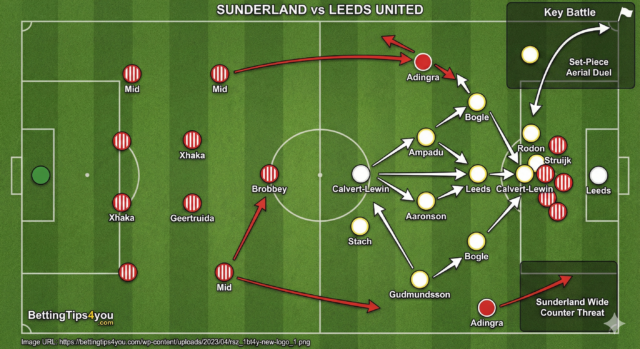
This tactical board visualizes the clash of styles: Sunderland (red) sit compact, looking to exploit wide channels through Adingra and counter-attacks. Meanwhile, Leeds (white) flood the central zones, relying on vertical passes to Calvert-Lewin and heavy set-piece dominance to break down Sunderland’s defensive block.
The most interesting tactical tension here is between Sunderland’s preference for width and Leeds’ vulnerabilities in wide defensive areas — and, at the same time, Leeds’ tendency to attack through the middle against a Sunderland side that can be comfortable without the ball.
Sunderland’s style notes paint a clear picture: long balls, width, and spells playing in their own half. That can mean a few things in practice. It can mean building patiently in a lower block and going long only when pressed. It can also mean deliberately skipping the midfield line to find the wide areas early, then playing the match in the channels, with Brobbey as the reference point to either bring runners into play or win territory and set pieces.
The likely Sunderland XI supports that. Mukiele and Hume can give width from full-back zones, and with Adingra and Le Fée in the attacking band, Sunderland have the ingredients to create overloads on either side: a wide winger holding the touchline, a full-back overlapping, and a midfielder drifting across to create triangles. If Leeds do, as Le Bris expects, switch into a back five, then Sunderland’s wide play becomes a question of timing. A back five can match you on the outside and protect the box — but it can also concede the half-spaces if the wing-backs get pinned and the outside centre-backs are dragged wider.
That’s where Le Fée and Rigg become central to the story. If Sunderland can pull Leeds’ wing-backs deep with early wide passes, there’s room for a midfielder or “10” to receive just inside, facing forward, and either slide a through ball into the channel or switch the play quickly to the far side. Leeds are described as weak at defending through ball attacks and very weak at defending against skilful players; those two notes, taken together, point to danger if Sunderland can tempt Leeds to step out and then play in behind the stepping defender.
Leeds, though, won’t travel to wear it. Their own strengths suggest a side that can steal the ball, create chances, and keep shooting until something gives. The “non-aggressive” tag is an interesting one alongside “stealing the ball from the opposition” as a strength — it implies they may not press frantically for 90 minutes, but they do have moments where they jump passing lanes and pounce, especially in central areas.
If Leeds’ central core revolves around Ampadu, as Farke describes, then their out-of-possession behaviour might be about protecting the middle first, forcing Sunderland wide, and trusting the back three’s physicality to clear the box. In possession, it’s about those first passes through the heart of the pitch and getting the ball into areas where Calvert-Lewin can attack it.
This could become a game of two very different types of directness. Sunderland’s directness can be territorial — long balls, width, and squeezing second balls in wide areas. Leeds’ directness can be vertical — quick passes through midfield and early deliveries, particularly if they feel Sunderland are set and compact.
The wing zones may decide which brand of directness wins. Sunderland are noted as weak at defending attacks down the wings. Leeds are also noted as weak at defending attacks down the wings. It’s rare to get such symmetry, and it invites a simple conclusion: both sides will look at the same map of the pitch and circle the same areas.
For Sunderland, attacking wide against a Leeds back five could mean isolations: Adingra in space against a wing-back, or quick switches to create 1v1s that force Leeds to shuffle. For Leeds, the wide threat could come from Bogle and Gudmundsson delivering early crosses, or from set-piece delivery into a box stacked with aerial targets like Rodon, Bijol, Struijk and Calvert-Lewin. Le Bris has effectively warned his own team about this: good takers, good delivery, and physical presence.
Set pieces, then, feel like a thread running through the entire tactical read. Sunderland are described as strong at defending set pieces; Leeds are described as very strong at attacking set pieces. That’s not a contradiction so much as a collision. If Leeds can win free-kicks and corners in the final third, they will believe they have a route to goal. If Sunderland can defend those moments cleanly, they remove one of Leeds’ most reliable weapons and force Leeds to beat them through open play.
Another subplot is possession — not because either side is obsessed with it, but because both are labelled as weak at keeping it. Sunderland’s ball possession is listed at 44%, Leeds at 48%. Neither side is living in the opponent’s half for long periods by default. That can lead to phases of scrappy football where second balls matter, where duels decide territory, and where transitions decide chances.
In those transition moments, Sunderland’s ability to protect a lead is noted as a strength. That suggests once Sunderland go ahead, they have the structure and mentality to shut doors. Leeds, conversely, are noted as strong at coming back from losing positions. Put those together and you have a match that could pivot sharply around the first goal: Sunderland trying to turn the game into a series of controlled defensive moments, Leeds trying to keep the game alive through volume and pressure.
The Numbers That Support the Story
Start with the most basic indicator of Sunderland’s season so far: they’ve taken 27 points from 17 games, with a record of 7 wins, 6 draws and 4 defeats, scoring 19 and conceding 17. That modest goals-for number is a clue as well as a warning: Sunderland have often been in tight games, and their own profile includes “finishing scoring chances” as a weakness. In other words, they may create enough to compete, but converting it into comfortable afternoons is not always straightforward.
Leeds’ record is 5 wins, 4 draws and 8 defeats from 17 matches, with 24 scored and 31 conceded. The concessions stand out — 31 goals against is a lot for 17 games — and it fits with the listed defensive weaknesses, particularly against through balls, skilful players and wing attacks. It also explains why Leeds matches can swing: they can create chances, but they can also give them up.
Shot volume underlines the stylistic contrast. Leeds are listed at 247 total shots across 18 played games, an average of 13.72 per match. Sunderland are at 180 total shots across 18, an average of 10 per match. That gap matters because shot volume tends to translate into pressure and territory, even when the finishing isn’t perfect. Leeds also have “take a lot of shots” explicitly as part of their style, and the numbers back it up.
Where those shots come from adds colour. Sunderland’s shot breakdown shows 73% of their shots coming from inside the box and 27% from outside; Leeds’ split is 67% inside and 33% outside. That suggests Sunderland’s attacking sequences, when they land, can end closer to goal — but Leeds are more willing to fire from range, which can be both a threat and a way of keeping opponents pinned.
The goals totals support the idea that Leeds are noisier: over 18 played games, Leeds have scored 25 (1.39 per game) and conceded 32 (1.78 per game), while Sunderland have scored 20 (1.11 per game) and conceded 18 (1.00 per game). Sunderland’s defensive number is the standout: conceding one per game across 18 matches speaks to structure, and it also tallies with their strengths in protecting the lead and defending set pieces.
Possession numbers reinforce that neither team is looking to dominate the ball for its own sake. Sunderland’s listed possession is 44%, Leeds’ is 48%, with passing totals of 6,778 for Sunderland (80% accuracy) and 7,472 for Leeds (82% accuracy). Leeds will likely have more of the ball, but not in a way that guarantees control; Sunderland will likely accept spells without it, and try to make their moments count.
The “moments” also show up in individual output. For Sunderland, Wilson Isidor leads their league goals with 4, while Dan Ballard, Enzo Le Fée, Brian Brobbey and Chemsdine Talbi each have 2. For Leeds, Dominic Calvert-Lewin has 7 league goals, with Lukas Nmecha on 4, Anton Stach on 3, and Joe Rodon and Noah Okafor on 2. That’s a major focal-point difference: Leeds have a clear top scorer, Sunderland have a spread that points to shared responsibility — and possibly why so many of their games have been tight.
Creativity is another angle: Sunderland’s assist leaders show Granit Xhaka with 4 and Enzo Le Fée with 3, while Leeds have Anton Stach, Sean Longstaff and Brenden Aaronson all on 2. The Xhaka number, in particular, matters tactically: if Sunderland want to make width and long balls work without becoming hopeful, someone has to deliver the pass that turns a wide position into a chance. Xhaka’s output suggests he’s been doing that regularly.
And finally, look at clean sheets. Sunderland have 6 across 18 games; Leeds have 2. That’s not destiny, but it is a clear signal of how often Sunderland manage to shut opponents out — and how often Leeds allow games to drift into end-to-end territory.
Key “Moments” to Watch
There’s a strong chance this game is decided not by sustained dominance, but by a handful of defining passages.
One is the first serious spell of Leeds pressure. Leeds’ profile suggests they will shoot, and shoot often. If Sunderland start with a lower block, those early shots might be from range — and the key detail will be whether Sunderland can keep Leeds to low-danger efforts outside the box, or whether the ball starts finding runners in the area. If Leeds establish a rhythm of second balls and recycled attacks, Sunderland’s wide outlets will have to double as relief valves: an out-ball into the channels, a Brobbey contest, then a chance to reset 40 yards higher.
Another moment sits on the touchlines: Sunderland’s width against Leeds’ wing defending. Leeds are described as weak down the wings and against skilful players. That sounds like a direct invitation for Adingra to get the ball early and often, to force the wing-back into decisions, and to try to create either a delivery to the far post or a cut-back into the half-space. If Sunderland can pin Leeds’ wing-backs deep, the next layer is the arrival of Le Fée or Rigg into those pockets just inside. That’s where through balls live, and Leeds are also described as weak against them.
Then there are the set-piece confrontations. Leeds are described as very strong at attacking set pieces and strong at shooting from direct free kicks. Sunderland are described as strong at defending set pieces. The key detail won’t just be who wins the first header — it will be who wins the second ball. If Sunderland clear but can’t step out, Leeds can reload and keep the pressure. If Sunderland defend and then break, Leeds’ back three can suddenly be running back towards their own goal, and that’s where mistakes and panic fouls can happen.
Calvert-Lewin’s role is another obvious swing factor. Farke has been clear that Leeds have been creating lots of situations from open play for him, and that set plays have also served him recently. If Leeds’ wide delivery is sharp, and if Calvert-Lewin is winning his aerial duels, Sunderland’s centre-backs will be in for a bruising day. If Sunderland can stop the supply, or match him physically in the box, Leeds may have to rely more heavily on volume shooting and the chaos of rebounds.
Finally, don’t ignore the psychological rhythm of the season so far. Sunderland have shown they can manage tight games — 0-0 at Brighton, 1-0 against Newcastle, 1-1 at Liverpool. Leeds have shown they can be involved in high-scoring matches — 4-1 against Crystal Palace, 3-3 with Liverpool, 3-1 against Chelsea. If Sunderland can keep this one in the “tight” lane, it suits their profile. If Leeds can drag it into the “wild” lane, it suits theirs.
What could go wrong with this read? Football loves to laugh at neat tactical predictions. A single early goal can flip everything: a team set up to counter suddenly has to chase; a team built to shoot from all angles suddenly tries to protect a lead; set pieces can turn on one poorly-timed jump. And when both sides are labelled as weak at keeping possession, the ball can spend long stretches behaving like a pinball — ricochets, second balls, and moments that don’t fit any plan at all.
Best Bet for Sunderland vs Leeds
Works worldwide • Email + on-site access • Instant unlock
Sunderland to Win
Sunderland’s rise to sixth in the table has been built on a foundation of defensive solidity and efficient game management, traits that stand in stark contrast to the chaotic nature of Leeds United’s season. While the visitors arrive with a reputation for high-scoring affairs, their defensive record is a significant liability. Leeds have conceded 31 goals in just 17 matches, averaging 1.78 goals against per game. This fragility is particularly evident in wide areas and against through balls—two specific weaknesses that align perfectly with Sunderland’s strengths. With Simon Adingra providing a threat on the flank and Enzo Le Fée operating in the pockets to deliver key passes, the hosts have the tools to unlock a Leeds backline that often struggles to cope with skilful players and movement in the channels.
Furthermore, the game state dynamics favour the home side. Sunderland are explicitly noted for their strength in protecting a lead once they get their noses in front, showing the composure to shut down matches. Leeds, conversely, tend to chase games, relying on volume shooting and comebacks. While Leeds possess firepower through Dominic Calvert-Lewin, their inability to keep clean sheets (only two all season) puts immense pressure on their attack to score multiple goals to get a result. At the Stadium of Light, Sunderland’s disciplined structure and ability to exploit defensive lapses make them the logical selection to secure three points against a relegation-threatened opponent.
What could go wrong Leeds are dangerous when backed into a corner and possess a genuine goal threat, averaging nearly 14 shots per game. If Sunderland concede first, their lower possession numbers (44%) might make it difficult to chase the game against a Leeds side that can crowd the midfield. Additionally, Dominic Calvert-Lewin’s aerial presence poses a direct challenge to Sunderland’s centre-backs.
Correct score lean
2-1 to Sunderland
While Sunderland have been defensively sound, conceding just one goal per game on average, Leeds’ high shot volume and aggressive attacking style suggest the visitors can find the net. However, Leeds’ porous defense is likely to be their undoing. A 2-1 scoreline reflects Sunderland’s ability to exploit Leeds’ defensive frailties while acknowledging the visitors’ capacity to create chaos and score from set pieces or open play scenarios involving Calvert-Lewin.
Selected Bookmakers Offers
| |
New cust. Deposit £10+ in 7 days & bet on sports. Min odds apply. Reward = 4 x £10 Free Bets (2 x £10 Bet Builders & 2 x £10 Sports bet). Valid 7 days. Free bets not valid on e-sports & non UK/IE horse racing. 18+. T&Cs apply. | |
| |
Open Account Offer - New Customers only. Bet £10 and get £30 in Free Bets when you join bet365. Sign up, deposit between £5 and £10 to your account and bet365 will give you three times that value in Free Bets when you place qualifying bets to the same value settle. Free Bets are paid as Bet Credits. Min odds/bet and payment method exclusions apply. Returns exclude Bet Credits stake. T&Cs , time limits & exclusions apply. Registration Required. #Ad. 18+ Only, gambleaware.org | |
 | |
18+. Play Safe. From 00:01 on 18.10.2022. £30 bonus. New customers only. Minimum £10 stake on odds of 1/2 (1.5) or greater on sportsbook (excluding Virtual markets). Further terms apply. #Ad. 18+Only, gambleaware.org | |
| |
New customers only. Register, deposit with Debit Card, and place first bet £10+ at Evens (2.0)+ on Sports within 7 days to get 3 x £10 in Sports Free Bets & 2 x £10 in Acca Free Bets within 10 hours of settlement. 7-day expiry. Eligibility exclusions & T&Cs Apply. | |
| |
New cust only. Opt-in required. Deposit & place a bet within 7 days and settle a £10 minimum bet at odds of 4/5 (1.8) or greater to be credited with 3 x £10 Free Bets: 1 x £10 horse racing, 1 x £10 Free Bet Builder and 1 x £10 football. Free Bets cannot be used on e-sports and non-UK/IE horse racing. 7 day expiry. Stake not returned. 18+. T&Cs apply. Acca Club: Available to new & existing customers. 3 or more selections. Min Odds: 3/10 (1.3) per leg. Max stake: £500. Max Winnings: £200,000 per boost. Profit Boost amounts vary. Horse Racing, Greyhounds & Trotting excluded. Exclusions apply. Full T&C’s apply. 18+ GambleAware.org. | |
 | |
New members only. £10+ bet on sports (ex. Virtuals) 1.5 min odds, settled within 14 days. Free Bets: accept in 7 days, valid 7 days; £20 use on sportsbook, £10 on Bet Builder. Stake not returned. T&Cs.+ deposit exclusions apply #Ad. 18+Only, gambleaware.org | |
| |
New bettors. Select bonus at signup or use code SPORT. Wager deposit & bonus 8x. Max qualifying bet = bonus. Valid 60 days. Odds, bet & payment limits apply. T&Cs Apply; 18+ | Please gamble responsibly #Ad. 18+Only, gambleaware.org | |
 | |
New customers only, 18+. Min deposit £10. Place a £50 bet on any sport at 2.0+ to qualify for £25 in free bets and 10 Free Spins. Free Bets and Spins valid 7 days. £0.10 Free Spins. T&Cs apply. Please bet responsibly. #Ad. 18+Only, gambleaware.org | |
| |
New members only. £10 min deposit & bet on sportsbook (ex. virtuals), placed & settled at 1.5 min odds in 14 days of sign-up. Win part of E/W bets. Free Bets: accept in 7 days, valid 7 days, use on sportsbook only (ex. virtuals), stakes not returned. T&Cs Apply and deposit exclusions apply. Please gamble responsibly #Ad. 18+Only, gambleaware.org | |
 | |
18+ New customers only. Opt in, and bet £10 on football markets (odds 2.00+). No cash out. Get 6x£5 football free bets at specified odds for set markets, which expire after 7 days. Offer valid from 12:00 UK Time on 25/08/2023. Card payments only. T&Cs Apply | gambleaware.org | Please gamble responsibly #Ad. 18+Only, gambleaware.org | |