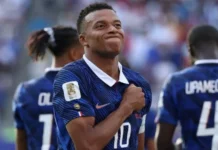

France vs England: Tactical Pride, Tired Legs and One Last World Cup Statement. Read on for all our free predictions and betting tips.


Both sides enter this match after semi-final defeats that exposed defensive vulnerabilities. England’s forced defensive reshuffle due to injury and France’s unsettled backline create an environment ripe for goals at both ends. The attacking talent on both teams and Miami’s taxing conditions further support the likelihood of both teams scoring.
A 2-1 win for France fits the physical and tactical context, with France benefiting from extra recovery and England’s defensive disruptions likely causing communication errors. England’s attacking threat ensures they score, but France’s freshness and quality should secure a narrow victory in a high-tempo contest.
Compare form, H2H, goals trends and key data for France v England.
France and England meet at Miami Stadium on Saturday night in a World Cup third-place play-off carrying far more emotional weight than the bronze medal suggests.
France vs England — bet365 Market Snapshot
Swipe through key markets with illustrative probabilities and sample bet365 odds based on our match analysis.
France scored in 4 of their last 5 matches, while England scored in 5 of their last 5 matches, giving this market a clear recent-data foundation.

England have scored in all of their last 5 matches, while France have scored in 4 of their last 5, indicating a strong likelihood of goals.
A narrow 2-1 victory for France aligns with the tactical and physical factors influencing this match.
France have kept 3 clean sheets in their last 5 matches, showing relative defensive strength despite recent injury concerns.
Three Punchy Stats
- France created only 0.31 expected goals against Spain, underlining how completely their attack was restricted in the semi-final.
- England have now lost all seven of their World Cup knockout matches against teams ranked inside the world’s top 10, a record that continues to frame the debate around their performances against elite opposition.
- Kane and Bellingham have scored 12 of England’s 14 goals at this World Cup, making their availability and attacking influence central to England’s prospects in Miami.
Attacking Form Comparison
Recent scoring records for France and England show which side carries the more dependable attacking rhythm into this fixture.
France have scored in 4 of their last 5 matches, demonstrating reliable offensive performance.
England have scored in all of their last 5 matches, showing strong attacking form.
Defensive Record Comparison
Clean-sheet and concession data for France and England highlight where defensive control may shape the balance of this matchup.
France kept 3 clean sheets in their last 5 matches, providing the defensive context for how England may approach the final third.
England kept 1 clean sheets in their last 5 matches, providing the defensive context for how France may approach the final third.
Neither side wanted this fixture. France arrived at the semi-final believing another final was within reach, only to be shut down by Spain in a controlled 2-0 defeat. England’s pain was different but just as sharp: Anthony Gordon gave them the lead against Argentina before Thomas Tuchel’s increasingly defensive approach invited pressure and ended in a 2-1 loss.
Now two bruised squads must recover physically, reset mentally and produce one final performance in the heat and humidity of Miami. That is easier said than done. Third-place matches are often treated as awkward obligations, yet this one carries serious consequences for both managers, several players and the wider mood surrounding each national team.
For Didier Deschamps, it is a final farewell after an extraordinary spell in charge of France. For Tuchel, it is an immediate test of whether England can respond to another painful collapse rather than disappear beneath the weight of criticism.
A match shaped by disappointment
The central tactical question is not simply which team has more quality. It is which team can rediscover its competitive edge quickly enough.
France’s semi-final defeat was comprehensive. Spain restricted them to just 0.31 expected goals, a figure that measures the quality of scoring opportunities created. In practical terms, France barely constructed enough danger to expect even one goal.
That failure was especially striking because the French attacking unit included Kylian Mbappe, Michael Olise, Desire Doue and Rayan Cherki. There was pace, invention and individual skill, but very little collective momentum.
Mbappe’s public criticism of France’s tactical approach added another layer to the occasion. Deschamps now faces a delicate final selection. He must decide whether to remain loyal to the structure that brought France deep into the tournament or release his attackers with greater freedom in a match carrying less strategic risk.
England’s semi-final exposed a different problem. Their initial plan worked. Gordon’s goal demonstrated how Argentina could be attacked in wide areas, and England looked capable of creating more when they played positively.
Then came the retreat.
By attempting to protect their advantage, England surrendered initiative to Lionel Messi and an Argentina side that did not need a second invitation. Messi created both goals, with Enzo Fernandez and Lautaro Martinez completing the comeback.
The controversial point is unavoidable: England did not lose because they were too adventurous. They lost because they stopped being adventurous enough.
Tuchel’s decision to reinforce the defence may have looked pragmatic, but pragmatism without an outlet can become passivity. Against elite opponents, simply adding defenders does not guarantee greater control. Sometimes it merely gives the opposition more targets to pin back.
France must reconnect midfield and attack
France’s likely structure places Manu Kone and Warren Zaire-Emery behind an attacking line of Cherki, Olise and Doue, with Mbappe operating at the top.
That selection would offer enormous technical variety. Cherki can manipulate tight spaces, Olise can create from central or wide positions, and Doue can carry the ball directly at a defensive line. Mbappe provides the threat behind, particularly when opponents push their full-backs forward.
The challenge is connection.
Against Spain, France’s attacking players became isolated. Their possession did not consistently move through midfield into dangerous central areas, leaving the forwards receiving the ball too far from goal or with too many defenders already organised around them.
England’s midfield pairing of Declan Rice and Elliot Anderson could make that problem worse if they remain compact. Rice offers defensive security, while Anderson can help contest second balls and prevent France from establishing an easy rhythm.
France therefore need sharper movement between the lines. Olise and Cherki cannot simply wait for passes into feet. They must rotate, drag England’s midfielders out of position and create lanes for Zaire-Emery or Kone to advance.
Mbappe’s positioning will also be crucial. If he remains fixed between the centre-backs, England can narrow the pitch and surround him. If he drifts towards the left, he could force Djed Spence and Ezri Konsa into uncomfortable decisions over who follows him.
That could open central space for Doue or a late-arriving midfielder. France’s attack is at its most dangerous when the opposition cannot identify a single reference point. It becomes far easier to defend when every player occupies a predictable zone.
England cannot repeat the Argentina retreat
England’s probable attacking shape looks balanced on paper. Morgan Rogers, Jude Bellingham and Gordon can operate behind Harry Kane, offering physical strength, ball-carrying and direct running.
The temptation for Tuchel may be to manage the match cautiously, particularly with England’s defence potentially reshuffled. That would be understandable, but it would also risk repeating the error that ended their semi-final.
France are less comfortable when opponents force them to defend transitions. Theo Hernandez is naturally aggressive from left-back, while Jules Kounde can also advance on the opposite side. Those movements create attacking width, but they may also leave areas behind them.
Gordon’s pace could be England’s most effective weapon. His goal against Argentina showed the value of attacking space before the opposition defence becomes settled. If England move the ball slowly, France can protect the central zones and keep Mbappe high for counter-attacks. If England play forward quickly, Gordon and Rogers can turn French full-backs towards their own goal.
Kane’s role should extend beyond finishing. His ability to drop away from the defensive line could pull a centre-back forward, creating channels for Bellingham or Gordon to attack.
However, England must avoid crowding the same central areas. Rogers and Bellingham both like to influence play between midfield and defence. Their movement has to be coordinated rather than competitive.
The simplest version is often the best: Kane drops, one attacking midfielder runs beyond him, and the opposite winger holds the width. Football can become terribly complicated when managers are under pressure. Occasionally, the cleverest tactical idea is remembering where the space actually is.
Defensive changes could define the contest
Both teams enter the match with concerns in defence.
William Saliba was forced off against Spain after suffering further back trouble, making his involvement highly unlikely. Maxence Lacroix replaced him and is in contention to start, while Ibrahima Konate could also come into the side.
Deschamps explained that Konate had not been at his best and was less familiar with the left-sided centre-back role. That creates an important decision. France can select the defender with greater positional familiarity or the one with the stronger reputation. In a match likely to feature rotations and fatigue, clarity may be more valuable than status.
England have a similar issue after Reece James suffered an apparent muscular problem against Argentina. Jarell Quansah is available again following suspension, but Spence may move to the right, allowing Nico O’Reilly to return on the left.
That reshuffle could affect England’s build-up. Spence offers energy and forward running, while O’Reilly gives the left side a different profile. If both advance simultaneously, Rice may be asked to protect a large amount of space.
France will look to exploit any lack of familiarity in England’s defensive line. Mbappe, Doue and Olise are all capable of changing positions quickly, and even a brief hesitation between full-back and centre-back could create a shooting opportunity.
England must therefore defend as a connected unit rather than as four individuals. Communication will matter as much as pace.
Heat, fatigue and motivation
The conditions may influence the tempo as much as either manager’s tactics. Miami’s heat and humidity are likely to make sustained pressing difficult, particularly for players recovering from emotionally and physically exhausting semi-finals.
France have had an extra day to recover, which could become increasingly significant after the interval. England looked exhausted during the closing stages against Argentina, and another intense contest shortly afterwards may test their concentration.
That does not automatically mean the match will be slow. Rotated line-ups can produce unpredictability because defensive relationships are less established. Fresh attackers may play with freedom, while tired defenders can struggle with repeated changes of direction.
The emotional atmosphere is equally complicated. Some players will see this as a consolation match. Others will view it as a final opportunity to influence how their tournament is remembered.
Deschamps has an obvious motivational theme. France can send their departing manager out with a victory and earn a third bronze medal from four appearances in the third-place play-off.
England’s motivation is more internal. They have lost their two previous third-place matches, against Italy in 1990 and Belgium in 2018. A win would secure their second-best finish at a men’s World Cup, but the larger objective is restoring credibility after the tactical collapse against Argentina.
A final test of courage
This match should not be reduced to a battle between two disappointed teams. It is a study in response.
France must prove they can play with more imagination than they showed against Spain. England must demonstrate that they can continue attacking after taking control, rather than treating every lead against elite opposition as something fragile and precious.
The individual duel between Mbappe and England’s reshaped defence will draw attention, but the decisive battle may occur in midfield. Whichever side can connect possession to attack without leaving itself exposed will have the clearest route to control.
For Deschamps, victory would provide a dignified final chapter. For Tuchel, a strong performance would not erase the Argentina defeat, but it could ease the anger surrounding his decisions.
No child dreams of lifting the third-place medal. No supporter spends years imagining the bronze play-off. Yet once the whistle blows, national pride tends to make a mockery of indifference.
France and England may arrive in Miami carrying disappointment, criticism and tired legs, but neither will want to leave the World Cup with another defeat.
Both Teams To Score (BTTS)
This market requires both competing teams to score at least one goal during the 90 minutes of standard play. It operates entirely independently of the final match winner, focusing purely on offensive efficiency and defensive vulnerability at both ends of the pitch.
Correct Score
This market requires predicting the exact final scoreline at the conclusion of standard regular time. Because there is zero margin for error, it represents a high-volatility selection with elevated price rewards compared to standard match outcomes.
Other Opportunities in these Markets: Choosing between these options involves clear tactical trade-offs. Cautious approaches favour markets like Both Teams to Score, which offer higher probability but lower prices, keeping the selection active as long as both attacks look dangerous. Higher-risk strategies look toward Correct Score options, where early game-state changes or late goals can completely destroy a selection despite accurate tactical profiling. Volatility, narrow margins, and shifting game states heavily dictate returns, especially in third-place fixtures where motivations fluctuate.
⚔️ Pick 1: Both Teams to Score (Yes) – Odds: 4/9
Both national teams enter this fixture following painful semi-final defeats where defensive structures eventually cracked under pressure. England opened the scoring through Anthony Gordon against Argentina but ultimately suffered a 2-1 defeat after a deep defensive retreat invited relentless pressure. This pattern demonstrates England’s ability to unlock elite opponents early on, while also exposing their vulnerability when attempting to protect a lead. With Reece James suffering a muscular injury, England face a forced defensive reshuffle. Djed Spence may move to the right side, while Nico O’Reilly enters on the left, creating an unverified backline combination that lacks competitive familiarity.
France possess an extraordinary attacking assembly including Kylian Mbappe, Michael Olise, Desire Doue, and Rayan Cherki. Although Spain restricted them heavily, the individual brilliance within the French frontline remains a constant threat against a disrupted English defence. Concurrently, France face severe defensive adjustments of their own. William Saliba is highly unlikely to participate due to ongoing back trouble. His projected replacement, Maxence Lacroix, or the alternative option Ibrahima Konate, introduces uncertainty, particularly given Konate’s unfamiliarity with the left-sided centre-back role. The combination of elite, motivated forwards and unsettled defensive line-ups on both sides creates a clear environment for goals at both ends of the pitch. Miami’s intense heat and humidity will additionally sap defensive energy, making sustained tracking difficult as players tire during the second half.
Key Tactical Mismatch
Anthony Gordon attacks wide areas rapidly, utilising direct pace to catch opponents before their defensive shape can settle.
Theo Hernandez and Jules Kounde advance aggressively to create width, leaving vacant space behind them for quick opposition counters.
🎯 Pick 2: Correct Score (France 2-1) – Odds: 15/2
A precise 2-1 victory for France aligns with the physical and situational elements surrounding both teams in Miami. France benefit from an extra day of recovery following their semi-final exit, a crucial factor given the draining heat and humidity. England displayed severe exhaustion during the closing stages of their defeat against Argentina, and asking a physically depleted squad to replicate intense physical outputs so quickly presents a major obstacle. With England’s defensive line facing multiple forced alterations due to Reece James’ injury, communication errors are highly probable. France possess the individual quality in Kylian Mbappe and Michael Olise to punish these minor positional hesitations.
However, England maintain a potent attacking threat that prevents a clean sheet. Harry Kane and Jude Bellingham remain central to England’s offensive output, having combined for 12 of the team’s 14 tournament goals. They have the physical profile and technical capacity to breach a French defence missing William Saliba. Maxence Lacroix or a misplaced Ibrahima Konate will struggle to contain Kane’s movement when he drops deep to link with runners. This dynamic guarantees England opportunities, but France’s superior freshness and deeper rotational clarity should carry them through. Historically, France respond effectively to these scenarios, securing three bronze medals from four previous play-off appearances, whereas England have lost both of their historical third-place encounters. A tightly contested, high-tempo affair finishing 2-1 to France satisfies all tactical and physical conditions.
Frequently Asked Questions
What does the Both Teams to Score market require to win?
The Both Teams to Score market requires both competing teams to score at least one goal during the 90 minutes of standard time. If the final scoreline finishes as 2-1 or 1-1, the selection wins, whereas a 2-0 or 0-0 scoreline results in a lost bet. This market focuses purely on offensive execution and defensive flaws rather than the final match winner, keeping bets active regardless of which team dominates the scoreline.
How does the Correct Score market operate in football betting?
The Correct Score market operates by requiring the bettor to predict the exact final scoreline at the end of regular time. If you back a 2-1 victory, that exact sequence must manifest; any variation like 3-1 or 1-2 means the selection fails. Because there is zero room for error, this market offers high odds to compensate for the significant difficulty of forecasting exact margins.
Why are third-place play-off matches frequently high-scoring?
Third-place play-offs are frequently high-scoring due to reduced tactical pressure and extensive defensive rotations. Since the ultimate goal of reaching the final is gone, teams play with greater attacking freedom while physical fatigue compromises defensive discipline. This context often generates highly unpredictable matches with more open-play chances than standard knockout rounds.
Do extra-time goals count towards Correct Score or BTTS bets?
Extra-time goals do not count towards standard Correct Score or Both Teams to Score bets. All standard football match markets are settled based exclusively on the scoreline at the completion of 90 minutes plus injury time. Any goals scored during the subsequent 30 minutes of extra time or penalty shootouts are completely excluded from these selections.
What is the main trade-off when choosing Correct Score over Match Result?
The main trade-off is sacrificing a high probability of winning in exchange for a larger potential price payoff. A Match Result bet covers any winning scoreline for that team, whereas Correct Score leaves zero margin for error. This makes Correct Score highly volatile and vulnerable to late game-state changes, such as a consolation goal in final injury time.
How do defensive injuries impact the over/under goals markets?
Defensive injuries generally lower collective cohesion and increase the likelihood of goals, shifting interest toward over selections. When regular central defenders are missing, backlines struggle with positioning and communication errors. This structural weakness allows elite attackers to exploit sudden space, raising the probability of a higher overall match scoreline.
What does the Draw No Bet market offer for cautious approaches?
The Draw No Bet market eliminates the risk of a tied match by returning your full stake if the game ends level after 90 minutes. You select either team to win, and if they succeed, you receive your payout at lower odds. If the scoreline remains level at full-time, the selection acts as a complete refund rather than a loss, providing a safety net against late stalemates.
How does stadium climate affect live betting markets?
High heat and humidity cause rapid physical exhaustion, which frequently leads to slower passing tempos but more severe defensive errors. As tracking runs becomes difficult, the final half-hour can open up dramatically. Live bettors monitor these shifts to exploit growing spaces, which often result in late goals as defensive lines lose structural integrity.