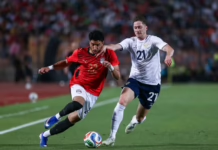

The last rehearsal before the real noise starts. Read on for all our free predictions and betting tips.



Read Rationale ▾
The Netherlands possess superior technical qualities and home advantage to dominate play at the Johan Cruijff Arena. Uzbekistan deploy a defensive back five under Cannavaro to restrict space effectively, keeping scorelines tight and minimizing high-volume outcomes in international friendly fixtures.
Read Rationale ▾
Koeman’s side holds significant attacking presence through Malen and Gakpo to penetrate defensive lines twice. Uzbekistan struggled for forward momentum against elite entities recently, matching the 2-0 scoreline seen in their previous international encounter against Canada.
Compare form, H2H, goals trends and key data for Netherlands v Uzbekistan.
Netherlands face Uzbekistan in their final friendly before the World Cup, with Ronald Koeman and Fabio Cannavaro seeking answers after recent defeats.
Netherlands vs Uzbekistan — BetMGM Market Snapshot
Market snapshot showing illustrative details and pricing based on official squad listings.
The Netherlands carry strong historical depth from Euro 2024 semi-finals, establishing prominent control markers over Uzbekistan’s structural outline.

Uzbekistan have lost only two of their last 14 international matches, showing compact defensive patterns under pressure.
Uzbekistan’s previous match concluded in a 2-0 scoreline against Canada, mirroring common outcomes against higher-ranked international sides.
Donyell Malen has scored seven goals in his last seven appearances for Roma, showing strong individual clinical touch.
Three Punchy Stats
- The Netherlands had gone 10 matches unbeaten. before Algeria ended that run with a 1-0 win, making this response test feel more meaningful than a routine warm-up.
- Uzbekistan have lost only two of their last 14 internationals, a reminder that Cannavaro’s side are not simply turning up to admire the Dutch passing patterns.
- Eldor Shomurodov has scored 44 goals. for Uzbekistan, while Donyell Malen has hit seven in his last seven games for Roma, giving both teams a forward with a clear scoring reference point.
Defensive Performance: Resiliency Profiles
A comparative overview of general structural stability based on recent international outings.
Koeman’s unit sustained significant consistency prior to the narrow defensive breach against Algeria.
Cannavaro’s tactical configuration prioritises narrow lines, conceding infrequently over an extended match sample.
Attacking Spark: Prolific Finishers
Individual metrics highlighting high-volume outputs for key attacking assets.
The Dutch forward provides a highly effective alternative to disrupt deep defensive low blocks.
The focal point of Uzbekistan’s transitional attack, carrying paramount responsibility upfront.
The Netherlands and Uzbekistan meet on Monday, 8 June 2026, in an international friendly that looks modest on paper but carries real weight for both camps. This is the final outing before the World Cup begins for each nation, which means the result matters less than the evidence: rhythm, sharpness, fitness, defensive balance and whether the attacking patterns look ready for tournament pressure.
For the Netherlands, this is a chance to remove the sour taste of a 1-0 defeat to Algeria, a match they dominated but still lost. Football can be cruel like that. You can have the ball, control the tempo, look the more polished side and still end the night wondering whether the sport was invented purely to annoy managers. Ronald Koeman will want a response, but he will also know this is no time for reckless intensity with Japan waiting six days later.
For Uzbekistan, this is another major test before their long-awaited World Cup debut. The White Wolves have finally reached the global stage after years of near misses, and now face the kind of opposition that will expose hesitation, loose touches and poor spacing. Fabio Cannavaro’s side lost 2-0 to Canada last time out, but they have also shown resilience over a longer run, with only two defeats in their last 14 internationals.
A Dutch side looking for control, not chaos
The Netherlands arrive with strong tournament credentials. They reached the semi-finals of Euro 2024, the quarter-finals of the 2022 World Cup, and the quarter-finals of the most recent UEFA Nations League. That tells us two things. First, this is a side used to going deep. Second, going deep is no longer enough. The Dutch expectation is not just to look stylish in orange and exit gallantly with everyone saying, “Ah, what a lovely team.” That act is getting old.
Koeman’s team had been on a 10-match unbeaten run before Algeria ended it, and the timing of that defeat is awkward rather than disastrous. In warm-up matches, the performance often matters more than the scoreline, but losing 1-0 in a game of Dutch dominance will still irritate. It raises familiar tournament questions: can they convert territorial control into clean chances, and can they avoid being punished by opponents willing to sit, wait and strike late?
The possible Netherlands line-up gives Koeman plenty of technical quality and structure. Bart Verbruggen is listed in goal, with Denzel Dumfries, Jan Paul van Hecke, Virgil van Dijk and Nathan Ake forming the back line. Frenkie de Jong, Ryan Gravenberch and Tijjani Reijnders offer the midfield blend of control, carriage and forward movement, while Crysencio Summerville, Memphis Depay and Cody Gakpo provide the attacking line.
That is a side built to dominate possession and territory. The key will be tempo. Slow Dutch possession can become decorative rather than dangerous. Quick Dutch possession, with De Jong receiving between pressure lines and the wide forwards attacking the box, is a very different beast. Uzbekistan will almost certainly try to keep the game compact, so the Netherlands must move the ball with purpose rather than simply enjoying the luxury of it.
Injuries and selection calls add tension for Koeman
This is not a perfectly clean Dutch build-up. Memphis Depay and Jurrien Timber both overcame fitness concerns to make the squad, but the injury picture still matters. Jerdy Schouten is sidelined with an ACL injury, while Matthijs de Ligt and Xavi Simons are also absent. Stefan de Vrij was left out, and Jeremie Frimpong did not make the cut.
Against Algeria, Koeman was without his preferred right-back options, with Denzel Dumfries suspended and Timber joining up late after Arsenal’s run to the Champions League final. Mats Wieffer filled in, but Dumfries may return here, giving the Netherlands a more natural presence on that flank.
That right side could be one of the most interesting areas of the game. If Dumfries starts, the Dutch can stretch Uzbekistan’s back five and force their wide defender to make uncomfortable decisions: follow the runner and leave space inside, or hold the line and allow crosses to come in. It is not glamorous tactical chat, admittedly, but full-back positioning is where plenty of international matches quietly get decided.
Donyell Malen is another intriguing attacking option after scoring seven goals in his last seven games for Roma. Even if he does not start, that scoring rhythm is difficult to ignore. Tournament squads need players who feel hot, not just players who look neat on a team sheet.
Uzbekistan’s back five has to be more than a survival plan
Uzbekistan are ranked 50th by FIFA, which places them 43 spots below the Netherlands. That gap matters, but it should not be treated as a punchline. Their qualification for the World Cup is a major achievement, and their recent results show a side that is difficult to beat. Since losing to Qatar in an AFC qualifier at the end of 2024, they have suffered only two defeats.
Cannavaro is likely to use a back five, with Abdukodir Khusanov central to that defensive structure. The idea is clear: protect the middle, limit spaces between centre-backs, and make the Netherlands play around the block rather than through it. Against a Dutch side that can become frustrated when dominance is not rewarded, that approach has logic.
The issue is what happens after the first pass out. Against Canada, Uzbekistan competed well but lacked cutting edge, with Eldor Shomurodov missing two major chances before the game finished 2-0. Shomurodov remains hugely important as Uzbekistan’s all-time top scorer with 44 goals, but he cannot carry the attacking burden alone. Abbosbek Fayzullaev and the midfield line must offer enough support to stop the match becoming one long defensive shift.
Uzbekistan’s possible line-up has Yusupov in goal, with Sayfiev, Abdullaev, Khusanov, Ashurmatov and Nasrullaev forming the defensive unit. Fayzullaev, Hamrobekov, Shukurov and Uronov are listed behind Shomurodov. It suggests a compact shape, with the priority being survival in central areas before looking for moments in transition.
The emotional edge: friendly by name, audition by nature
The word “friendly” can be misleading. Nobody wants to get injured, nobody wants a wild tackle, and no manager wants chaos this close to a World Cup. But every player also knows these minutes count. A poor touch, a sleepy defensive moment or a flat attacking display can alter selection debates. A sharp cameo can do the opposite.
The Netherlands need confidence without carelessness. Uzbekistan need proof that they can withstand elite pressure without losing their attacking nerve. Both sides are coming off defeats, which adds a little sting. Not full derby-level chaos, of course — nobody is throwing tea across the changing room just yet — but enough tension to make this more than a gentle jog in fancy shirts.
Tactical verdict: Dutch precision against Uzbek resistance
This match should be shaped by Dutch possession and Uzbek defensive discipline. The Netherlands will want to use their midfield to control the ball, then create overloads through wide movement and advanced runners. Uzbekistan’s job is to keep the game narrow, protect Khusanov’s defensive zone and ensure Shomurodov is not isolated every time they win the ball back.
The danger for the Netherlands is impatience. If the first goal does not come early, the temptation may be to force passes into crowded areas. That is exactly the kind of match state Uzbekistan will want. The danger for Uzbekistan is passivity. Sitting deep is one thing; becoming trapped is another. If they cannot carry a threat on the counter, the pressure may eventually become too much.
In the bigger picture, this is a final rehearsal for two very different World Cup stories. The Netherlands are chasing the kind of global prize that has remained painfully out of reach. Uzbekistan are stepping into their first World Cup with pride, curiosity and a fair bit of pressure of their own. One side is trying to sharpen a familiar weapon. The other is trying to prove it belongs in the room.
That is why this friendly matters. Not because the scoreline will define either team’s summer, but because the performance may reveal whether the Netherlands are ready to be ruthless — and whether Uzbekistan are ready to be more than just stubborn.
📊 Structural Market Analysis & Options
Match Result & Total Goals Market
This selection combines a straight team victory with a cap on the combined goals scored. It functions as an integrated single bet where both elements must hit. This profile serves standard approaches by lowering the requirements of a high-scoring blowout, though a sudden tactical shift can quickly disrupt the setup.
Correct Score Market
This represents a precise selection targeting the exact final scoreline. It offers higher returns but faces substantial volatility. A solitary defensive error or late consolation goal in dead time will invalidate the position, making it a high-variance track.
🎯 Rationale: Netherlands to Win & Under 2.5 Goals
The Netherlands establish clear technical control lines through a midfield base containing Frenkie de Jong, Ryan Gravenberch and Tijjani Reijnders. Ronald Koeman’s configuration focuses heavily on maintaining territorial dominance at the Johan Cruijff Arena. This focus is magnified following their recent inability to translate possession into scoring returns during the 1-0 defeat against Algeria. Rather than pursuing a chaotic attacking approach, the Dutch hierarchy will likely place emphasis on structural stability and controlled pacing to deny transition tracks to their opponents.
Uzbekistan enter this setup under Fabio Cannavaro with a well-tested defensive blueprint centered around Abdukodir Khusanov. Deploying a low back five, the visitors focus completely on narrow spacing, denying interior passing windows and forcing elite teams into wide, less dangerous distributions. Having suffered only two defeats in their last 14 international matches, they have proven highly adept at avoiding substantial scoring margins. This structural resistance ensures that while the Dutch control the outcome, the absolute volume of clear chances remains limited throughout the ninety minutes.
⚔️ Tactical Indicators:
- The Netherlands prioritize tactical control and defensive recovery following their recent blank against Algeria.
- Uzbekistan use a rigid back five that has limited opponents to small margins in 12 of their last 14 outings.
- The upcoming World Cup tournament schedule creates a scenario where conserving energy overrides high-tempo attacking risks.
Risk Factor: An early defensive lapse from the visitors could force their block to open up, increasing the overall transitional space for Dutch forwards.
🎯 Rationale: Correct Score 2-0
A 2-0 scoreline coordinates tightly with the tactical profiles displayed by both international squads. The Netherlands possess sufficient high-level quality across their forward line, including Cody Gakpo, Memphis Depay and Crysencio Summerville, to compromise low defensive blocks. Furthermore, Donyell Malen’s individual track record of seven goals in seven matches for Roma provides an active clinical option from the bench. Two central breakthroughs represent a realistic projection against a stubborn but ultimately outmatched defensive system.
Uzbekistan’s attacking capability remains highly dependent on Eldor Shomurodov, who holds an impressive 44 international goals. However, the service lines from midfield are expected to be heavily pressured by Virgil van Dijk and Jan Paul van Hecke. This isolation mirrors Uzbekistan’s recent 2-0 defeat against Canada, where forward sequences lacked clinical support. Deprived of regular transition phases, the visitors face significant barriers to breaking through a premier Dutch back line, keeping their own side of the scoreboard empty.
Risk Factor: Exceptional individual tracking by Shomurodov or a set-piece breakthrough could invalidate the clean sheet requirements.
Key Tactical Mismatch
De Jong and Gravenberch control interior lines, maintaining high territorial dominance to squeeze opponent layouts.
Shomurodov faces defensive isolation when the midfield line drops deep, restricting forward continuation options.
🙋 Comprehensive Structural Q&A
⊕What does a Netherlands to Win & Under 2.5 Goals bet mean?
A Netherlands to Win & Under 2.5 Goals bet means the Dutch squad must secure a victory while the total match score remains at two goals or fewer. This combination requires specific scorelines such as 1-0 or 2-0 to fulfill the criteria.
⊕How does the Correct Score market operate for international friendlies?
The Correct Score market operates by requiring the participant to accurately name the final exact scoreline at the end of regulation time. In international friendlies, conservative team testing often leads to narrower selections like 1-0, 2-0, or 1-1.
⊕Why is Under 2.5 Goals selected alongside a Dutch victory?
Under 2.5 Goals is selected because Uzbekistan maintain a highly resilient back five that restricted opponents to two losses in 14 matches. This defensive layout prevents high-scoring blowouts, keeping the tally minimal even when facing superior opposition.
⊕What happens to the bet if Uzbekistan scores during the match?
If Uzbekistan scores, the Correct Score 2-0 selection automatically fails. However, the combined win and under market can still succeed if the final scoreline lands exactly on a 2-1 Dutch victory.
⊕Does an international friendly alter typical manager tactics?
International friendlies alter standard setups by prioritizing squad fitness and mechanical evaluations over aggressive result-chasing. Managers like Koeman use these minutes to test structural shapes, which frequently curbs high-tempo risk-taking.
⊕How does Donyell Malen’s form affect the attacking selections?
Donyell Malen’s form introduces an efficient finishing element after netting seven goals in seven games for Roma. His presence boosts the likelihood of the host nation finding the two required goals to settle a precise 2-0 outcome.
⊕What is the significance of the match location at the Johan Cruijff Arena?
The Johan Cruijff Arena provides a strong home advantage where the Netherlands habitually dominate possession metrics. This setting forces visiting lower-ranked teams to retreat deeper into defensive lines, directly lowering overall match scorelines.
⊕Can late tournament squad cuts change the projection profiles?
Late tournament squad changes alter structural fluidities due to the absence of key elements like Xavi Simons or Jeremie Frimpong. These disruptions typically lead to more conservative passing patterns, reinforcing lower goal totals.
Last Odds Update: Feb 10, 14:20 GMT | Editorial Policy
18+ | GambleAware | T&Cs apply
Set a budget, use limits, and stop when it’s not fun.