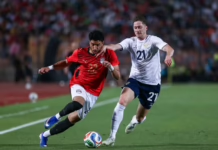

A Neutral Stage With Plenty at Stake. Read on for all our free predictions and betting tips.



Read Rationale ▾
Angola dominate the historical matchups with three wins in four games. The Central African Republic possess a fragile defensive structure, having conceded twelve goals across five matches, while struggling significantly in matches away from home territory, paving the way for a controlled home victory.
Read Rationale ▾
Angola previously achieved a clean 4-0 shutout in this matchup and remain structured defensively. With the Central African Republic recently enduring heavy 0-2 and 0-5 defeats against Comoros, Madagascar, and Ghana, a routine two-goal margin reflects their structural vulnerabilities.
Compare form, H2H, goals trends and key data for Angola v Central African Republic.
Angola and the Central African Republic meet on Tuesday afternoon in an all-African international friendly at the Estadi d’Andorra la Vella, and while the word “friendly” sits neatly beside the fixture, the mood around this match feels far sharper than that.
Angola vs Central African Republic — bet365 Market Snapshot
Swipe through key markets with illustrative probabilities and sample bet365 odds based on our match analysis.
Angola hold historical dominance with three wins in four games, making them firm favourites against their fragile visitors.

Central African Republic conceded 12 goals across their last 5 matches, highlighting a porous structural baseline.
Angola previously registered a clean 4-0 lockout victory, making a decisive margin highly realistic.
Angola secured a clean sheet against Egypt, highlighting their capacity to deny offensive output under structure.
Three Punchy Stats
- Angola have won three of the four previous meetings between these nations, giving them the stronger head-to-head record.
- The Central African Republic have conceded 12 goals across their last five matches, which underlines the scale of their defensive challenge.
- Angola have kept just one clean sheet in their last seven matches, with that shutout coming in a 0-0 draw against Egypt in December 2025.
Structural Leakage: Defensively Conceded Volume
The defensive metrics highlight a massive difference in stability between the two back lines over recent runs.
A concession total of twelve goals across their last five matches reveals an enduring issue with space management.
While structurally heavier, the lack of clean sheets shows susceptibility to late structural drops.
Both sides arrive in Andorra with something to repair. Angola need to rediscover control at both ends of the pitch after a run that has produced frustration rather than rhythm. The Central African Republic, meanwhile, are trying to stop their defensive issues from becoming the loudest story every time they play. Somewhere in the middle of that tension sits a warm-up match that could easily turn into a serious examination of structure, confidence and patience.
This June window is not about points, tables or tournament survival. It is about rehearsal. It is about coaches testing whether ideas actually survive contact with an opponent. And, let’s be honest, it is also about pride. Nobody wants to fly to neutral European soil just to spend 90 minutes being tactically undressed in public. That is not a friendly; that is a group therapy session with shin pads.
For Angola, the emotional temperature is obvious. Their last outing ended in a 1-1 draw with Mauritania, a game that slipped away after they conceded in stoppage time. That kind of late concession stings because it does not merely change a result; it changes the feeling around the performance. A controlled match becomes a missed opportunity. A disciplined display becomes another reminder that concentration must last until the final whistle, not until everyone starts mentally checking the flight times home.
The Central African Republic also come into this match after a 1-1 draw, having shared the spoils with Togo in their previous friendly. That result followed a dramatic 3-2 win over Chad in World Cup qualifying, but the broader picture remains less comfortable. Defensive balance has been a recurring problem, and when a side concedes an average of 2.4 goals per game across five matches, the issue is not just a bad afternoon. It is a pattern.
Angola: Control Is There, But Ruthlessness Is Missing
Angola’s recent form tells a slightly complicated story. They are not collapsing, but they are not quite convincing either. Their last five matches include a 3-2 win over Zambia, a 2-1 defeat to South Africa, draws against Zimbabwe, Egypt and Mauritania, and a sense that the Black Sable Antelopes are often close to a result without fully gripping it.
The 0-0 draw against Egypt showed that Angola can produce defensive discipline. Yet that match remains their only clean sheet across the last seven games, which makes it harder to frame the back line as a settled strength. They can defend well in phases, but they have not yet shown enough consistency to make opponents feel suffocated.
That is where the tactical pressure comes in. Angola’s expected shape includes Hugo Marques in goal, with Tó Carneiro, Buatu, Gaspar and Eddie Afonso across the defensive line. In midfield, Kelliano, Show and Maestro offer the platform, while Chico Banza, Zini and Mário Balbúrdia carry the attacking responsibility.
The absence of Manuel Benson matters. Angola are without an important wide option after his injury late in the domestic season, and that removes a piece of natural attacking variation from their June plans. Without him, the wide areas may require more collective movement rather than individual acceleration. In plain English: Angola might need to create chances through choreography rather than chaos.
That is not necessarily a bad thing. Against a Central African Republic side that has struggled defensively, Angola may benefit from patient circulation, repeated switches of play and clever occupation of the half-spaces. The danger, though, is becoming too neat. Football has a cruel sense of humour: sometimes the team that looks tidier does everything except score, then gets punished by one direct attack and spends the post-match interview talking about “small details”. Nobody needs another small-details monologue. They need final-third authority.
Central African Republic: Full Squad, Fragile Structure
The Central African Republic arrive with a clean bill of health, which gives Eloge Enza Yamissi the opportunity to use a full-strength team. That is significant because, when a side is trying to correct defensive problems, availability matters. A coach cannot build stability if the pieces keep changing every five minutes.
Their expected line-up starts with Dominique Youfeigane in goal, protected by Wesley Zahibo, Sacha M’Baka, Julien Kouadio and Maurice Selemby. The midfield and attacking support unit features Sami Wattel, Joël Ngoya, Junior Sambia, Yawanendji Malipangou and Goduine Koyalipou, with Delphin Mokonou leading the line.
On paper, that gives the Wild Beasts enough bodies to compete through midfield and support attacks quickly. The issue is not whether they can cause Angola problems. They can. Their 3-2 win over Chad showed they can still find attacking moments, and their 1-1 draw with Togo suggests there is at least some resilience to build on.
The problem is what happens when the ball is lost.
Across recent matches, the Central African Republic have been too easy to open up. They lost 0-5 to Ghana, 0-2 to Comoros and 0-2 to Madagascar before the Chad victory and Togo draw shifted the mood slightly. A team can survive one poor defensive result. It cannot ignore several. When the gaps appear repeatedly, opponents stop seeing them as accidents and start seeing them as invitations.
Against Angola, the Central African Republic must manage defensive transition with far more discipline. Their midfield cannot leave the back line exposed, and the full-backs cannot be dragged into aggressive positions without cover behind them. If the match becomes stretched, Angola’s front three will have the chance to attack space rather than bodies. That is exactly the kind of game the Central African Republic should avoid.
The Key Tactical Battle: Tempo Versus Transition
This match may be decided less by possession and more by what happens immediately after possession changes hands. Angola should look to control the tempo, especially through Kelliano, Show and Maestro. If that midfield trio can dictate rhythm, Angola can push the Central African Republic backwards and force them to defend for longer spells.
However, Angola’s own clean-sheet record keeps the door open. The Black Sable Antelopes have not been secure enough to treat this as a one-way tactical exercise. Their defensive line has to handle direct balls, second phases and moments of late pressure better than it did against Mauritania. Conceding in stoppage time is not merely unlucky; it is a warning that concentration can fade when the match appears under control.
For the Central African Republic, the best route into the game may come from refusing to overplay. If they try to build slowly under pressure and lose the ball in central areas, they may invite exactly the type of Angola attack they do not want to face. Their safer route is likely to involve quicker forward passes, more aggressive support around Delphin Mokonou and a willingness to test Angola’s centre-backs before the defensive block is fully set.
This is where the friendly label becomes misleading. Both teams need solutions. Angola need a cleaner attacking edge and more reliable defensive management. The Central African Republic need proof that their structure can survive against a side with a stronger head-to-head record. That makes the match useful, but also uncomfortable. And useful but uncomfortable is basically the football version of going to the dentist.
Head-to-Head Edge Adds Pressure
The recent history between the sides favours Angola. They won 2-1 away to the Central African Republic in June 2023, also won 2-1 in June 2022, and recorded a 4-0 victory in June 2015. The Central African Republic’s win in this fixture came in June 2016, when they beat Angola 3-1.
That record does not decide this match, but it shapes the psychology around it. Angola know they have usually found a way past this opponent. The Central African Republic know the same thing, which makes the first goal feel particularly important. If Angola score early, old doubts could resurface for the Wild Beasts. If the Central African Republic strike first, the entire emotional tone of the match changes.
What This Friendly Should Reveal
For Angola, this is a test of maturity. They do not need fireworks; they need control with bite. A clean, efficient performance would matter more than a chaotic thriller, especially after the disappointment of conceding late against Mauritania. The front three must offer more than movement. They need end product.
For the Central African Republic, this is about defensive credibility. Their attack has shown signs of life, but their recent concession rate remains the glaring issue. Yamissi has a full squad available, so this is a valuable opportunity to tighten distances between the lines, reduce panic in transition and show that the Togo draw was not just a brief pause in a difficult run.
The likely flow points towards a competitive game with Angola carrying the stronger structural base and the clearer head-to-head advantage. But the Central African Republic are not arriving as passengers. They have enough attacking threat to make Angola uncomfortable, particularly if the match opens up and becomes emotional.
And it probably will become emotional. Angola are tired of nearly performances. The Central African Republic are tired of defending like the door has been left open during a storm. In Andorra, both teams get another chance to prove that recent problems are fixable rather than defining.
This may be a friendly by category, but the stakes are real in the only way June friendlies can be real: not through trophies, but through trust. Trust in the system. Trust in the back line. Trust in the final pass. By full-time, one of these sides should feel a little closer to the team they are trying to become.
📊 Betting Market Explanation
Match Result & Both Teams to Score (BTTS)
This combined market requires selecting the outright match winner alongside whether both teams will score during regular time. It operates as a single outcome where both conditions must be met concurrently. For instance, picking a team to win while denying the opponent a goal requires a victory alongside a clean sheet.
Other Opportunities: Cautious approaches can utilise simple Double Chance or Draw No Bet selections to insulate against unexpected draws, whereas higher-risk angles can isolate precise winning margins. The primary trade-off rests on volatile late goals shifting game states rapidly.
Correct Score
The Correct Score market tasks analysts with identifying the exact final scoreline at the end of regular 90-minute play. It is a highly specific selection with no margin for error, offering higher baseline prices to offset the increased analytical variance.
Other Opportunities: More defensive strategies may involve backing multiple scoreline options simultaneously or turning to standard Over/Under goals thresholds, which accommodate a wider range of physical match dynamics without tying down the exact final distribution.
Key Tactical Mismatch
Patient circulation via Kelliano, Show, and Maestro to isolate opposing backlines in space.
Porous defensive gaps leading to twelve goals conceded over their last five matches.
🎯 Pick 1: Angola to Win & Both Teams to Score – No Rationale
Angola carry a definitive structural advantage into this fixture, reinforced heavily by historical records that show three victories out of four previous meetings with the Central African Republic. While the hosts have experienced individual drops in focus, such as the late concession against Mauritania, their midfield framework utilizing Kelliano, Show, and Maestro allows them to control the tempo of matches for long sequences. This capability will likely push the visitors deep into their own defensive territory, denying them meaningful counter-attacking avenues.
⚔️ Tactical Indicators:
- Angola have won three of the four historic head-to-head fixtures against this opponent.
- The Central African Republic have conceded twelve goals across their last five matches.
- The visitors failed to score in major recent defensive collapses against Comoros and Madagascar.
The Central African Republic suffer from an unstable defensive structure that has leaked an average of 2.4 goals per game over their last five matches. Defeats such as the 0-5 collapse against Ghana and the 0-2 shutouts by Madagascar and Comoros show a clear vulnerability when standard spaces are opened up by patient midfields. Without Manuel Benson, Angola must work meticulously through systematic positioning, but the technical gulf in central transition should choke the away side’s distribution pathways. The primary threat to a clean win remains Angola’s own defensive lapses, which cost them late against Mauritania.
Risk Factor: Angola’s lone clean sheet in seven outings means absolute defensive concentration is required to avoid single lapses in friendly play.
🎯 Pick 2: Angola 2-0 Correct Score Rationale
A 2-0 scoreline strikes a clear analytical equilibrium between Angola’s controlled tactical approach and the Central African Republic’s defensive struggles. The visitors have shown a pattern of conceding multiple goals, let down by wide defensive tracking and a midfield that often leaves the defensive line entirely unprotected. Given that Angola previously recorded a commanding 4-0 shutout win in this historical series, they possess a template for unlocking this specific opposition structural block without exposing themselves at the back.
Angola’s offensive structure will be missing the individual variation of the injured Manuel Benson, meaning their chance creation will depend on collective choreography and deliberate built-up phases rather than rapid individual counter-attacks. This lowered variance points away from a high-scoring blowout and towards a more professional, controlled two-goal victory. With the Central African Republic routinely blanking against structured opponents on neutral grounds, a methodical performance should wrap up a comfortable margin. Unexpected early individual scoring from the visitors could disrupt this dynamic entirely.
Risk Factor: An early defensive mistake by Angola or excessive passive circulation could alter the game state away from a controlled margin.
❓ Interactive Questions & Answers
⊕ How does the Match Result and Both Teams to Score market work?
The Match Result and Both Teams to Score market requires you to accurately select the winning team along with whether both sides score. Both outcomes must be correct simultaneously for the bet to win. For example, backing a selection to win with a “No” means they must secure a victory while keeping a clean sheet.
⊕ What happens to my selection if Angola vs Central African Republic ends in a 0-0 draw?
If the match ends in a 0-0 draw, both the match result win and correct score selections will lose. Because neither team managed to score or secure a victory, any prediction based on an outright winner or specific positive scoreline fails to meet the criteria.
⊕ Why is the confidence rating for the Correct Score selection lower than the Main Bet?
Correct Score markets carry a much lower confidence rating because predicting exact scorelines involves high statistical variance. While a main match result bet covers a wider range of physical scenarios, a single unexpected defensive lapse or late goal will completely invalidate a precise scoreline choice.
⊕ Does a neutral venue like Estadi d’Andorra la Vella impact team dynamics?
A neutral venue removes standard home-ground advantage, leveling the playing field regarding fan support and travel strain. Teams must rely entirely on their inherent tactical structure, coordination, and depth rather than emotional energy built up from a local crowd environment.
⊕ How does the absence of Manuel Benson influence the predicted scoreline?
The absence of wide midfielder Manuel Benson limits Angola’s raw individual variation in the final third. This structural absence makes a wild, high-scoring blowout far less probable, directing expectations toward a controlled, methodical choreography that points naturally to lower positive scorelines.
⊕ What is the significance of the head-to-head record between these teams?
The head-to-head history reveals that Angola have systematically managed to unlock the Central African Republic across past iterations. Winning three out of four prior competitive matches establishes a psychological and tactical blueprint that validates their strong favoritism.
⊕ Can defensive records in friendlies be trusted when analyzing a match?
Defensive records provide a general tracking framework, but friendly environments introduce experimental substitutions that can alter structural stability late in games. While underlying patterns remain useful, extensive rotation often produces uncharacteristic errors during closing phases.
⊕ Where can I check if the odds for these markets have updated before kick-off?
You can monitor real-time pricing updates by visiting major sportsbooks such as Bet365 directly before the match begins. Football prices are dynamic and fluctuate based on late squad selection announcements, market volume shifts, and breaking fitness configurations.
Last Odds Update: Feb 10, 14:20 GMT | Editorial Policy
18+ | GambleAware | T&Cs apply
Please gamble responsibly. Always set a strict personal budget, utilise platform deposit limits, and ensure you stop playing immediately when the activity is no longer fun.