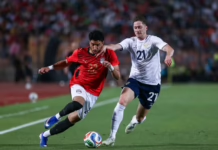

A Friendly With Bruised Pride, Fresh Faces and Plenty to Prove. Read on for all our free predictions and betting tips.



Read Rationale ▾
Greece possess a resilient backline, keeping five clean sheets in their last ten matches. Given that friendly encounters often involve heavy squad rotation and a reduced competitive tempo, defensive structures usually dominate over attacking fluency. This tactical baseline strongly indicates a tight, low-scoring affair with fewer than three total match goals.
Read Rationale ▾
Italy hold the superior technical capability and boast an impressive record of three wins in their last five fixtures. A narrow margin remains highly plausible because Greece’s compact unit rarely breaks down completely. Silvio Baldini’s squad possess the elite quality needed to unlock the hosts exactly once while keeping things secure at the opposite end.
Compare form, H2H, goals trends and key data for Greece v Italy.
Greece host Italy in an international friendly in Crete on 7 June 2026, with both sides rebuilding after World Cup disappointment and looking ahead to the Nations League.
Greece vs Italy — BetMGM Market Snapshot
Swipe through key markets with illustrative probabilities and sample BetMGM pricing based on our match analysis.
Greece maintain a robust five clean sheets record in their last ten fixtures, giving them a defensive foundation against Italy’s attacking setup.

Greece boast a low 0.60 goals conceded per game average, heavily contributing to a lower-scoring tactical layout for this tie.
Italy average 1.80 goals scored per match, making a narrow 1-0 or 2-0 outcome plausible against a rigid defence.
With Italy keeping four clean sheets in recent games, the backline remains highly structured away from home.
Three Punchy Stats
- Italy’s squad refresh is dramatic: 15 players made their senior Azzurri debut. against Luxembourg on Wednesday.
- Greece have won just once in their last eight games. before this friendly.
- Gianluigi Donnarumma has already reached 82 senior caps at the age of 27, making him the experienced anchor in an otherwise youthful Italy group.
Defensive Metrics: Goals Conceded per Game
A direct evaluation of defensive stability reveals how structurally resilient both backlines remain heading into this friendly tie.
Their minimal concession average points to a highly disciplined defensive block that gives away few clear scoring chances.
Conceding exactly one goal per game shows structural consistency while leaving occasional room for opponents to exploit.
Shutout Efficiency: Clean Sheets in Recent Cycles
Clean sheet tallies highlight the capacity of both teams to completely stifle opposing attacks throughout ninety minutes.
Achieving shutouts in half of their recent fixtures illustrates a system that prioritises structural safety.
Maintaining a solid defensive record during recent tactical integration shows their enduring backline organisation.
Greece and Italy meet in Crete on Sunday night in an international friendly that may not carry tournament jeopardy, but it certainly carries emotional weight. Kick-off is scheduled for 8.00pm on 7 June 2026 at the Stadio Thódoros Vardinoyánnis, and both nations arrive with that awkward end-of-season feeling: tired legs, frustrated supporters and the uncomfortable knowledge that neither will be heading to the upcoming World Cup.
That alone gives this fixture a sharper edge than the word “friendly” usually suggests. Let’s be honest, “friendly” is often football’s most misleading label. There will be experiments, yes. There will be substitutions, probably plenty of them. But for two countries trying to restore belief after qualifying disappointment, this is not just a casual summer run-out in the sunshine. It is a chance to reset the tone before the next UEFA Nations League campaign begins in late September.
Greece are preparing for a demanding Nations League group featuring Germany, the Netherlands and Serbia. Italy, meanwhile, are looking towards a group containing France, Belgium and Turkey. Nobody is easing into autumn with a warm blanket and a cup of tea here. Both sides need answers, and quickly.
Greece Need More Than Nearly Moments
Greece come into this match under pressure. Ivan Jovanovic’s side failed to reach the World Cup playoffs, finishing third in a qualifying group topped by Scotland. That disappointment hit harder because expectations had risen after some eye-catching Nations League performances, including a win over England at Wembley and finishing level on points with the Three Lions.
Since then, the mood has dipped. Greece lost at home to Paraguay, drew 0-0 in Hungary, and then needed a dramatic late goal to avoid defeat against Sweden. In Solna, Kostas Tsimikas gave Greece the lead, but the match turned against them before Giorgios Masouras struck from close range in the 95th minute to secure a 2-2 draw.
That late equaliser matters. Not because it fixes everything — it absolutely does not — but because it showed Greece still have resistance. There is stubbornness in this team, even when rhythm disappears and the match starts getting messy. Greece have not exactly been cruising lately, with only one win in eight games, but the Sweden draw at least offered proof that they can still punch back when the evening starts going wrong.
The challenge now is to turn survival instincts into control. Against Italy, Greece will need more than emotion and late pressure. They will need clean structure, sharper possession and better defensive management after conceding twice in Sweden.
Italy’s Rebuild Starts With Youth, Nerves and Donnarumma
Italy arrive with a very different kind of pressure. Their World Cup playoff exit still hangs over them, especially after beating Northern Ireland in the semi-finals before losing to Bosnia-Herzegovina on penalties. For a nation that won the Euros five years ago but has not reached the World Cup since 2014, another absence is brutal. Even by football’s dramatic standards, that is a storyline with a grim soundtrack.
The response has been a major reset. Gennaro Gattuso has gone, having only been hired during qualifying, and Silvio Baldini is now serving as interim head coach. A permanent appointment is expected after FIGC presidential elections later this month, so this camp has the feel of a bridge between eras.
Baldini’s squad is youthful and largely untested. Only Pio Esposito, Niccolo Pisilli, Marco Palestra and Gianluigi Donnarumma had previously been capped at senior level before the Luxembourg friendly. Then came the big wave: 15 players made their Italy debut on Wednesday, when Pio Esposito scored the second-half winner in a 1-0 victory over Luxembourg.
That makes this Italy side fascinating and slightly chaotic. There is talent, freshness and enthusiasm, but also the obvious risk of a team still learning each other’s movements. For Greece, that unfamiliarity is an opportunity. For Italy, it is a test of whether individual quality can survive the lack of shared international experience.
And then there is Donnarumma. While many senior internationals are already enjoying their summer break, he earned his 82nd cap at 27 against Luxembourg and is expected to feature again. In this squad, he is not just the goalkeeper. He is the adult in the room, the emergency brake, the calm voice when a young back line starts treating the ball like a hot potato.
Tactical Battle: Greece’s Full-Strength Core Against Italy’s New-Look Shape
The contrast in selection is one of the most interesting parts of this fixture. Greece essentially chose a full-strength side against Sweden and are not expected to make many changes. Italy, by contrast, are leaning heavily into experimentation.
That could shape the match. Greece should have more continuity, especially with players such as Tsimikas and Christos Tzolis expected to start again. Their likely XI — Tzolakis; Vagiannidis, Retsos, Mavropanos, Tsimikas; Zafeiris, Kourbelis, Triantis; Tzolis; Douvikas, Pavlidis — suggests a side with established senior figures and enough attacking threat to put pressure on Italy’s reshuffled defence.
Vangelis Pavlidis captained Greece against Sweden in the absence of injured captain Tasos Bakasetas, and his leadership will again be important if selected. Greece need their front line to give them more than effort. They need presence, timing and a reliable first pass under pressure.
One selection question centres on Tasos Douvikas, who scored 14 Serie A goals while helping Como qualify for the Champions League. He will hope to move ahead of Andrews Tetteh and into the starting lineup. That is not just a personnel call; it could change Greece’s attacking rhythm. Douvikas offers a clear goal threat, and against an Italy defence featuring unfamiliar combinations, his movement between centre-backs could become a major theme.
Italy’s likely XI — Donnarumma; Fortini, Comuzzo, Ahanor, Bartesaghi; Ndour, Lipani, Pisilli; Fini, Esposito, Koleosho — looks young, fresh and adventurous. The midfield trio will need to protect the defence while still feeding the attacking line quickly enough to prevent Greece from settling into a comfortable press.
The danger for Italy is that youth can bring bravery and naivety in equal measure. That is not an insult; it is football. One minute a young player looks fearless, the next he is playing a square pass in his own third that makes every coach age three years. Baldini will want courage, but controlled courage.
Key Individuals Could Decide the Rhythm
For Greece, Tsimikas is central because of what he offers on the left side. He already scored against Sweden, and his ability to influence both phases gives Greece an important outlet. If Tzolis starts ahead or inside him, Greece can create overloads down that channel and force Italy’s right side into repeated defensive decisions.
Pavlidis also carries responsibility, especially with Bakasetas absent. Greece need someone to connect emotion with execution. Passion is useful, but misplaced passion is just a yellow card waiting to happen. Pavlidis has to help set the tone without letting the game become frantic.
For Italy, Esposito is the obvious attacking focus after scoring against Luxembourg. A second strong performance would strengthen his case in a squad where many players are still trying to introduce themselves at senior level. Pisilli, already among the few capped players before this camp, also has a chance to bring balance to midfield.
Donnarumma remains the clearest point of reference. With an unfamiliar defence in front of him, his communication may be as important as his shot-stopping.
What This Match Really Means
The result matters, but the performance may matter more. Greece need to prove they can move beyond late rescue acts and produce a complete, controlled display. Italy need to show that this youth-heavy group is not merely an emergency experiment, but the start of something coherent.
There is a slightly uncomfortable truth here: both nations are too proud to treat this as just another friendly. Greece are chasing reassurance. Italy are chasing identity. That makes the match compelling, even without competitive points attached.
By the end of Sunday night in Crete, neither side will have solved every problem. Football does not work that neatly, unless you are writing a bad motivational poster. But Greece can restore some belief with a more assertive display, while Italy can leave with another useful step in their rebuild if the young players handle the pressure of a tougher away environment.
For supporters, this is the kind of friendly worth watching closely: not because it promises perfection, but because it may reveal which players and ideas survive into the next serious chapter.
📊 Market Explanation and Tactical Rationale
Match Result & Total Goals Markets
The Total Goals market allows selections based on the combined scoreline of both teams exceeding or falling below a specified number. An Under 2.5 selection requires two or fewer goals to be scored in total. Cautious strategies benefit from high historical defensive consistency, whereas higher-risk angles rely on explosive attacking variances. Trade-offs involve balanced price points versus late-game variance where structural shapes weaken under exhaustion.
Correct Score Market
The Correct Score market demands an exact match prediction for the final scoreline at full-time. This selection features higher volatility and larger margins, making it a higher-risk choice. Volatility remains substantial as a single defensive error or penalty decision completely alters the state, meaning precise tactical game-state evaluation is vital for identifying plausible paths.
🎯 Pick 1 Rationale: Under 2.5 Goals
Greece have demonstrated exceptional defensive reliability under Ivan Jovanović, maintaining five clean sheets across their last ten fixtures. This structural design restricts space in the middle third and makes breaking down their defensive shape extremely challenging. Furthermore, Greece concede a minimal average of just 0.60 goals per match, showcasing their ability to handle high-pressure attacking phases efficiently.
⚔️ Tactical Indicators:
- Greece managed 5 clean sheets during their last ten international matches.
- The home side maintain a low 0.60 goals conceded per fixture ratio.
- The last three head-to-head fixtures between Greece and Italy all finished under 2.5 goals.
Risk Factor: Friendly fixtures often invite experimental tactical choices and rapid substitutions, which can lead to structural loss and unexpected scoring windows late on.
🎯 Pick 2 Rationale: Italy 1-0 Greece
Italy carry superior technical quality across their midfield unit and forward lines, helping them achieve three victories in their previous five fixtures. Silvio Baldini’s tactical approach focuses on ball control and methodical penetration, which provides the tools needed to unlock Greece’s rigid shape exactly once. However, because Greece’s compact unit rarely collapses entirely, an expansive scoreline remains highly unlikely.
ITALY GOALS/GAME
GREECE CONCEDED/GAME
Risk Factor: Greece possess an efficient transitional game and a strong record on home soil, meaning a defensive clean sheet for the hosts could easily result in a 0-0 stalemate.
Key Tactical Mismatch
Boasting three wins in five games. Excellent spatial rotation can tire out rigid defensive low-blocks over ninety minutes.
Prone to deep compression when facing elite build-up play, limiting counter-attacking outlets under heavy pressure.
❓ Interactive Questions and Answers
⊕ How does the Under 2.5 Goals market operate?
The Under 2.5 Goals market settles as a winning choice if the combined scoreline of both teams features two or fewer goals at full-time. This means scorelines like 0-0, 1-0, 0-1, or 1-1 satisfy the criteria, whereas any game producing three or more total goals results in a loss.
⊕ What variables justify selecting a low-scoring game here?
Greece maintain an impressive defensive profile, conceding a minor 0.60 goals per match alongside five clean sheets in ten outings. Coupled with the typically slower competitive intensity of exhibition friendlies, defences regularly hold the upper hand over attacking configurations.
⊕ How does the Correct Score market function?
The Correct Score market requires selecting the exact final scoreline at the end of regulation play. If the final whistle blows at any other score configuration, the selection fails, highlighting the high volatility and risk nature of this specific market option.
⊕ Why is a narrow 1-0 Italy win considered plausible?
Italy hold the clear technical edge and have recorded three victories in their past five games. Given Greece’s compact backline, Silvio Baldini’s squad possess the elite quality to convert once while preserving a clean sheet via their own solid defensive unit.
⊕ Does home advantage significantly boost Greece’s outlook?
Greece are historically resolute at the Stadio Thódoros Vardinoyánnis, remaining unbeaten in their last four home international games. This home comfort reinforces their defensive determination, making them highly capable of limiting elite opposition to minimal goalscoring chances.
⊕ What role do managerial setups play in friendlies?
Managers use friendly ties to gauge roster depth and experiment with structural spacing. Ivan Jovanović will test mid-block compression, while Silvio Baldini focuses on possession phases, which often creates an analytical chess match over high-scoring entertainment.
⊕ How do friendly matches affect scoring rates?
Exhibition matches generally produce lower scoring patterns due to frequent second-half substitutions and reduced competitive friction. As core combinations are swapped out around the hour mark, fluid attacking rhythm often declines in favour of maintaining basic defensive positioning.
⊕ Can transitional phases decide this tactical matchup?
Transitional efficiency represents the primary path to breaking a tactical deadlock. If Greece successfully absorb Italy’s build-up play, their direct counter-attacks will test Italy’s recovery lines, making defensive turnovers the critical factor across ninety minutes.
Last Odds Update: Jun 5, 15:49 BST | Editorial Policy
18+ | GambleAware | T&Cs apply
Set a strict budget, use personal account limits, and always stop immediately when the process is no longer fun.