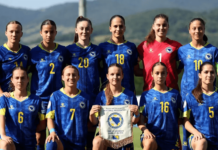

A Group A match with pressure already rising. Read on for all our free predictions and betting tips.



Sweden boast a formidable defensive record with four clean sheets in seven matches, including three consecutive clean sheets in Euro U19 Women action. Bosnia managed just two shots in their opening match, highlighting their severe struggles in creating high-quality attacking opportunities against organised structures.
A 2-0 scoreline reflects Sweden’s tactical control and patient possession via their 3-1-4-2 system. While Sweden are highly efficient defensively, they generally maintain a controlled tempo rather than pursuing explosive scorelines, making a structured, multi-goal victory highly plausible.
Technical preview of Bosnia and Herzegovina W U19 vs Sweden W U19 in Group A of the UEFA European U19 Women’s Championship 2026, including tactical analysis, form and key stats.
Bosnia W U19 vs Sweden W U19 — bet365 Market Snapshot
Swipe through key markets with illustrative probabilities and sample bet365 odds based on our match analysis.
Sweden’s strong possession habits and clean sheet platform contrast sharply with Bosnia’s tough defensive opening defeat.

Bosnia allowed five goals in their opener while Sweden kept a clean sheet against Poland’s defensive unit.
Sweden’s 3-1-4-2 setup offers extreme control, making lower multi-goal scorelines plausible in their territorial strategy.
Sweden have recorded four clean sheets across seven games, building an incredibly steady platform.
Three Punchy Stats
- weden have four clean sheets across seven games Sweden have conceded only four goals in seven matches and have kept four clean sheets. That defensive base is the foundation of their control, because it allows them to manage matches without needing chaos to win them.
- Bosnia’s 5-0 defeat to Germany and Sweden’s 1-0 win over Poland created a six-goal swing in Group A goal difference after one match. That is not just a table detail; it changes the pressure on both teams immediately.
- Sweden have recorded 65 total attacks and 24 dangerous attacks, compared with Bosnia’s 20 total attacks and six dangerous attacks. That gap points to a major difference in how often each team is reaching meaningful areas.
Territorial Dominance: Dangerous Attacks Recorded
A direct comparison of how often each side breached the opponent’s defensive third in their opening group stage fixtures.
Struggled heavily to move the match away from their own penalty area against relentless pressing.
Consistently arrived into meaningful advanced zones through fluid sideways and vertical ball circulation.
Attacking Volume: Total Shots in Openers
Shot volume highlights the efficiency of chance creation and general penetration inside the final third.
Fewer opportunities in forward areas leaves the defensive line under massive pressure for long stretches.
Maintained a steady flow of attempts, showing confidence in breaking down structured, compact blocks.
Bosnia and Herzegovina W U19 meet Sweden W U19 in Group A of the UEFA European U19 Women’s Championship 2026, and the emotional temperature around this fixture is already higher than a calm group-stage label suggests. One side are trying to steady themselves after a bruising opening defeat. The other arrive with three points, a clean sheet and the kind of tactical clarity that makes opponents feel as though the pitch has suddenly shrunk.
Bosnia’s 5-0 loss to Germany was not just damaging on the scoreboard; it exposed how hard this level can be when a team cannot escape pressure cleanly. Sweden, meanwhile, opened with a 1-0 win over Poland, a result that looked narrow but carried the signs of a side in control: cleaner discipline, stronger possession habits and enough structure without the ball to keep the match on their terms.
That contrast gives this game its edge. Bosnia need a response, not just a result. Sweden need to avoid the trap of assuming control will automatically become comfort. Youth football can be wonderfully chaotic, which is part of its charm and occasionally part of its comedy. One mistimed clearance, one panicked foul, one goalkeeper having the afternoon of her life, and suddenly the sensible tactical preview gets kicked into the bin.
Still, the core question is simple: can Bosnia turn survival into possession, and can Sweden turn possession into pressure?
Sweden’s 3-1-4-2 gives them the cleaner route to control
Sweden’s 3-1-4-2 shape is built for territorial dominance. The back three give them security in the first phase, while the single holding midfielder acts as the connector, recycling possession and protecting against transitions. Ahead of that, the four-player midfield line can stretch the pitch horizontally, making it difficult for opponents to press without leaving space somewhere else.
That matters against Bosnia’s 4-2-3-1. In theory, Bosnia’s double pivot should help screen the defence and block central access. In practice, their opener against Germany showed how quickly that system can become pinned back if the first pass out of pressure is loose. Their 62% pass accuracy from that match is the figure that should worry them most. It is not only about technique; it is about breathing space. When a team cannot complete enough passes, it spends too long defending, chasing and reacting.
Sweden completed a far more convincing possession performance against Poland. They made 212 passes compared with Bosnia’s 141 in their respective openers, and their pass accuracy was recorded at 137 against Bosnia’s 62. However that figure is framed, the football meaning is clear: Sweden have looked more reliable when circulating the ball. They are less likely to turn routine possession into a fire drill.
Bosnia will probably need to make this game awkward. That does not mean reckless. It means compact distances, brave timing and a refusal to let Sweden’s wing midfielders receive in stride. If Bosnia’s wide players drop too deep, Sweden can camp in their half. If they jump too early, Sweden can play around them. It is a tactical tightrope, and yes, it looks more like walking it in boots than ballet shoes.
Bosnia’s main issue is chance creation
The most alarming attacking number around Bosnia is their shot output. They managed just two total shots in the 5-0 defeat to Germany, while Sweden recorded seven in the win over Poland. Across the recent attacking figures, Bosnia’s total shots are also listed at two, with an average of 0.29 per game, compared with Sweden’s eight and 1.14 per game.
That is not a small gap. Shots are not everything, but they are the clearest sign that a team is at least reaching dangerous areas. Without them, every defensive mistake becomes heavier because there is no attacking threat to balance the match emotionally. A team that cannot shoot often ends up defending not only the opponent, but the scoreboard, the clock and its own anxiety.
Bosnia’s best route may come through moments rather than patterns: a turnover, a set-piece, a loose second ball, or a Swedish pass played too casually into midfield. They did win once recently by a 5-0 scoreline against Luxembourg U19 W and also beat Armenia U19 W 3-1, so they are not without attacking reference points. The issue is whether those ideas survive against a side who are better organised out of possession.
Sweden’s nine interceptions against Poland hint at why Bosnia may struggle to build rhythm. Interceptions are often a sign of anticipation rather than panic. Sweden are not only waiting to defend; they are reading passes, stepping in and turning defensive moments into new attacks. Against a Bosnia side trying to recover confidence, that could become suffocating.
Discipline could shape the rhythm
Bosnia committed 12 fouls and received two yellow cards in their opening match. Sweden committed seven fouls and received no yellow cards. That contrast says plenty about the different emotional states of the two teams. Bosnia were under strain and had to disrupt play. Sweden were more composed and better able to defend through positioning rather than desperation.
This does not make Bosnia dirty or Sweden angelic. Football is not a courtroom, although some players appeal like barristers after every throw-in. But discipline matters hugely in a match where one team may spend long stretches without the ball. If Bosnia concede cheap free kicks, Sweden can keep the ball in advanced zones, reset pressure and deny them the one thing they desperately need: breathing room.
For Sweden, the challenge is to stay patient. A 3-1-4-2 can dominate territory, but it can also become too flat if the forwards do not threaten depth and the midfield line only circulates sideways. Their two forwards pressing from the front should be important, particularly against a Bosnia backline that has already shown vulnerability when forced into uncomfortable areas.
Form points towards Sweden, but Bosnia still have a fight to frame
Sweden’s recent run gives them a strong platform. Their last six matches include wins over Poland U19 W, Ukraine U19 W, Netherlands U19 W and Bulgaria U19 W, plus a draw with Italy U19 W and a defeat to Poland U19 W. Across seven games, they have scored nine and conceded four, with four clean sheets.
Bosnia’s recent results are more uneven but not empty. Their last six include wins over Armenia U19 W, Luxembourg U19 W and San Marino U19 W, a draw with Belarus W U19, and defeats to Germany U19 W and Romania U19 W. Across seven games, they have scored 20 and conceded 11, a wild profile that suggests they can score heavily in the right match but can also be opened up when the level rises.
This is where the controversy sits: Bosnia’s overall scoring average of 2.86 looks impressive, but it may flatter their attacking outlook for this specific fixture. Sweden’s defensive profile, including three consecutive clean sheets in Euro U19 Women action and an unbeaten record in six of their last seven Euro U19 Women matches, makes this a much tougher attacking exam.
For Bosnia, the target is not simply to attack more. It is to attack better. A rushed clearance toward a lone forward will not be enough. They need the No 10 zone in the 4-2-3-1 to connect play, draw fouls, and stop the match becoming attack versus clearance. If that link fails, Bosnia’s striker could spend the game feeling like she has been sent on a hiking trip without a map.
The midfield battle is the heart of the match
The key tactical zone is central midfield. Sweden’s holding midfielder has a major role in controlling tempo, while the advanced midfield line can create overloads around Bosnia’s double pivot. If Sweden can keep switching play and pulling Bosnia sideways, gaps should appear between full-back and centre-back, or in front of the defensive line.
Bosnia must decide whether to protect the middle or press Sweden’s wider outlets. They probably cannot do both for 90 minutes. Their dangerous attacks figure of six, compared with Sweden’s 24, underlines the territorial challenge. Sweden are more used to arriving in advanced areas, while Bosnia need to prove they can move the match away from their own penalty area.
Set-pieces may also matter. Both teams recorded one corner in their most recent matches, so neither side comes into this game with a clear corner-volume edge. But for Bosnia, any dead-ball situation in Sweden’s half could be valuable simply because it offers structure, rest and a chance to get numbers forward without needing to pass through the press.
Final analysis: control against resistance
This match looks like a test of Sweden’s patience and Bosnia’s resilience. Sweden have the more convincing tactical structure, cleaner discipline and stronger recent defensive numbers. Their 3-1-4-2 should help them control central areas, create width and press Bosnia’s build-up from the front.
Bosnia’s task is emotional as much as tactical. After conceding five against Germany, they need to show that the opening match has not drained their belief. The 4-2-3-1 can still give them a solid base, but only if the midfield holds its shape and the front four offer a genuine outlet. If Bosnia are forced into another low-possession, low-shot performance, the match could become very difficult to reset.
Sweden should expect resistance, because no team at this level wants to be defined by one bad result. Bosnia will fight for second balls, look for set-piece moments and try to turn Swedish possession into frustration. But the balance of the matchup points towards Sweden having more ways to control the game: better ball circulation, stronger interception numbers, cleaner discipline and a defensive record that gives them room to be calm.
The human drama is obvious. Bosnia are trying to prove they belong in this contest after a punishing opener. Sweden are trying to show their first win was not just efficient, but the start of something more commanding. That is what makes this fixture worth watching: not just the likely tactical pattern, but the emotional resistance inside it.
📊 Market Explainer
Both Teams to Score (BTTS) – No
This market requires at least one team to keep a clean sheet. If either team fails to score, or if the match finishes in a 0-0 stalemate, the selection is successful. It provides a defensive buffer for highly structured match-ups.
Correct Score Market
A high-risk, high-reward approach where you determine the exact full-time scoreline. It requires precise game-state evaluation, balancing defensive solidness against a side’s average goal output.
Other opportunities in this market: Cautious approaches can look at a straight Sweden victory, trading a lower price for maximum probability. Higher-risk strategies include specific multi-goal scorelines such as 3-0. Volatility remains present in youth football due to late game-state shifts, where late fatigue can puncture a defensive shape.
Key Tactical Mismatch
Recorded 24 dangerous attacks and 212 passes in their opener, showing high competence circulating the football inside advanced areas.
Recorded a low 62% pass accuracy while conceding 5 goals against Germany, showing extreme vulnerability when pinned back deeply.
🎯 Both Teams to Score – No Rationale
Sweden present an exceptionally stable defensive profile coming into this Group A fixture. They have registered four clean sheets across their last seven outings, including an unblemished record in three consecutive Euro U19 Women tournament appearances. This level of organization makes them incredibly difficult to break down, particularly for an opposition unit currently enduring severe issues inside the attacking third.
⚔️ Tactical Indicators
- Sweden managed 9 interceptions against Poland, reading passes early to kill transitions.
- Bosnia produced a minimal output of just two total shots in their heavy 5-0 opening defeat.
- Bosnia recorded a mere 6 dangerous attacks compared to Sweden’s commanding 24.
Bosnia’s defensive layout was heavily breached in their opening match, but their lack of ball retention is what fundamentally hampers their offensive threat. Completing just 141 passes with a modest 62% accuracy means they are constantly chasing the ball, leaving their lone striker isolated. Without a functional link between the double pivot and the attacking midfield line, creating sustained final-third pressure becomes an uphill struggle.
Risk Factor: Youth football inherently carries a higher degree of erratic mistakes. A single unforced lapse in concentration, a loose backpass, or an unexpected penalty can instantly dissolve a clean sheet layout.
🎯 Sweden W U19 2-0 Correct Score Rationale
A structured 2-0 scoreline perfectly matches the current tactical identities of both nations. Sweden’s 3-1-4-2 blueprint is heavily geared towards territorial dominance and suffocating possession rather than wide-open transitional chaos. They completed 212 passes in their opening group stage fixture, demonstrating a patient approach that prioritises control and limits defensive exposure.
While Bosnia suffered a severe 5-0 loss to Germany, they possess previous defensive reference points where they limited lines, such as their recent competitive fixtures. A natural urge to rebuild pride after a punishing opener will likely force Bosnia into a highly compact, low-block defensive shell. Sweden’s structural goal record—netting nine times while conceding four across seven matches—proves they are efficient but rarely explosive, routinely executing measured victories over lower-ranked opposition.
Risk Factor: If Sweden find an early breakthrough inside the opening fifteen minutes, Bosnia’s defensive structure could collapse under emotional strain, leading to an expanded scoreline similar to their opening matchday.
❓ Frequently Asked Questions
⊕ What does the Both Teams to Score – No market mean?
⊕ Why is the price on a straight Sweden victory so low?
⊕ How does Sweden’s 3-1-4-2 system impact the goal volume?
⊕ What are the main defensive statistics for Sweden?
⊕ Can Bosnia create realistic chances based on their opening match?
⊕ What is the significance of dangerous attacks data?
⊕ How does discipline affect the flow of this fixture?
⊕ What is a risk when backing low scorelines in youth football?
18+ | GambleAware | T&Cs apply
Please gamble responsibly. Establish a clear budget, employ sensible deposit limits, and ensure you stop playing immediately when it ceases to be fun.