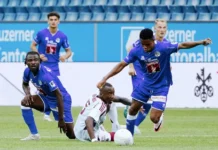

Basel vs Lausanne Sport: Pressure, Control and an Early Test at St. Jakob-Park. Read on for all our free predictions and betting tips.



Basel’s defensive record remains fragile, conceding 58 goals last season and seeking only their second home clean sheet in 13 matches. Lausanne maintain a strong away scoring rate, averaging over one goal per away game last season. Seven of the last eight meetings saw both teams score, making BTTS a logical choice.
Basel created 2.2 expected goals in their opener, with attacking threats like Shaqiri and Celar. Lausanne’s defensive frailties on the road, including four consecutive away losses by 11-1 aggregate, suggest Basel can exploit gaps. Basel’s own defensive lapses make a clean sheet unlikely, supporting a 3-1 scoreline.
Basel’s pursuit of another Swiss Super League title continues on Saturday evening when Lausanne Sport visit St.
Basel vs Lausanne Sport — bet365 Market Snapshot
Swipe through key markets with illustrative probabilities and sample bet365 odds based on our match analysis.
Basel’s stronger opening and home platform position them as favourites against Lausanne’s away vulnerabilities.

Basel’s defensive fragility and Lausanne’s consistent away scoring suggest goals at both ends.
Basel’s attacking creation and Lausanne’s defensive leaks align with a 3-1 home win prediction.
Basel generated 2.2 expected goals against Servette, highlighting their attacking potential despite defensive issues.
Three Punchy Stats
- Seven of the last eight meetings between Basel and Lausanne have featured goals from both teams, highlighting how regularly this fixture has opened up at both ends.
- Lausanne lost their final four competitive away matches by a combined score of 11-1, a sequence that exposes the scale of their recent difficulties on the road.
- Basel created 2.2 expected goals against Servette but needed a 78th-minute penalty to win 1-0, showing both the strength of their chance creation and the need for greater efficiency.
Attacking Efficiency Contrast
Basel’s high chance creation challenges Lausanne’s away scoring consistency.
Basel’s attacking output gives Lausanne Sport a clear tactical problem to solve.
Lausanne Sport can trouble Basel by turning promising attacks into cleaner final actions.
Defensive Stability Comparison
Basel’s home defensive struggles contrast with Lausanne’s poor away record.
Basel’s defensive shape will be tested whenever Lausanne Sport increase the tempo.
Lausanne Sport must match Basel’s discipline and avoid conceding cheap openings.
Jakob-Park for gameweek two of the 2026-27 season.
Both teams avoided defeat on the opening weekend, but the mood around their results could hardly be more different. Basel began with a 1-0 victory over Servette, while Lausanne were held to a 1-1 draw by Grasshopper after conceding an 81st-minute equaliser.
That leaves Basel fifth with three points and Lausanne seventh with one, although the table carries little meaning after a single round. The performances behind those results are far more revealing.
Basel controlled the danger against Servette, preventing their opponents from creating any big chances, but needed a 78th-minute penalty to secure the win. Lausanne, meanwhile, became increasingly passive after going ahead against Grasshopper, surrendering attacking ambition until the equaliser began to feel unavoidable.
Saturday’s meeting should therefore be shaped by one central question: can Lausanne remain brave enough to threaten Basel, or will they retreat and invite pressure once again?
Basel Have a Platform, Not Yet a Finished Product
Opening-day victories are useful because they create breathing room, but Basel’s 1-0 success should not be mistaken for a complete performance.
Stephan Lichtsteiner’s side generated 2.2 expected goals against Servette, a measure of the quality of the chances they created. That suggests Basel produced enough attacking situations to score more than once. However, their eventual breakthrough came from the penalty spot, underlining the difference between building promising attacks and finishing them decisively.
At the other end, Basel conceded 1.19 xG overall, including 1.02 from open play. Servette did not create a recognised big chance, yet they still accumulated enough lower-value opportunities to remind Basel that control can be fragile.
That issue matters because defensive vulnerability has not disappeared overnight. Basel conceded 58 goals across 38 league games last season, an average of more than 1.5 per match. Their final home fixtures of 2025-26 were similarly unstable, producing one win, one draw and two defeats.
Across those four matches at St. Jakob-Park, Basel scored seven goals but conceded nine. That is entertaining for the neutral and mildly terrifying for anyone responsible for organising the back line. Clean sheets have also been scarce, with Basel now seeking only their second competitive home shutout in 13 games.
The opening win over Servette was therefore important emotionally as well as mathematically. Basel had lost five of their final six league fixtures last season, so starting the new campaign with discipline and three points offered welcome relief.
One narrow victory does not erase that collapse, but it gives Lichtsteiner something solid on which to build.
Why the Midfield Structure Could Decide the Game
Basel are likely to operate with Metinho and Ludwig Thorell as a double pivot behind an attacking line that could include Xherdan Shaqiri.
The purpose of a double pivot is not simply to place two midfielders in front of the defence. It allows one player to support possession while the other protects against transitions, helping the team circulate the ball without becoming completely exposed when an attack breaks down.
That protection could be crucial against Lausanne. The visitors showed attacking intent early against Grasshopper, and their away scoring record from last season demonstrates that they are capable of creating problems. Lausanne scored 20 goals across 19 league trips, averaging slightly more than one per away match.
Basel’s task will be to dominate territory without leaving easy routes into the space behind their midfield. If Metinho and Thorell position themselves well, Shaqiri should be able to operate higher up the pitch, where his influence can be directed towards creating rather than recovering.
The potential front four of Shaqiri, Philip Otele, Albian Ajeti replacement option Zan Celar, and one of the wider attacking players gives Basel technical variety. Celar is expected to lead the line because Kaio Eduardo remains unavailable until at least November with a cruciate ligament injury.
Celar’s role will involve more than finishing. He may need to pin Lausanne’s central defenders, occupy the penalty area and create space between the visitors’ midfield and defensive lines. If Basel can move the ball quickly into that area, Lausanne’s shape could begin to stretch.
Lausanne Must Resist the Temptation to Hide
Luka Elsner’s first competitive match as Lausanne manager ended in frustration.
His team led Grasshopper but gradually sacrificed their attacking threat in an attempt to protect the advantage. Once Lausanne stopped giving their opponents reasons to defend, the momentum shifted. The equaliser arrived in the 81st minute, but it had been coming.
That approach would be especially dangerous at St. Jakob-Park.
Basel may not yet be operating at full rhythm, but allowing them to recycle possession without pressure would give Shaqiri and the supporting attackers repeated chances to find weaknesses. A low defensive block can be effective when it is paired with counter-attacking ambition. Without that outlet, it becomes less of a tactical plan and more of a prolonged emergency.
Lausanne’s recent league form adds to the pressure. Their draw with Grasshopper extended their winless run to five matches, although it was the first time during that sequence that they avoided defeat.
Their away form is an even greater concern. Lausanne lost each of their final four competitive matches on the road by a combined score of 11-1. They also finished last season with the fifth-worst away points record in the league, collecting 19 points.
Those figures do not mean Lausanne should arrive defeated before kick-off. They do mean that Elsner must find a better balance between caution and ambition.
Olivier Custodio and Jamie Roche are expected to anchor the midfield, with Teddy Okou unavailable from the projected team and Brandon Soppy likely to start at right-back because Hamza Abdallah remains sidelined by a knee problem. Abdallah has been out since December 2025 and is expected back in early September.
The midfield pair will need to protect the centre without becoming pinned too close to their own penalty area. If Custodio and Roche can disrupt Basel’s build-up and release Fousseni Diabaté alternatives such as Alvyn Sanches’ listed supporting attackers quickly, Lausanne can force the hosts to defend while moving backwards.
That is where Basel have looked less comfortable.
The Wide Areas Could Become a Pressure Point
Basel have a concern at left-back after Moussa Cisse was forced off against Servette. Coleen Louis could replace him in the starting XI.
Any change in a defensive unit can affect timing and communication, particularly against a side that may look to counter through wide spaces. Lausanne are expected to use Brandon Soppy and Morgan Poaty as full-backs, with Kaly Sene’s listed attacking replacements supporting Sekou Fofana alternatives behind forward Kaly Janneh.
The precise names in the projected attacking line are less important than the tactical principle: Lausanne need runners who can carry the ball away from pressure.
If they regain possession and immediately play backwards, Basel will simply reset and attack again. If they can find Raoul Giger alternatives such as Gaoussou Diakité’s listed creators between the lines, they may expose the areas outside Basel’s double pivot.
For Basel, the answer is counter-pressing. That means trying to recover the ball immediately after losing it, before Lausanne can organise a break. Done well, it keeps the visitors trapped. Done badly, it can remove several Basel players from the defensive phase in a single pass.
This is why the match may be more open than the opening-week scorelines suggest.
A Match About Nerve as Much as Quality
Basel will expect to control possession, territory and the rhythm of the game. Their stronger opening result, home advantage and attacking options give them a clear platform.
Yet Lausanne’s route into the contest is equally clear. Basel’s defensive record remains vulnerable, their home form at the end of last season was inconsistent and their opening clean sheet did not come without pressure.
The visitors must therefore avoid repeating the psychological retreat that cost them against Grasshopper. Protecting a lead is not the same as abandoning the ball and hoping the clock develops sympathy.
For Basel, patience will be essential. Lausanne may defend in numbers, and forcing passes too early could create the transitions Elsner’s side need. Lichtsteiner will want controlled aggression: enough speed to unsettle the visitors, but enough discipline to prevent the match becoming chaotic.
The emotional stakes are already rising despite the season being only one game old. Basel want to prove that the opening win represents a genuine response to last season’s poor finish. Lausanne want to show that their new manager can quickly address the passivity and away-day fragility that have followed them into the new campaign.
At St. Jakob-Park, the team that handles those anxieties best may be the one that takes control.
Other Opportunities in these Markets
Selections in goal-based and scoreline markets cater to contrasting risk tolerances:
- Cautious vs Higher-Risk Approaches: Broad coverage options like Both Teams To Score YES offer higher probability by accepting any scoreline where neither side keeps a clean sheet. Conversely, exact score bets carry elevated volatility and lower win probability in exchange for higher odds.
- Trade-Offs and Game States: Market prices reflect underlying probability and bookmaker margins. Late goals, defensive retreats, or early red cards dramatically alter game-state dynamics, making specific scorelines sensitive to single moments of defensive miscommunication.
📊 Market Explainer
Both Teams to Score (BTTS)
Selection: Both Teams To Score YES. Both teams must score at least once during normal time. The match winner does not matter; the selection is settled only by whether each side finds the net.
Correct Score Market
Selection: FC Basel vs Lausanne Sport 3-1. Predict the exact score at the end of 90 minutes plus stoppage time. Extra time and penalties do not count unless the bookmaker states otherwise.
⚔️ Pick 1: Both Teams To Score YES @ 40/85
FC Basel host Lausanne Sport at St. Jakob-Park in gameweek two of the Swiss Super League season following an opening weekend that exposed recurring defensive traits for both clubs. Stephan Lichtsteiner’s side recorded a 1-0 victory over Servette, yet clean sheets remain a rare commodity for the hosts. Basel conceded 58 goals across 38 league matches last campaign, averaging over 1.5 goals conceded per contest. Their final four home fixtures of 2025-26 yielded nine goals conceded, and they are currently seeking merely their second competitive clean sheet at home in 13 matches.
Lausanne Sport demonstrate consistent away scoring capability despite overall road struggles. Luka Elsner’s team scored 20 goals across 19 away league fixtures last season, averaging over one goal per match on their travels. Midfield anchors Olivier Custodio and Jamie Roche provide stability to feed supporting attackers like Alvyn Sanches, while full-back Brandon Soppy advances to support wide movements. Additionally, Basel’s defensive cohesion faces questions after left-back Moussa Cisse was forced off injured against Servette, potentially requiring Coleen Louis to fill the backline gap.
Historically, this matchup yields goals at both ends of the pitch. Seven of the last eight meetings between FC Basel and Lausanne Sport featured goals from both teams. Given Basel’s heavy expected goals creation paired with an unstable defensive record, both teams finding the net remains highly probable.
🎯 Tactical Indicators
- Seven of the last eight meetings between Basel and Lausanne featured goals for both teams.
- Basel conceded 58 goals in 38 league games last term and seek just their second home clean sheet in 13 competitive matches.
- Lausanne scored 20 goals in 19 away league trips last season, maintaining a scoring rate above one goal per match.
Risk Factor: Lausanne’s tendency to become passive when leading or defending deep could limit their attacking opportunities if they retreat fully.
Key Tactical Mismatch
Generated 2.2 expected goals in week one, using Shaqiri and Celar to penetrate dangerous zones.
Lost their final four away matches last season by an aggregate score of 11-1, showing defensive frailty.
🎯 Pick 2: FC Basel vs Lausanne Sport 3-1 @ 11/1
A 3-1 victory for FC Basel combines their substantial offensive output with Lausanne Sport’s pronounced vulnerabilities on the road. Basel generated 2.2 expected goals in their season opener against Servette, confirming strong chance creation through Xherdan Shaqiri and forward Zan Celar, who steps into the attack while Kaio Eduardo remains sidelined with a long-term cruciate ligament injury. Basel’s technical options across the front line enable them to press aggressively and exploit defensive gaps.
Lausanne’s recent road record reveals severe defensive fragility. Elsner’s side lost their final four competitive away fixtures of last season by a combined margin of 11-1, while finishing with the fifth-worst away points tally in the division (19 points from 19 games). With regular right-back Hamza Abdallah unavailable due to a knee injury, Lausanne’s defensive flanks are particularly susceptible to rapid counter-pressing routines from Basel’s wide attack.
However, Basel’s own defensive concessions make a complete shut-out improbable. Basel conceded 1.19 expected goals against Servette and allowed nine goals across their final four home fixtures of last season. Lausanne possess sufficient away scoring metrics to grab a goal, but their defensive collapse under sustained pressure makes a 3-1 home win a logical and mathematically aligned scoreline prediction.
Risk Factor: Basel's finishing efficiency requires sharp execution after relying on a 78th-minute penalty to break down Servette despite generating 2.2 expected goals.
Frequently Asked Questions
What does Both Teams To Score YES mean in football betting?
Both Teams To Score YES means both teams must score at least one goal during regular time, regardless of the match winner.
How does the Correct Score market function for FC Basel vs Lausanne Sport?
The Correct Score market requires selecting the exact final scoreline at full-time, such as FC Basel 3-1 Lausanne Sport.
Why is Both Teams To Score YES a suitable selection for this fixture?
Seven of the last eight meetings featured goals from both teams, with Basel’s defensive record and Lausanne’s away scoring supporting this choice.
What key factors make a 3-1 home win plausible for FC Basel?
Basel’s strong chance creation and Lausanne’s defensive struggles on the road align with a 3-1 home victory prediction.
How do cautious and higher-risk betting markets differ?
Cautious markets like BTTS cover multiple scorelines with higher probability, while Correct Score bets require exact results with higher volatility.
What team news items affect defensive setups for this game?
Basel’s left-back Moussa Cisse is injured, and Lausanne’s defender Hamza Abdallah remains sidelined, impacting defensive stability.
How does Lausanne Sport's away record impact full-time predictions?
Lausanne’s poor away record, including four consecutive losses, suggests vulnerability that favors multiple Basel goals.
Are Pick 1 and Pick 2 mathematically compatible?
Yes, a 3-1 scoreline satisfies Both Teams To Score YES, making the two selections compatible.