


bet365

BetMGM

Betfred

BetVictor

BetUK

LiveScoreBet

10Bet

Virgin Bet

EasyBet
Can Arsenal turn set-piece muscle and right-side rhythm into a statement against Liverpool?
Thursday night at the Emirates feels like one of those fixtures that doesn’t need marketing. Read on for complete analysis and the best betting tips.


To use the Live Streaming service you will need to be logged in and have a funded account or to have placed a bet in the last 24 hours. Geo location and live streaming rules apply.
Global Video Listings for this match
Works worldwide • Email + on-site access • Instant unlock
▾
City average 2.14 goals/game and face a United defense conceding 1.52/game. United's open style invites transition attacks, favoring a high-scoring City win.
▾
Matches statistical averages: City's high output vs United's leaky defense, with United's high shot volume earning a consolation goal.
▾
[bt4y_readers_tip]
Arsenal vs Liverpool Predictions and Best Bets
Arsenal vs Liverpool — bet365 Market Snapshot
Swipe through key markets with illustrative probabilities and sample bet365 odds based on our match analysis.
Arsenal are clear favourites at the Emirates, with implied probabilities reflecting their home dominance and Liverpool’s travel struggles.
Pricing favors Arsenal wins to nil, with 1-0 and 2-0 among the shortest prices, though the 1-1 draw is also a consideration.
Markets slightly favour BTTS No and Under 2.5 goals, aligning with Arsenal’s defensive strength at home.
Gyokeres leads the anytime scorer market, with Saka and Jesus also prominent. Merino and Havertz offer foul options.
- Emirates authority: Arsenal’s home league record is 9 wins, 1 draw, 0 losses, with 26 goals scored and just 5 conceded — opponents spend nights defending.
- The table gap is real: Arsenal are top with 48 points and a +26 goal difference after 20 matches; Liverpool are fourth on 34 points with +4.
- A chronic offside issue: Liverpool average 4.56 offsides per match compared to Arsenal’s 3.13, and Liverpool are labelled very weak at avoiding offside — transitions die early.
For the latest betting trends check out our Arsenal betting tips stats page and our Liverpool betting tips stats page.
Arsenal v Liverpool, under the lights, with the league leaders hosting a side sitting fourth, is big on its own terms — and it gets bigger when you add the context that Arsenal are six points clear at the top of the table and arrive having won their last five league matches.
It is also, quietly, a game that can tilt the mood of a season. Liverpool won the reverse fixture 1-0 on 31 August 2025, and Arsenal have already lost twice in the league this season. Liverpool are one of only two sides to beat them. That makes this feel less like a routine “blockbuster” and more like an examination: can Arsenal impose themselves against the opponent that has historically caused them so many problems, while Liverpool try to prove they can land a statement result away from home?
There is a neat tension running through the numbers and the narrative. Arsenal are top with 48 points from 20 matches, with 40 goals scored and only 14 conceded. Liverpool are fourth with 34 points from the same 20 matches, scoring 32 and conceding 28. Arsenal’s goal difference sits at +26; Liverpool’s at +4. That is the shape of the table in blunt terms, and it also frames the evening. Arsenal have been the league’s most efficient machine so far; Liverpool have been a side with quality, threat, and edges, but also leaks.
The league table alone explains why the match has that “season-defining” feel. The line that victory would take Arsenal 17 points clear of Liverpool with 17 games remaining is a reminder of how early it still is, and how huge the gap could become between the leaders and one of the title holders’ main rivals. It is also why Liverpool’s unbeaten league run since November, despite being winless in their last two games, matters. They are still picking up points. They are still hard to beat. They have not hit a clean stride, but they are not collapsing either.
Arne Slot has even been candid about the noise around his team’s style, calling the “dull, boring” criticism “hard to hear” and admitting he doesn’t completely disagree. He has also been direct about a familiar frustration: Liverpool are “struggling to create a lot of chances”, even while he insists his teams try to play attacking football. That candour lands in an interesting place against an Arsenal side described as the “complete package”, one that is winning games while not always looking at full throttle for long stretches.
That slight mismatch — Arsenal’s results-first authority versus Liverpool’s search for consistent fluency — is what makes the tactical angle so intriguing. Both sides are described as possession teams who want to control the game in the opposition’s half, both are labelled “non-aggressive” in style, and both lean on short passing. So this is not a simple story of one side sitting in and breaking. It is more likely to become a battle over who can play their football more cleanly, who can take the best territory, and who can live with the moments when control breaks down.
And there will be moments. Previous meetings have not been shy of them. The last six clashes listed include scorelines of 2-2, 3-1, 2-1, and a 0-2. Across 46 meetings, there have been 87 goals for Liverpool and 67 for Arsenal, with 20 draws. Even if you ignore any romance around “classic fixtures”, the simple fact is these sides tend to share the ball, share the territory, and then trade punches when the structure finally bends.
Thursday’s version has its own specific hooks. Arsenal are extremely strong at attacking set pieces and defending set pieces, and Liverpool are weak at defending set pieces. Arsenal also create chances using through balls at a very strong level and lean into right-sided attacking patterns. Liverpool are very strong attacking down the wings, strong on counter attacks, and strong in aerial duels — but they are also marked very weak at avoiding offside and very weak at stopping opponents from creating chances. That is a fascinating mix: Liverpool can hurt you, but they also give you repeated invitations to build pressure.
So the question becomes less “who wants the ball?” and more “who survives the parts of the game they don’t like?” Arsenal’s strengths point towards turning sustained territory into high-quality chances and set-piece punishment. Liverpool’s weaknesses point towards stress under repeated waves — especially if they keep stepping offside or losing their shape on second balls. Liverpool, meanwhile, have a clear route to making this uncomfortable: wing progression, quick counters, and aerial presence, with Cody Gakpo and others providing the finishing points of attacks.
It all sets up an evening where the Emirates could be watching a game of control — and then suddenly, chaos.
Team News and Likely Set-Ups
Arsenal’s possible starting XI reads: David Raya; Jurriën Timber, William Saliba, Gabriel Magalhães, Piero Hincapié; Martin Ødegaard, Martín Zubimendi, Declan Rice; Bukayo Saka, Viktor Gyökeres, Leandro Trossard.
That shape screams a familiar 4-3-3 feel, with Rice and Zubimendi offering a double-security blanket behind Ødegaard’s creativity, and Saka plus Trossard flanking a central striker. It also fits Arsenal’s formation summary in the league: a 4-3-3 used 17 times, with 32 scored and 10 conceded across those games. Even before you talk about individuals, that structure gives Arsenal obvious balance: protection in front of the centre-backs, two wide forwards who can threaten in transition or in settled play, and enough passing quality to play through pressure.
Free Bet Offers
Swipe to see more →
T&Cs Apply. Click to view.
T&Cs Apply. Click to view.
T&Cs Apply. Click to view.
T&Cs Apply. Click to view.
T&Cs Apply. Click to view.
T&Cs Apply. Click to view.
Liverpool’s possible starting XI is: Alisson; Conor Bradley, Ibrahima Konaté, Virgil van Dijk, Milos Kerkez; Alexis Mac Allister, Ryan Gravenberch; Dominik Szoboszlai, Florian Wirtz, Curtis Jones; Cody Gakpo.
That is a 4-2-3-1 on paper, and it mirrors Liverpool’s formation summary: 4-2-3-1 used 19 times in the league, scoring 32 and conceding 25 in those games. The double pivot of Mac Allister and Gravenberch hints at control and circulation, with Wirtz, Jones and Szoboszlai supplying the connective tissue behind a forward. If Liverpool can keep the ball, that line of three can overload central pockets and then release the wide threat.
There is also a layer of selection tension around both sides’ forward lines. For Arsenal, there is a very clear debate around Viktor Gyökeres. He has started the last five Premier League matches and has only a penalty against Everton to show for it, his only goal in nine appearances since the start of November. The argument being made around him is not that he is useless — it is that his profile is different. He stays higher, plays within the width of the box, and tries to occupy centre-backs. Gabriel Jesus, by contrast, floats, combines, and has looked more dangerous in cameos since returning from injury, matching Gyökeres’ goal output in far fewer minutes across the last five matches.
That matters for how Arsenal attack. If Gyökeres starts, Arsenal get a fixed reference point for through balls and crosses, and a body that can pin Konaté and van Dijk. If Jesus starts, Arsenal get fluidity, more touches between the lines, and potentially more combination play around Ødegaard and Saka. Arsenal have also got Kai Havertz back to fitness and “soon” competing for minutes, which adds another option for the central striker role.
For Liverpool, the selection picture is complicated by injury flags in the lineup information: Szoboszlai is marked injured, and Bradley is marked injured, with Federico Chiesa also flagged injured among the substitutes. Yet Szoboszlai and Bradley appear in the possible starting XI. That uncertainty matters because Liverpool’s right side and their midfield press-and-play rhythm can look very different depending on who is actually available. If Bradley cannot start, Liverpool’s right-back options listed include Joe Gomez and Jeremie Frimpong among substitutes; if Szoboszlai cannot start, Liverpool lose a key runner and connector from the advanced midfield line.
Slot has also spoken about centre-back depth, noting Joe Gomez being back is “a big help” and that “in an ideal world you have more than two centre-backs available”. With van Dijk and Konaté both at 20 league appearances, Liverpool’s reliance on them has been heavy. Against an Arsenal side that attacks down the right and is extremely strong at set pieces, the centre-backs’ timing and concentration are not optional extras — they are the whole base of the performance.
How the Match Could Be Played
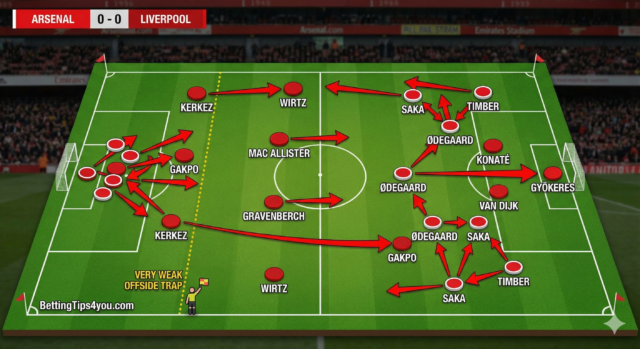
This board visualizes the tactical squeeze: Arsenal controlling territory, specifically overloading the right flank with Saka, Ødegaard, and Timber. Liverpool are poised to counter quickly through Wirtz and Gakpo, but their “very weak” offside trap creates a dangerous vulnerability against Arsenal’s precise through balls and set-piece dominance.
Arsenal’s default way of playing is laid out in blunt terms: they control the game in the opposition’s half, play short passes, lean into possession football, and attempt through balls often. They also attack down the right. That last point is huge here, because it points directly at a likely duel: Bukayo Saka versus Milos Kerkez, with Martin Ødegaard drifting into the right half-space to create triangles and slip passes inside.
If Arsenal set up with Timber at right-back and Saka ahead of him, that flank can become a conveyor belt of territory. Timber’s presence can allow Arsenal to build with security and then underlap or overlap depending on the movement of Ødegaard and Saka. The core idea stays the same: Arsenal want to pin Liverpool back, force Liverpool’s wide defenders to make constant decisions, and then use through balls to break the last line when the moment appears.
Liverpool’s style profile says they also want to control the game in the opposition’s half and play short passes. In other words, Liverpool are not arriving with a blueprint to sit in a 5-4-1 and survive. They want to play. They want to have the ball. They want to build attacks. That is where the chess element comes in: two sides trying to own the same zones.
The key is what happens when one of them cannot. Arsenal’s strengths lean towards chance creation and set-piece dominance. Liverpool’s weaknesses lean towards allowing opponents to create chances and being poor at protecting a lead. That means Arsenal’s best periods could look like repeated waves: win the ball back, recycle possession, force Liverpool to defend set pieces, and keep turning the screw until something breaks.
Liverpool, on the other hand, have two clear weapons that don’t require them to dominate the ball for 90 minutes. One is wing attack — marked very strong — and the other is counter attacks — marked strong. If Arsenal push high to “control the game in the opposition’s half”, Liverpool can look for the first clean forward pass into the space Arsenal leave behind. The presence of Wirtz as a creative attacker, plus the running and ball-carrying of Gravenberch, gives Liverpool the tools to turn a regain into a threat quickly.
That is where Arsenal’s midfield selection becomes the whole story. Declan Rice is Arsenal’s highest-rated league player at 7.33, with four goals and three assists in 18(1) appearances. Zubimendi has made 19(1) appearances and completes passes at 89.5%. Ødegaard is the organiser, and Timber offers athletic cover from the back line. Put those pieces together and Arsenal can defend transitions with structure: one midfielder pressures the ball, one screens the passing lane, and one keeps the shape intact.
Liverpool’s attacking patterns will likely try to stretch Arsenal horizontally. If Gakpo plays from the left, Liverpool can draw Timber and Saliba towards the touchline and try to open channels for underlaps from Wirtz or runs from Jones. On the other side, if the right-back slot is not Bradley, Liverpool still have options to push width and deliver. Liverpool are also strong in aerial duels, with van Dijk winning 5.2 aerials per league match and Konaté at 3.9. That matters for attacking set pieces, but it also matters for long diagonals and second balls — the messy bits of a game that can disrupt a side trying to play neat football.
Then there is the offside factor. Liverpool are marked “very weak” at avoiding offside, and the team offside numbers are striking: Liverpool average 4.56 offsides per match, while Arsenal average 3.13. That has tactical consequences. If Liverpool’s forward line keeps stepping too early, it kills counters before they start and turns promising breaks into frustration. It also gives Arsenal cheap resets: win the ball, squeeze up, catch Liverpool offside, and start again in good field position. In a game where both sides want control, gifting the opponent repeated restarts in their favour is a dangerous habit.
Arsenal’s set-piece angle is the other headline. Arsenal are very strong at attacking set pieces and defending set pieces. Liverpool are weak at defending set pieces. The “match forecast” even leans hard into that theme, stating that Arsenal will score from a set-piece situation and will create many scoring chances. Whatever you think of forecast language, the underlying tactical point is simple: if Arsenal spend long stretches in Liverpool’s half, corners and wide free-kicks become inevitable. Every corner becomes a mini-game: can Liverpool hold their line, win first contact, and clear the second phase — or do Arsenal turn pressure into a goal?
Personnel supports the threat. Gabriel Magalhães has three league goals, and he wins 3.1 aerials per match. Saliba is at 2.4 aerials per match. Rice has four goals from midfield. Even if Arsenal don’t score directly from a header, sustained set-piece pressure creates chaos: loose balls, blocked shots, scrambles, and the kind of ugly moment that decides big games.
In open play, the central duel could hinge on whether Arsenal’s through-ball tendency lands behind Liverpool’s double pivot. Arsenal’s profile says they create chances using through balls at a very strong level. If Ødegaard gets time to receive on the half-turn, and if Saka and Trossard time runs between full-back and centre-back, Arsenal can get to the byline or into the box without needing 30 passes. That is what makes them feel ruthless: not just possession for possession’s sake, but possession with an intent to puncture.
Liverpool’s response, in tactical terms, needs to be compactness and timing. Their weaknesses include stopping opponents from creating chances — marked very weak. In practical terms, that means they can get stretched, lose runners, and allow the opponent to play into dangerous areas too easily. The fix is often boring: keep distances tight, track runners, and win duels. Slot’s own comment about struggling to create chances adds another pressure point: if Liverpool defend deep for long spells and then cannot create enough at the other end, the game becomes a siege.
The Numbers That Support the Story
Arsenal’s season has the clean shape of a dominant team. They are 15-3-2 after 20 matches, scoring 40 and conceding 14, an average of two goals scored per league match and 0.7 conceded. That matters because it turns tactical control into points. Arsenal don’t just keep the ball; they turn matches into predictable outcomes by limiting what the opponent can do.
At home, the picture is even sharper. Arsenal’s home league record is 9 wins, 1 draw, and 0 losses across 10 matches, scoring 26 and conceding 5. That means Arsenal average 2.6 goals scored per home league game and 0.5 conceded. If Liverpool spend the night under pressure, it is because Arsenal create that environment routinely at the Emirates, and opponents rarely escape without conceding.
Liverpool’s league season has been good, but not clean. They are 10-4-6, scoring 32 and conceding 28, which means they concede 1.4 per match on average. Away from home, the numbers are more exposed: 4 wins, 2 draws, 4 losses, scoring 17 and conceding 18 in 10 away matches. That means Liverpool concede 1.8 per away match. In a stadium where Arsenal score freely, that is a hard starting point.
The shot profiles also fit the tactical narrative. Arsenal average 15.2 shots per match in the league, with 5.10 on target, while Liverpool average 15.05 shots per match with 4.20 on target. Arsenal’s shot conversion rate is listed at 13% overall, Liverpool’s at 11%. The difference is not that Liverpool never shoot — they do — it is that Arsenal hit the target more often and finish slightly more efficiently. That matters in a big game, because the margins are often one or two clear looks.
Expected goals adds another layer. Arsenal’s xG for is 1.76 per match and xG against is 0.90, while Liverpool’s xG for is 1.69 and xG against is 1.25. The consequence is blunt: Arsenal create slightly more and allow far less. That aligns with the idea of Arsenal spending long stretches in control and Liverpool having to be sharp, clinical, and disciplined with the moments they do get.
Head-to-head history supports the idea that Liverpool can always make this uncomfortable, even when Arsenal look stronger on paper. Across 46 meetings, Arsenal have won 11, Liverpool have won 15, and 20 have been draws. Arsenal have also lost 26 Premier League games to Liverpool, their most against any opponent, level with Manchester United. That does not decide Thursday night, but it explains why the emotional temperature is higher than a standard “first v fourth” fixture. This opponent has repeatedly found ways to land punches.
There are also smaller statistical tells that can shape the feel of the match. Arsenal score first in 14 of their 20 league matches, while Liverpool score first in 11 of 20. Arsenal’s first-half record is strong at home: in first halves at the Emirates, they have conceded just one goal across 10 matches. That matters for Liverpool because it sets a clear challenge: start fast enough to avoid getting pinned, and stay patient enough not to force the final pass too early.
And then, back to set pieces, because it is impossible to ignore them. Arsenal’s strengths list makes attacking set pieces a defining weapon, and Liverpool’s weaknesses list marks defending set pieces as a soft spot. In practical terms, every free-kick in the channel, every corner, and every long throw into the box becomes a pressure point. Arsenal do not need to dominate every phase to win this match; they can win it by repeatedly landing in the same place and turning that repetition into a goal.
Key “Moments” to Watch
There is a moment early in matches like this when you learn what kind of night it will be: the first time Arsenal build down the right, and Liverpool have to decide whether to engage high or retreat. If Liverpool step up, Arsenal’s through-ball game becomes immediate — Ødegaard receiving, Saka running, and Gyökeres or another central forward trying to attack the space between centre-back and full-back. If Liverpool retreat, Arsenal’s territory becomes suffocating, and the corners start to pile up.
Another moment to watch is Liverpool’s timing on runs behind. Liverpool’s offside numbers are loud, and being very weak at avoiding offside is not a cosmetic flaw. Against a back line featuring Saliba and Gabriel Magalhães, stepping too soon wastes the very transitions Liverpool need. The night can easily become a cycle: Liverpool win it, try to go quickly, get flagged, and then watch Arsenal recycle the ball into their half again. That is not just frustrating — it is physically draining, and it invites the kind of late-game concentration wobble that set-piece monsters feed on.
If Arsenal start Gyökeres, the central wrestling match becomes a story in itself. Konaté and van Dijk are elite aerial presences on paper, and Gyökeres is described as an “occupier” of centre-backs, someone who stays high and tries to create space for teammates. That means Arsenal’s wide play has a clear target. It also means Liverpool’s centre-backs cannot drift. If they get drawn to the ball side too easily, Arsenal can hit that through ball into the far-side channel, and suddenly the game opens.
If Arsenal start Jesus instead, the “moment” shifts from duels to combinations. Liverpool’s weakness at stopping opponents from creating chances becomes more dangerous when the opponent can play one-touch around the box. Jesus floating, linking, and dragging defenders into awkward decisions would feed directly into Arsenal’s short-passing, possession-heavy identity. In that scenario, Liverpool’s midfielders have to be brave enough to track and tackle without leaving gaps.
For Liverpool, the big moments will come on the wings. Their strengths point to wing attacks and counter attacks, and that means Gakpo’s ability to carry and combine, plus the support runners around him, are critical. Liverpool do not need 15 attacks to score; they need two or three clean breaks where the final ball lands. Arsenal’s defensive numbers mean those breaks are rare, so when they appear, Liverpool have to be ruthless.
Set pieces are the most obvious swing factor, and not just in a “corner might go in” way. Arsenal are very strong at defending set pieces too, which means Liverpool could find themselves expending effort to win corners or free-kicks and then getting little back. That has a psychological edge: it tells a side they cannot even lean on the old reliables.
There is also the simple reality of game state. Liverpool are marked weak at protecting the lead. If Liverpool do score first, the next 15 minutes become huge: can they keep structure, slow Arsenal’s momentum, and avoid handing Arsenal a cheap route back through set pieces or long shots? Liverpool are also weak at defending against long shots, while Arsenal are strong at creating long shot opportunities. That specific clash of traits is exactly how you get a big-game equaliser: the defending side sinking too deep, the ball popping out, and someone with clean technique — Rice is a four-goal midfielder this season — stepping onto it.
What could go wrong with this read? Quite a lot, because football is petty and chaotic. Arsenal can dominate territory and still get caught by one clean counter. Liverpool can look blunt for an hour and still produce one devastating sequence when Wirtz finds a pocket and releases Gakpo. A single refereeing decision, a deflection from a long shot, or an early goal that flips the tempo can turn a tactical plan into something unrecognisable. Even a side that “controls the game in the opposition’s half” can spend 20 minutes chasing shadows if the opponent strings three or four brave passes together.
Best Bet for Arsenal vs Liverpool
[bt4y_article_veil]
Arsenal to Win
The data presents a brutal reality for Liverpool: their defensive structure dissolves when they leave Anfield. While Arsenal are an efficient machine at the Emirates—winning nine of ten matches and conceding a microscopic 0.5 goals per game—Liverpool concede an average of 1.8 goals per match on the road. This 1.3-goal swing in defensive solidity between the two sides’ respective home and away profiles is the defining metric of this contest. Arsenal do not just win at home; they suffocate opponents, having conceded only one first-half goal in ten matches at the Emirates. They turn matches into predictable processions.
Tactically, this is a nightmare matchup for the visitors. Arsenal possess a “very strong” rating for attacking set pieces, which directly exploits Liverpool’s “weak” rating for defending them. With Gabriel Magalhães (three goals) and William Saliba dominating the air, every corner or wide free-kick is a high-probability scoring opportunity. Liverpool’s inability to defend dead balls means Arsenal can bypass open-play congestion and simply bully them into submission.
Furthermore, Liverpool’s reliance on transition attacks is fatally undermined by their staggering incompetence at staying onside. They average 4.56 offsides per match—a “very weak” tactical flaw that plays perfectly into the hands of Arsenal’s disciplined high line. Every time Liverpool look to break with Cody Gakpo or Florian Wirtz, they are statistically likely to mistime the run, handing possession immediately back to Arsenal. Arsenal create chances through precise through balls, while Liverpool allow opponents to create chances at will. In a game of territory, the team that keeps the ball and defends the box wins. That team is Arsenal.
What could go wrong Football is rarely played entirely on paper, and Liverpool possess chaos factors that defy structure. Despite their defensive leaks, they remain a potent threat on the break with strong wing play. If Arsenal’s high line gets its timing slightly wrong just once, the pace of Liverpool’s front line can undo 80 minutes of dominance. Additionally, the psychological weight of history—Liverpool have won 15 of 46 meetings and won the reverse fixture—could induce anxiety if Arsenal fail to score early.
Correct score lean
Arsenal 2-0 Arsenal’s home defense is the best in the league, allowing just five goals all season at the Emirates. Liverpool are “struggling to create a lot of chances” by Arne Slot’s own admission. Combined with Arsenal’s average of 2.6 goals scored per home game, a disciplined, multi-goal clean sheet is the logical outcome of these converging trends.
Free BT4Y Tipster Account Create your free BT4Y account, build your tipping record and compete with other football tipsters. New verified accounts also unlock 3 FREE Medium Stakes Premium tips.Join the competition. Get 3 FREE Premium Tips.
Join Free & Claim 3 Tips
Selected Bookmakers Offers
[ninja_table_builder id=”419877″]