


bet365

BetMGM

William Hill

Betfred

BetUK

LiveScoreBet

10Bet

Virgin Bet
Can Manchester United reinvent their attack without Bruno Fernandes against Newcastle?
Boxing Day at Old Trafford rarely needs selling, but this one has its own edge. Read on for complete analysis and the best betting tips.


To use the Live Streaming service you will need to be logged in and have a funded account or to have placed a bet in the last 24 hours. Geo location and live streaming rules apply.
Global Video Listings for this match
Works worldwide • Email + on-site access • Instant unlock
▾
City average 2.14 goals/game and face a United defense conceding 1.52/game. United's open style invites transition attacks, favoring a high-scoring City win.
▾
Matches statistical averages: City's high output vs United's leaky defense, with United's high shot volume earning a consolation goal.
▾
Readers’ Tip
Vote your pick — quick & anonymous
Terms & Conditions (tap to view)
Manchester United vs Newcastle Predictions and Best Bets
Man Utd vs Newcastle — bet365 Market Snapshot
Swipe through key markets with illustrative probabilities and sample bet365 odds based on our match analysis.
Bookmakers see this as an incredibly tight contest, with United slight favourites at Old Trafford but Newcastle right in the mix.
The 1–1 draw is the shortest priced outcome, followed by 2–1 wins for either side, suggesting a competitive game with goals.
The markets are leaning heavily towards action, with BTTS Yes and Over 2.5 Goals trading at very short prices.
Zirkzee is priced to threaten the Newcastle goal, while Anthony Gordon is expected to draw plenty of attention from the United defence.
- United’s matches have been loud this season: they average 16.53 shots and 1.82 goals per game, but concede 1.65 goals and keep clean sheets in just 6%.
- Newcastle’s away profile hints at why game-state matters: they score 0.88 goals per away match and take 102 minutes per away goal, yet still concede only 1.25 goals.
- The scorers left behind change the attack’s shape: United’s top scorers include Mbeumo (6) and Fernandes (5), while Newcastle’s Woltemade leads his side with 8 and just scored twice vs Chelsea.
Check out our Manchester United betting hub for the latest deep-dive stats, trends, and expert predictions for the 2025/26 season.
Match Tempo: Average Goals per League Game
United’s matches have been exceptionally open this season, averaging nearly 3.5 goals per game, while Newcastle have been involved in slightly tighter affairs.
With 31 goals scored and 28 conceded in just 17 games, United’s fixtures rarely lack action at either end of the pitch.
The Magpies have kept things tighter, with a goal difference of just +1 reflecting a more pragmatic approach on the road.
Defensive Stability: Goals Conceded per Game
A clear contrast in defensive reliability, with Newcastle performing significantly better at the back compared to United’s porous backline.
Conceding nearly two goals per game highlights the defensive fragility that has plagued their campaign so far.
Eddie Howe’s side has remained relatively organized, conceding five fewer goals than their opponents despite playing the same number of games.
Manchester United host Newcastle United in a Premier League meeting that arrives with both sides carrying a bit of emotional luggage from the week just gone. United come into it off two frustrating outcomes: a 4-4 draw with Bournemouth, followed by a 2-1 defeat at Aston Villa. Newcastle, meanwhile, have just let a lead slip in a 2-2 home draw with Chelsea, a game that still managed to underline a growing connection between their record signing and the crowd.
For Ruben Amorim, it’s the kind of fixture that can either steady a wobble or amplify it. United haven’t won at home since October, and there’s a very specific problem to solve this time: Bruno Fernandes won’t feature after pulling up against Villa and being replaced at half-time. Amorim has described it as a soft tissue injury and said his captain will miss “some games”. Whatever United were planning for this match, it isn’t that.
Newcastle, for their part, travel with a manager who is publicly refusing to be seduced by recent history. Eddie Howe has been clear that his team’s good run against United “counts for nothing” and that his process remains the same: highlight weaknesses, protect your own. It’s a tidy soundbite, but it also rings true because the match in front of them is different to the ones behind them. United at Old Trafford, under a new coach trying to reshape habits, is not the same test as a United side still playing on instinct.
And yet, history does hang around the corridors. Newcastle have won five of their last six games in all competitions against United and four of the last five Premier League meetings since losing 2-0 in the 2023 League Cup final. That’s not a prediction; it’s pressure. For United, it’s the reminder that this opponent has increasingly enjoyed this match-up. For Newcastle, it’s the temptation to think it’ll all happen again.
It probably won’t. It never does in quite the same way. Especially not with Fernandes missing, and with United likely needing to build a functional attacking rhythm from a different reference point. The intrigue here isn’t just who plays. It’s how both sides react when the game demands something slightly uncomfortable: when United need to create without their conductor, and when Newcastle have to prove their process really is independent of the badges on the shirts.
Team News and Likely Set-Ups
United’s headline is unavoidable: Fernandes is out, with a suspected hamstring issue and a broader description of soft tissue damage. The knock-on effect is bigger than losing a name on the team-sheet. It’s about what Fernandes normally provides — direction, risk, tempo — and how Amorim replaces those functions rather than simply replacing the player.
A predicted United XI has Senne Lammens in goal, with a back three of Leny Yoro, Ayden Heaven and Luke Shaw. The wing-backs are expected to be Diogo Dalot on the right and Patrick Dorgu on the left. Dorgu’s case is helped by his recent assist and a strong showing at Villa, while Dalot is described as the clear option on the opposite flank with Noussair Mazraoui away at the Africa Cup of Nations.
William Hill
Bet £10 Get £30 In Free Bets
Show Terms & Conditions
BetMGM
Bet £10 Get £40 In Free Bets
Show Terms & Conditions
bet365
Bet £10 Get £30 In Free Bets
Betfred
Bet £10 Get £50 In Free Bets
Show Terms & Conditions
10bet
100% Up To £50 On First Deposit
Show Terms & Conditions
The central midfield picture is where the Fernandes injury turns from inconvenience into a genuine tactical fork in the road. One suggestion is a pairing of Manuel Ugarte with Lisandro Martinez, a combination that was used in the second half at Villa Park and described as impressive. Martinez, still returning from a long-term knee injury and not having started a game since February, is an “option” rather than a certainty. If Amorim wants a more orthodox selection, Casemiro is available again after serving a one-match suspension.
Further forward, the likely front trio is Mason Mount, Matheus Cunha and Benjamin Šeško. Mount is credited with playing consistently well for weeks, and his work off the ball is framed as vital against Newcastle. Cunha is characterised as the only real goal threat in the United ranks with both Bryan Mbeumo and Fernandes missing. Šeško is still settling and hasn’t scored since the start of October, but Joshua Zirkzee is noted as being in no better form — and the indication is that Amorim prefers the Slovenian at the moment.
There are also broader availability constraints that shape the feel of this United side. Alongside Fernandes, Kobbie Mainoo is discussed as having a calf injury and being likely to miss out again. Harry Maguire and Matthijs de Ligt are both mentioned as potentially needing to be ready to return from injury to alter the expected back three, but the default assumption is that they are not.
Newcastle’s team news is less about a list of absentees and more about a specific attacking focal point. Nick Woltemade scored both goals in that 2-2 draw with Chelsea, and Howe went out of his way to praise his first-half performance: his link play, the way he dropped a little deeper to help build through the thirds, and then his presence when the ball arrived in the box. That description matters because it tells you how Newcastle can play in different phases: not simply hitting the penalty area early, but using their striker to knit attacks together.
Beyond that, the names available elsewhere in Newcastle’s squad are present across their season-leading contributors: Bruno Guimarães, Harvey Barnes, Anthony Gordon, Jacob Murphy, Sven Botman, Will Osula, Malick Thiaw, Dan Burn, Sandro Tonali, Lewis Miley, Anthony Elanga, Joelinton, Nick Pope and even Kieran Trippier appearing in a “man of the match” vote. It’s a deep cast list, but without a confirmed XI it’s the patterns and roles that become the guide.
How the Match Could Be Played
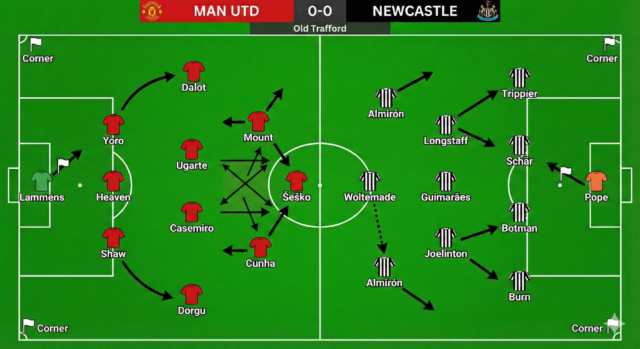
The first tactical question is simple: what does United’s build-up look like without Fernandes? The predicted shape implies Amorim sticks with the three centre-backs and wing-backs, and that alone creates a certain geometry. Yoro, Heaven and Shaw give you three points to circulate the ball, and Dalot and Dorgu offer the width to stretch Newcastle horizontally. That’s the “in possession” skeleton.
But skeletons don’t win football matches. The muscle is in midfield, and this is where Amorim’s choice between Casemiro and Martinez — and the way he uses Mount — becomes a story in itself.
If Casemiro partners Ugarte, United likely lean into a more familiar double-pivot feel: security, coverage, and the ability to hold central zones when attacks break down. That matters because United’s weaknesses include defending counter-attacks and protecting the lead, which suggests that game-state management can get messy if they commit too many bodies ahead of the ball. A Casemiro-Ugarte pairing reads like a coach trying to reduce chaos.
If Martinez steps in alongside Ugarte, it implies a different kind of control: recycling possession, reading the game, maintaining structure. That’s explicitly what’s said about him as a midfield option, and it fits a version of United trying to play through pressure rather than around it. The trade-off is obvious too: Martinez would not offer Fernandes’ creativity, so the chance creation needs to come from different lanes — wing-backs, Mount’s movement, Cunha receiving between lines, and perhaps the timing of Šeško’s runs.
Then there’s Mount. He’s been starting Premier League games in a run and is praised for pressing and consistent form. There is also the idea of him dropping deeper, because he has experience in that role and could be a foil for a “far less mobile Casemiro”. This is one of those selection details that could change the match’s tone. If Mount stays high, he can lead the press, arrive around the box, and help United hunt second balls. If Mount drops, he becomes a connective player, making up for the missing captain by helping the ball travel cleanly into attacking areas.
Against Newcastle, the pressing story matters. Newcastle’s style includes playing with width, attacking down the right, attempting crosses often, and taking long shots. If United press with a front three, they can try to force Newcastle into hurried wide deliveries — which then tests United’s own defensive vulnerabilities around set pieces. United are described as strong at attacking set pieces but weak defending them. Newcastle are strong at attacking set pieces, strong in aerial duels, and strong at defending set pieces. That’s a thematic clash: one team can see a dead-ball as an opportunity but also as a threat; the other seems comfortable living in those moments.
In open play, the key zones likely live on the flanks and in the half-spaces just inside them. Newcastle’s width means Dalot and Dorgu are not just attackers; they’re also firefighters. Push too high, and you risk leaving your outside centre-backs exposed in wide channels. Keep them too deep, and you lose one of your primary sources of chance creation. That tension is baked into wing-back football, and it’s sharper when you’re missing your main creative midfielder.
That’s why Cunha becomes so important. He’s framed as United’s only real goal threat in the current context, and he’s also the kind of player who can turn a slightly sterile build-up into something more direct: a carry, a quick wall pass, an early shot. Newcastle’s stated weakness includes defending counter-attacks being “very weak” and protecting the lead being “very weak”. That doesn’t automatically mean the game becomes a track meet, but it suggests that when Newcastle lose the ball with full-backs and midfielders committed, there can be a moment to attack quickly — especially if Mount’s off-ball work creates a turnover high up the pitch.
Newcastle’s attacking description of Woltemade offers a blueprint for how they can blunt a press. If he drops slightly lower, links play, and helps build through the thirds, he can create a spare man around United’s midfield line. That can pull one of United’s centre-backs forward — and that’s where the wide attackers or advancing midfielders can run into the space behind. In theory, it can also lure Casemiro or Ugarte into stepping out, which then tests the distances between United’s lines.
There’s also an emotional tempo question. United are at home, trying to break a run without a home win since October, and they’ve just been involved in a 4-4 and then a narrow defeat. Newcastle have shown they can score quickly and they can also concede late — their goal timings include a heavy share of conceded goals in the 81’–90’ bracket. United’s conceded-goal timings also show a spike late on. That sets up a match where the final 20 minutes could feel like a second game entirely, with structure fraying and the bench — if used — becoming crucial, even if the available names aren’t spelled out.
The tactical read, then, isn’t “one team will dominate”. It’s more like this: United will try to control possession and territory, pushing wing-backs high and creating lots of shooting situations, while Newcastle will try to use width, crossing patterns, and set pieces to turn phases of pressure into clear chances. Without Fernandes, United’s chance creation may tilt away from the centre and toward the wings. Newcastle’s game can live with that — but it also invites United to shoot from range, something United are described as very strong at creating.
The Numbers That Support the Story
United’s season profile in the league paints a team that generates volume and drama. They average 16.53 shots per match, with 5.71 on target, and an xG for of 1.82 per match. That measures shot quality and quantity rolled into one, and it suggests United usually create enough opportunities to score. They also average 1.82 goals scored per match, which aligns with that underlying chance creation.
The problem is the other end. United concede 1.65 goals per match, have kept clean sheets in just 6% of league games, and concede a goal every 55 minutes on average. Those numbers matter because they support the idea that even if United control the ball, it doesn’t necessarily translate into control of danger. Teams can still hurt them — in transition, in set-piece moments, or simply by forcing mistakes in the wrong zones.
Newcastle’s profile is different but complementary to the kind of match this could become. They average 12.12 shots per match and an xG for of 1.48, scoring 1.35 goals per match. That’s not the same shot volume as United, but it does point to a team capable of creating enough to be a threat in a big away game, especially if their attacking set pieces and aerial strengths come into play.
Defensively, Newcastle concede 1.29 goals per match and have kept clean sheets in 29% of games. That’s a more stable baseline than United’s, and it matters if United’s attack is having to reinvent itself without Fernandes. If United end up relying on wing-back delivery and second-phase shots, Newcastle’s ability to defend set pieces and manage aerial situations becomes central.
There’s also a striking contrast in where Newcastle score. Their away scoring average is 0.88 goals per match, with a minutes-per-goal figure of 102 away from home. That’s a blunt measure of how long it tends to take them to find the net on the road, and it hints at why United might still feel they can dictate the match early — especially with Old Trafford wanting a fast start.
Individual numbers add a bit of flavour to the tactical talk. For United, Mbeumo is listed as top scorer with 6 and Fernandes has 5, but both are unavailable for this match; that frames why Cunha being on 3 goals and Mount on 3 becomes more significant. Casemiro on 4 is also telling: if a deeper midfielder is among your leading scorers, it suggests goals can come from late runs, second balls, or set pieces rather than only from the front line. Dorgu being credited with 2 assists also supports the idea that the left wing-back lane could be a creative outlet.
For Newcastle, Woltemade leads with 8 goals and has just scored twice against Chelsea, which supports Howe’s confidence in him as both finisher and connector. Bruno Guimarães has 5 goals and is among the assist leaders too, which matters because midfield contribution can be the difference in games where the opposition tries to lock down your forward line.
Finally, the broader table context is explicit: United are 7th and Newcastle are 11th, with United on 26 points and Newcastle on 23 after 17 matches. That doesn’t decide anything on its own, but it does underline why this match feels like a pivot point in the season’s middle stretch: there isn’t a canyon between them, just a few results’ worth of separation.
Key “Moments” to Watch
This match could swing on small, repeatable moments rather than one grand tactical masterstroke.
One is the first 15 minutes after United lose the ball. Without Fernandes, United may have fewer tidy solutions when an attack breaks down. If Mount stays high, he can help lead a counter-press, but if the press is bypassed, Newcastle’s width and crossing tendencies can quickly turn into territory. Those are the moments when a wing-back is caught between stepping out and dropping, and when an outside centre-back is asked to defend space rather than a man.
Another is the battle over set-piece phases. United have strength attacking set pieces but are weak defending them, while Newcastle are strong on both attacking and defending set pieces and strong in aerial duels. That doesn’t mean every corner becomes a crisis, but it does mean each dead-ball is a potential momentum swing. The crowd’s mood on Boxing Day can turn on two or three of those moments: a free header cleared, a second ball won, a near-post flick that forces a save. It’s not glamorous, but it’s decisive.
Watch, too, how Newcastle use Woltemade. Howe’s description of him dropping slightly lower to help build through the thirds is a clue: if he pins a centre-back and then steps off into midfield space, he can create dilemmas. Does a centre-back follow him and open space behind, or does a midfielder step up and risk leaving a gap? United’s selection in midfield will heavily influence how they answer that question. Casemiro brings experience and bite; Martinez brings structure and passing rhythm; Ugarte brings running and duels, but is also described as having struggled at Villa. Those are different solutions to the same problem.
At the other end, the “chance economy” for United is crucial. With Fernandes, you expect a certain volume of final-third deliveries and risk-taking passes. Without him, United may need to be more deliberate: use Dalot and Dorgu high, encourage Cunha to receive in pockets, and ask Šeško to occupy centre-backs to create space for Mount to arrive late. If Šeško is still finding his feet and hasn’t scored since the start of October, the timing of his movement matters even more than the finishing. A striker can shape a match without scoring if he drags defenders into the wrong places and creates lanes for others.
Then there’s discipline and control. Casemiro is listed with 7 cards, Dorgu with 4, and Newcastle’s Dan Burn has 5 with Bruno Guimarães on 4. In a game that can tilt into transitions and set-piece scraps, those are the players who may find themselves walking the tightrope: one late tackle because a press is bypassed, one cynical tug because a runner is away, one collision at a dead-ball that winds everyone up.
What could go wrong with this read? Plenty. A game shaped around structure and zones can be flipped by one moment of poor decision-making, a slip in build-up, or a deflection that changes the rhythm. United’s recent scorelines show they can be dragged into chaotic matches; Newcastle’s recent outcomes show they can both score freely and concede late. If the early phase becomes ragged, the tactical plan can quickly turn into survival football — and then you’re left with fine margins, second balls, and who keeps their nerve in the final half-hour.
Best Bet for Manchester United vs Newcastle
[bt4y_article_veil]
Both Teams to Score — Yes
The case for goals at both ends at Old Trafford is built on Manchester United’s inability to control defensive situations rather than their attacking brilliance. United’s season profile is defined by chaos: they concede an average of 1.65 goals per match and have managed to keep clean sheets in just 6% of their league fixtures. That defensive fragility is structural, with the team conceding a goal every 55 minutes on average. Even when they dominate possession, they remain vulnerable to transitions and set pieces—two specific areas where Newcastle are described as strong.
On the attacking front, despite the absence of Bruno Fernandes and top scorer Bryan Mbeumo, United still generate significant volume. They average 16.53 shots and 1.82 goals per game. The expected wing-back system, utilizing Diogo Dalot and Patrick Dorgu, offers width to create shooting opportunities, and Matheus Cunha is identified as a potent threat capable of creating moments out of nothing. United have enough firepower to breach a Newcastle defence that has conceded late goals frequently and is coming off a 2-2 draw.
Newcastle’s away scoring record is modest (0.88 goals per match), but United’s specific weaknesses offer them a lifeline. Newcastle are strong at attacking set pieces and aerial duels, while United are explicitly weak at defending them. With Nick Woltemade in form after a brace against Chelsea and capable of linking play to pull defenders out of position, the visitors have the tools to exploit United’s open spaces. The statistical reality of United’s season—high shots, high goals conceded, and almost zero clean sheets—makes backing both sides to find the net the most logical angle.
What could go wrong: The primary risk is United’s creativity drying up completely without Fernandes. If they cannot transition the ball effectively to Cunha or Mason Mount, they might dominate sterile possession without scoring. Conversely, Newcastle’s low away scoring average (taking 102 minutes to score on the road) could mean they fail to capitalize even if United are generous defensively.
Correct Score Lean Draw 1-1 While United concede frequently, they are also at home and desperate to break a winless run. However, missing their primary creator and top scorer limits their ceiling. Newcastle have shown resilience but lack consistent goal output away from home. A score draw aligns with United’s tendency to be involved in tight, high-stress finishes and Newcastle’s recent 2-2 result. With both teams showing a spike in goals conceded in the final 20 minutes, a late equalizer to level the game at 1-1 is a plausible narrative.
Selected Bookmakers Offers
| |
New customers: Deposit £10+ in 7 days & bet on sports. Min odds apply. Reward = 4 x £10 Free Bets (2 x £10 Bet Builders & 2 x £10 Sports Bet). Valid 7 days. Free bets not valid on eSports and non-UK/IE horse racing. 18+. T&Cs apply. | |
| |
Open Account Offer - New Customers only. Bet £10 and get £30 in Free Bets when you join bet365. Sign up, deposit between £5 and £10 to your account and bet365 will give you three times that value in Free Bets when you place qualifying bets to the same value settle. Free Bets are paid as Bet Credits. Min odds/bet and payment method exclusions apply. Returns exclude Bet Credits stake. T&Cs , time limits & exclusions apply. Registration Required. #Ad. 18+ Only, gambleaware.org | |
 | |
18+. Play Safe. From 00:01 on 18.10.2022. £30 bonus. New customers only. Minimum £10 stake on odds of 1/2 (1.5) or greater on sportsbook (excluding Virtual markets). Further terms apply. #Ad. 18+Only, gambleaware.org | |
| |
New customers only. Register, deposit with Debit Card, and place first bet £10+ at Evens (2.0)+ on Sports within 7 days to get 3 x £10 in Sports Free Bets & 2 x £10 in Acca Free Bets within 10 hours of settlement. 7-day expiry. Eligibility & payment exclusions apply. T&Cs Apply. | |
| |
New cust only. Opt-in required. Deposit & place a bet within 7 days and settle a £10 minimum bet at odds of 4/5 (1.8) or greater to be credited with 3 x £10 Free Bets: 1 x £10 horse racing, 1 x £10 Free Bet Builder and 1 x £10 football. Free Bets cannot be used on e-sports and non-UK/IE horse racing. 7 day expiry. Stake not returned. 18+. T&Cs apply. Acca Club: Available to new & existing customers. 3 or more selections. Min Odds: 3/10 (1.3) per leg. Max stake: £500. Max Winnings: £200,000 per boost. Profit Boost amounts vary. Horse Racing, Greyhounds & Trotting excluded. Exclusions apply. Full T&C’s apply. 18+ GambleAware.org. | |
 | |
New members only. £10+ bet on sports (ex. Virtuals) 1.5 min odds, settled within 14 days. Free Bets: accept in 7 days, valid 7 days; £20 use on sportsbook, £10 on Bet Builder. Stake not returned. T&Cs.+ deposit exclusions apply #Ad. 18+Only, gambleaware.org | |
| |
New bettors. Select bonus at signup or use code SPORT. Wager deposit & bonus 8x. Max qualifying bet = bonus. Valid 60 days. Odds, bet & payment limits apply. T&Cs Apply; 18+ | Please gamble responsibly #Ad. 18+Only, gambleaware.org | |
 | |
New customers only, 18+. Min deposit £10. Place a £50 bet on any sport at 2.0+ to qualify for £25 in free bets and 10 Free Spins. Free Bets and Spins valid 7 days. £0.10 Free Spins. T&Cs apply. Please bet responsibly. #Ad. 18+Only, gambleaware.org | |
| |
New members only. £10 min deposit & bet on sportsbook (ex. virtuals), placed & settled at 1.5 min odds in 14 days of sign-up. Win part of E/W bets. Free Bets: accept in 7 days, valid 7 days, use on sportsbook only (ex. virtuals), stakes not returned. T&Cs Apply and deposit exclusions apply. Please gamble responsibly #Ad. 18+Only, gambleaware.org | |
 | |
18+ New customers only. Opt in, and bet £10 on football markets (odds 2.00+). No cash out. Get 6x£5 football free bets at specified odds for set markets, which expire after 7 days. Offer valid from 12:00 UK Time on 25/08/2023. Card payments only. T&Cs Apply | gambleaware.org | Please gamble responsibly #Ad. 18+Only, gambleaware.org | |