


bet365

BetMGM

William Hill

Betfred

BetUK

LiveScoreBet

10Bet

Virgin Bet
Can Palace’s chance-creation finally meet the moment against Tottenham’s wide threat at Selhurst Park?
Two London sides with a bit of a wobble meet under the Selhurst Park lights on Sunday, and neither will fancy turning up with the mood of a team collecting a third straight Premier League defeat. Read on for complete analysis and the best betting tips.


To use the Live Streaming service you will need to be logged in and have a funded account or to have placed a bet in the last 24 hours. Geo location and live streaming rules apply.
Global Video Listings for this match
Works worldwide • Email + on-site access • Instant unlock
▾
The data strongly supports a game with at least three goals. Tottenham’s last seven away league fixtures have all cleared the 2.5 goal line, highlighting their open style of play on the road. Palace are creating a high volume of chances (13.5 shots per game), while Spurs are prone to individual errors that gift opportunities. Conversely, Spurs are strong finishers and strong at set pieces, attacking a Palace weakness. With both teams struggling to keep possession and playing risky offside traps, the tactical setup favors goal-scoring chances over defensive rigidity.
▾
Both teams have shown a recent propensity for high-scoring draws (Palace vs. KuPS, Spurs vs. Newcastle). Palace rarely lose at home (unbeaten in 17/20), but their defense is conceding over a goal a game. Tottenham score freely (26 goals) but concede almost as many (23). Given Spurs' vulnerability to individual errors and Palace’s set-piece weakness, both sides are likely to find the net multiple times without finding the quality to secure a win, making a 2-2 split a value selection.
▾
Readers’ Tip
Vote your pick — quick & anonymous
Terms & Conditions (tap to view)
Crystal Palace vs Tottenham Hotspur Predictions and Best Bets
Crystal Palace vs Tottenham — bet365 Market Snapshot
Swipe through key markets with illustrative probabilities and sample bet365 odds based on our match analysis.
Palace’s strong home record sees them priced as favourites, though the odds suggest a competitive and possibly unpredictable London derby.
Pricing leans towards a 1-1 draw, but a 1-0 or 2-1 Palace win are also seen as distinct possibilities in this clash.
Markets suggest a high probability of goals, with BTTS Yes and Over 2.5 Goals both priced as likely outcomes.
Mateta is the clear favourite to score for Palace, with Richarlison leading the line for Spurs in terms of goal threat.
- Palace’s shot volume is huge: 378 total shots across their played matches at 13.5 per game, compared to Tottenham’s 266 at 10.64, shaping how pressure might build.
- The league numbers show fine margins: Palace are eighth with 26 points and a 21-19 goal record, while Tottenham are 14th with 22 points and 26-23, hinting at different routes to results.
- Discipline and game control could matter: Tottenham have 3 red cards and average 2.44 yellows per game, while Palace have 1 red and average 1.68, suggesting Spurs games can tilt on composure.
Attacking Intent: Shots Per Match
Despite their lower league position, Palace are consistently generating more shooting opportunities than Spurs, a key metric for this matchup.
Generating 378 shots so far, Palace are aggressive in creating chances, even if finishing has been an issue.
Spurs shoot less often but convert better, relying on quality over quantity in the final third.
Goals: Scored vs Conceded
Both teams have conceded nearly as many as they have scored, hinting at defensive vulnerabilities on both sides.
A tight record reflects their season: solid enough to be mid-table, but not dominant at either end.
Spurs are involved in higher-scoring games generally, scoring more but also leaking more goals than their hosts.
Discipline: Cards & Fouls
Tottenham’s aggressive style has led to a poorer disciplinary record, something that could be a factor in a heated derby.
With 3 reds already this season, Spurs’ discipline under pressure is a clear area of concern.
Crystal Palace and Tottenham Hotspur don’t need extra spice for this fixture — the place provides it — but the current context adds a sharpened edge.
Palace arrive off a draining EFL Cup night at Arsenal that ended level at 1-1 before a penalty-shootout defeat. Tottenham’s most recent outing was a 2-1 loss to Liverpool in which they finished with nine men, the sort of afternoon that can leave you with both bruises and a lingering sense of “what if?”
In the league, the table says Palace are eighth with 26 points from 17 matches, while Tottenham are 14th with 22. It’s not a canyon, but it’s enough of a gap to change the emotional temperature: Palace have a chance to keep nudging upward, Spurs are trying to stop the ground from feeling like it’s shifting under their feet.
The recent sequences tell you why this is tricky. Palace’s last six across competitions include a 4-1 defeat at Leeds United, a 0-3 home loss to Manchester City, a 2-2 home draw with KuPS, and that 1-1 at Arsenal in the cup. Tottenham’s last six include defeats to Fulham (1-2), Nottingham Forest (3-0) and Liverpool (1-2), with wins over Brentford (2-0) and Slavia Prague (3-0), plus a 2-2 draw at Newcastle United in between. In other words: neither side is stuck in permanent misery, but both are capable of dropping a clanger.
What makes this clash particularly fascinating is that the broad profiles hint at a match of competing contradictions. Palace are marked out as very strong at creating chances and strong at stealing the ball, yet also weak at finishing those chances, keeping possession, and defending set pieces. Tottenham, meanwhile, are strong at finishing scoring chances, strong down the wings, and strong at defending set pieces — but very weak at avoiding individual errors and very weak at defending against skilful players. Put that together and you can almost hear the football gods warming up their finest “you thought you knew how this would go” grin.
Team News and Likely Set-Ups
Oliver Glasner has offered a calm update on Jean-Philippe Mateta’s knee issue, insisting he is “coping really well” and that there is “no risk at all.” The tone there is reassuring, and it matters because Mateta is not just Palace’s reference point; he’s their leading league scorer with seven goals, and he appears in the possible starting XI too.
That possible Palace line-up is: Henderson; Canvot, Lacroix, Guehi; Clyne, Wharton, Hughes, Mitchell; Pino, Devenny; Mateta.
William Hill
Bet £10 Get £30 In Free Bets
Show Terms & Conditions
BetMGM
Bet £10 Get £40 In Free Bets
Show Terms & Conditions
bet365
Bet £10 Get £30 In Free Bets
Betfred
Bet £10 Get £50 In Free Bets
Show Terms & Conditions
10bet
100% Up To £50 On First Deposit
Show Terms & Conditions
On paper, it reads as a back three with wing-backs — a shape Palace have leaned on plenty, with their 3-4-2-1 listed as their Premier League formation in 15 matches, producing 18 goals scored and 18 conceded. Marc Guéhi and Maxence Lacroix are regulars in the back line, and Jaydee Canvot’s inclusion suggests a youthful presence alongside them. Tyrick Mitchell and Nathaniel Clyne as the wide outlets would make the flanks key lanes for both defending and breaking out. In midfield, Adam Wharton and Will Hughes points to a pairing tasked with managing Palace’s rhythm, competing for second balls and trying to feed the two players underneath Mateta.
The two behind the striker in this possible XI are Yéremy Pino and Justin Devenny. Pino’s role is especially intriguing because he’s among the players highlighted in Palace’s formation summary, and he also features as one of their more prominent attacking pieces in the squad list. Mateta, though, remains the focal point, and not just in name: Palace’s aerial numbers show he contributes there too, with 2.4 aerials won per match listed among their top five.
For Tottenham, Thomas Frank’s pre-match message is simple: “team news is the same as before the Liverpool game, everyone available then is available” for Selhurst Park. That’s the kind of sentence managers love delivering because it stops the conversation dead — and, by extension, it suggests Spurs won’t be springing any unexpected absences that alter their approach at the last minute.
Frank also said he would be “very happy” to welcome Dominic Solanke and Dejan Kulusevski back, but there are “still no dates” for them. The implication is that the return is anticipated rather than imminent, and there’s nothing else in the material indicating either will feature here.
A possible Tottenham line-up is: Vicario; Porro, Danso, Van de Ven, Spence; Gray, Bentancur; Kudus, Bergvall, Kolo Muani; Richarlison.
That reads as a 4-2-3-1, which aligns with Tottenham’s Premier League formations summary: 4-2-3-1 used nine times, with 13 scored and 12 conceded and a balanced win-draw-loss spread (3-3-3). It also fits their stylistic identity: playing with width, attempting crosses often, and generally taking an aggressive stance.
The big personnel notes are the spine and the speed. Guglielmo Vicario behind a back four that includes Pedro Porro and Djed Spence gives Tottenham energy in wide areas. Kevin Danso and Micky van de Ven in the centre looks like a partnership chosen for mobility, and Van de Ven has been right at the centre of the week’s conversation, with Frank defending him strongly after Liverpool manager Arne Slot described a challenge as “reckless.” Frank’s framing was that Van de Ven was sprinting back in transition, doing everything he can to block a shot, and that the two players had “sorted it out,” a detail that suggests Spurs won’t be treating the incident as a lasting distraction.
In midfield, Archie Gray and Rodrigo Bentancur form a double pivot in the possible XI. Ahead of them, Tottenham’s creativity and punch appear to come from Mohammed Kudus, Lucas Bergvall and Randal Kolo Muani supporting Richarlison. Kudus, in particular, stands out as Tottenham’s leading assister in the league with five, and he’s also Tottenham’s top-rated player in the “Top Players” list, narrowly ahead of João Palhinha and Cristian Romero.
How the Match Could Be Played
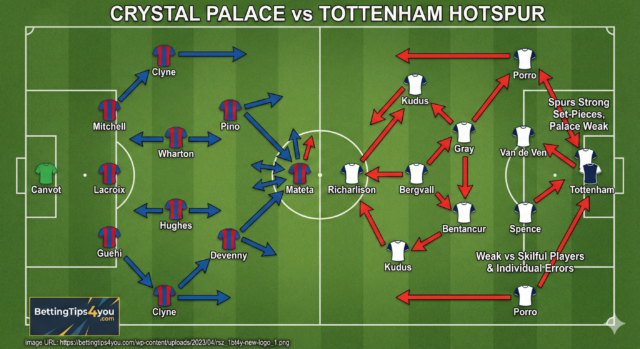
This board visualizes the clash of styles: Tottenham (white) push full-backs Porro and Spence high to overload wide areas, leaving space behind. Palace (blue) look to exploit this via direct counters to Mateta, while Pino and Devenny operate in the pockets to punish Spurs’ aggressive high line.
The first tactical question is the shape battle: Palace’s likely back three and wing-backs versus Tottenham’s wide-first 4-2-3-1.
Palace’s 3-4-2-1 can do a few useful things against a team that wants to play with width. It can match up naturally on the outside: wing-back to winger, outside centre-back ready to slide across, and a spare centre-back protecting the box. If Palace get their distances right, they can funnel Spurs into crosses from less dangerous zones — and Tottenham do like to cross often.
But there’s a catch: Palace are also listed as weak at defending set pieces. Against a Tottenham side marked as strong at defending set pieces and strong at protecting the lead, you can read a subtext. Spurs will be happy to play the game in phases where they win territory, deliver into the box, and force Palace into anxious clearances and cheap fouls. Palace are also listed as weak at avoiding fouling in dangerous areas, which is precisely the kind of weakness that turns a tidy defensive plan into 90 minutes of nerves.
This is where Frank’s comments about Tottenham’s defensive mentality matter too. He spoke about defenders doing “everything” to avoid conceding, and he framed transition defending as a sprint-and-block business. That suggests Spurs will accept moments of chaos — and with Spurs described as very weak at avoiding individual errors, chaos is never far away. The match may become less about who controls possession and more about who survives the messy passages without gifting a chance.
Palace, notably, are also labelled as non-aggressive and as a side playing in their own half, but with a very strong capacity to create chances and a habit of attempting through balls often. That combination hints at a team that can sit off, draw you in, and then try to play quickly into the spaces you leave. Tottenham’s “defending against skilful players” is labelled very weak, which makes the spaces behind Porro and Spence particularly important. If Palace’s two “tens” — Pino and Devenny in the possible XI — can receive on the half-turn and feed Mateta early, you can imagine Spurs’ back line getting pulled into uncomfortable angles.
The most obvious Palace route is direct-to-Mateta with runners underneath. Palace’s style includes long balls, and Mateta’s role in the air is supported by his place among Palace’s aerial duel contributors. If Palace go long early, it isn’t necessarily a sign of panic; it can be a deliberate way to bypass Tottenham’s double pivot and start attacking second balls around the edge of the box. In that scenario, Wharton and Hughes aren’t just passers — they become sweepers of loose balls, trying to keep Palace high enough to mount sustained pressure.
Tottenham, however, are described as very strong at stealing the ball from the opposition, and Palace are described as weak at keeping possession. That’s the recipe for Tottenham’s best spell: Palace try to build, Spurs nip in, and suddenly Kudus, Bergvall or Kolo Muani are running at a back line that is retreating rather than set. Richarlison’s league output adds an extra layer: he has seven Premier League goals, the same as Mateta, and Tottenham’s strengths include finishing scoring chances. If Spurs can win the ball in advanced areas, they have the profile of a side capable of turning one good transition into a goal.
The wide areas, though, are still likely to be the most repeated battleground. Tottenham are described as strong at attacking down the wings and playing with width, while Palace’s 3-4-2-1 can be stressed if wing-backs are pinned deep. If Porro and Spence push high, Palace’s wing-backs may be forced into a purely defensive role, which changes Palace’s ability to break out. That in turn increases the importance of the two behind Mateta: if Palace can’t get out via the flanks, they need to connect centrally, and that’s where Tottenham’s ball-winning strengths show up.
Set pieces could be the hidden hinge. Palace are weak defending them; Tottenham are strong defending them. That doesn’t automatically mean Tottenham will score from one, but it does suggest Spurs will feel comfortable defending their own box when Palace get corners or wide free-kicks, while Palace may feel the opposite emotion when the ball is delivered into their area. In a match between two sides described as out of sorts, those emotional swings — the little “here we go again” moments — can be decisive.
There’s also an offside subplot with a slightly comic edge. Both teams are listed as weak at avoiding offside. Tottenham also “play the offside trap” as part of their style. If Palace are looking for through balls and Tottenham are stepping up, you could get an afternoon of stop-start attacks where timing is everything and frustration is never far away. It can look scrappy, but it can also be the sign of a match being played on a knife-edge: one well-timed run and the whole thing opens.
Finally, consider game state. Tottenham are described as strong at protecting the lead. If Spurs score first, they may lean into their set-piece defending and their ability to take the sting out of moments. Palace, meanwhile, have been good enough this season to sit eighth with 26 points, but their weaknesses in finishing chances suggests they can’t always rely on volume alone to drag games back their way. That makes the first goal — and the first 10 minutes after it — feel particularly important.
The Numbers That Support the Story
The league table snapshot is the cleanest starting point: Crystal Palace are eighth with 26 points from 17 games, having scored 21 and conceded 19. Tottenham are 14th with 22 points from 17, scoring 26 and conceding 23. Spurs have the slightly louder attack, Palace the slightly tighter defensive record.
Shot volume points towards Palace being more consistent at generating attempts. Across their played matches in the provided overall section, Palace have 378 total shots, averaging 13.5 per game, while Tottenham have 266, averaging 10.64. Palace’s “take a lot of shots” label isn’t just a vibe, it’s reflected in that volume, and it helps explain why they’re marked as very strong at creating scoring chances even while being labelled weak at finishing them.
Where those shots come from matters too: Palace’s breakdown shows 71% inside the box and 29% outside, Tottenham’s 69% inside and 31% outside. That’s fairly similar, which suggests the difference is not about one side being all long-range hopefuls — it’s more about Palace creating more shooting moments overall.
Possession and passing numbers hint at how the ball might behave. Palace’s ball possession is listed at 46% with 11,075 total passes at 79% accuracy. Tottenham’s is 52% with 10,462 passes at 83% accuracy. Spurs’ higher possession and accuracy fits with the idea that they can control stretches — but Palace’s own style includes playing in their own half and using direct balls, so a possession gap doesn’t automatically mean Palace are being outplayed. It can simply mean they’re choosing their moments.
Clean sheets provide another angle on match temperament. Palace have 12 clean sheets across 28 played games, Tottenham have 10 across 25. That suggests both sides are capable of the kind of defensive performance that makes a match feel cagey — even if their recent results include heavy defeats for Palace and the odd chaotic day for Spurs.
The disciplinary numbers also hint at the tone Spurs might bring. Tottenham’s league record in the disciplinary section shows 3 red cards and an average of 2.44 yellow cards per game, while Palace have 1 red and average 1.68 yellows. Tottenham also average 11.52 fouls per game compared to Palace’s 10.32. That aligns with Spurs being labelled aggressive, and it gives context to Frank speaking about keeping a “cool head,” especially with his reference to Cristian Romero’s responsibilities after a sending-off against Liverpool.
The trends add some context that’s hard to ignore at Selhurst Park. Palace are unbeaten in 17 of their last 20 home matches in all competitions. Tottenham, in Premier League terms, are described as being on a poor run of just one win in eight matches, and their away league matches have recently been open, with over 2.5 goals in their last seven away Premier League games and an average of 1.50 conceded away in the league. Those are not guarantees of chaos, but they do suggest that when Spurs travel, matches can become eventful.
Finally, the head-to-head notes point to a Tottenham edge over time in this fixture, including Palace being described as having won just three of their last 20 Premier League meetings with Spurs. It doesn’t decide Sunday by itself, but it does sit in the background when the crowd starts getting restless or when Spurs have a good early spell: the psychological feel of a matchup can shape what risks teams take.
Key “Moments” to Watch
The first is how Palace handle Tottenham’s wide pressure. Spurs like to play with width and cross often, and Porro and Spence in the possible XI point towards full-backs who can get high. Palace’s wing-backs, Clyne and Mitchell, will be pulled into long defensive runs if Spurs sustain pressure. If Palace can stop the first cross, the next job is stopping the second phase, because that’s where fouls in dangerous areas and set pieces can creep in — and Palace’s profile suggests those moments can be uncomfortable.
The second is Palace’s ability to hurt Spurs between the lines. Tottenham are labelled very weak at defending against skilful players and very weak at avoiding individual errors. If Pino and Devenny can receive in pockets, turn, and slide early passes into Mateta, Spurs can be dragged into one-v-one defending close to goal. That’s where decision-making is tested: step out and risk being played around, or retreat and risk letting Palace pick their pass.
The third is the transition battle in midfield. Palace are strong at stealing the ball but weak at keeping possession; Tottenham are very strong at stealing the ball and play aggressively. That could create a match where neither side strings long spells together, and the most dangerous moments come from turnovers. The player most likely to shape Tottenham’s balance in those phases is Bentancur in the possible XI, with Gray alongside him, trying to get Spurs’ attacking line running forward rather than receiving with their backs to goal.
The fourth is finishing. Both sides have a striker with seven league goals: Mateta for Palace, Richarlison for Tottenham. Palace are described as weak at finishing scoring chances, while Tottenham are described as strong at it. That contrast can show up in small moments: a half-chance at the near post, a loose ball in the box, a quick cut-back from the byline. One side may need three looks; the other may need one.
The fifth is composure under stress. Tottenham’s week has included a match where they finished with nine men, and Frank’s comments on leadership and keeping a cool head suggest it’s a live topic inside the squad. Palace, meanwhile, have spoken about fixture congestion since 22 November and the difficulty of playing every third day with no training sessions, relying on rest and screen-based preparation. That can affect sharpness — the timing of runs, the timing of pressing triggers, and the mental freshness needed to make clean decisions under pressure.
What could go wrong with this read? Plenty. A game that looks set up as wing pressure versus back-three resistance can flip if an early goal forces one side out of their preferred shape. A match that seems likely to hinge on set pieces can end up decided by a single individual error in open play. And when both teams are flagged as weak at avoiding offside, a couple of disallowed “momentum” goals can change the emotional logic of the afternoon in seconds.
Best Bet for Crystal Palace vs Tottenham
[bt4y_article_veil]
Over 2.5 Goals
This London derby features two teams whose current tactical profiles and recent habits strongly point toward a high-scoring, chaotic affair rather than a disciplined tactical stalemate. The most compelling evidence comes from Tottenham’s travels: their last seven Premier League away matches have all seen over 2.5 goals scored. This trend is underpinned by a defensive record that sees them conceding an average of 1.50 goals on the road, combined with a style described as aggressive and prone to playing with a high defensive line.
The match-up of specific strengths and weaknesses further supports a goal-heavy game script. Crystal Palace are statistically prolific at generating opportunities, averaging a massive 13.5 shots per game compared to Tottenham’s 10.64. While Palace have struggled with finishing, the sheer volume of chances they create is likely to yield results against a Tottenham backline noted as “very weak” at avoiding individual errors. Furthermore, Spurs are vulnerable against skillful players, and with creative talents like Yéremy Pino operating between the lines to feed Jean-Philippe Mateta, the hosts have the tools to punish defensive lapses.
Conversely, Tottenham possess the clinical edge that Palace lack. They are rated as strong at finishing scoring chances and face a Palace defense that is weak at defending set pieces—an area where Spurs excel. With both sides flagged as weak at avoiding offside traps, the game is likely to be played vertically with frequent transitions. The combination of Tottenham’s error-prone aggression and Palace’s high-volume shooting creates a perfect storm for a match where both goalkeepers will be busy, making three or more goals the most logical outcome.
What could go wrong The primary risk lies in Palace’s documented weakness in finishing chances. If they generate their usual 13+ shots but fail to convert, the game could stall. Additionally, if Tottenham score early and lean into their ability to “protect the lead” and defend set pieces resolutely, they might effectively kill the game’s rhythm, resulting in a lower-scoring 0-1 or 1-1 scenario.
Correct score lean
Crystal Palace 2-2 Tottenham Hotspur
A high-scoring draw feels appropriate for two sides capable of brilliance and collapse in equal measure. Tottenham’s habit of conceding 1.5 goals away from home, paired with Palace’s ability to remain unbeaten in 17 of their last 20 home games, suggests the hosts will be resilient. With both teams possessing seven-goal strikers (Mateta and Richarlison) and significant defensive vulnerabilities—Spurs’ individual errors and Palace’s set-piece frailty—a chaotic stalemate reflects the “competing contradictions” of this matchup.
Selected Bookmakers Offers
| |
New customers: Deposit £10+ in 7 days & bet on sports. Min odds apply. Reward = 4 x £10 Free Bets (2 x £10 Bet Builders & 2 x £10 Sports Bet). Valid 7 days. Free bets not valid on eSports and non-UK/IE horse racing. 18+. T&Cs apply. | |
| |
Open Account Offer - New Customers only. Bet £10 and get £30 in Free Bets when you join bet365. Sign up, deposit between £5 and £10 to your account and bet365 will give you three times that value in Free Bets when you place qualifying bets to the same value settle. Free Bets are paid as Bet Credits. Min odds/bet and payment method exclusions apply. Returns exclude Bet Credits stake. T&Cs , time limits & exclusions apply. Registration Required. #Ad. 18+ Only, gambleaware.org | |
 | |
18+. Play Safe. From 00:01 on 18.10.2022. £30 bonus. New customers only. Minimum £10 stake on odds of 1/2 (1.5) or greater on sportsbook (excluding Virtual markets). Further terms apply. #Ad. 18+Only, gambleaware.org | |
| |
New customers only. Register, deposit with Debit Card, and place first bet £10+ at Evens (2.0)+ on Sports within 7 days to get 3 x £10 in Sports Free Bets & 2 x £10 in Acca Free Bets within 10 hours of settlement. 7-day expiry. Eligibility & payment exclusions apply. T&Cs Apply. | |
| |
New cust only. Opt-in required. Deposit & place a bet within 7 days and settle a £10 minimum bet at odds of 4/5 (1.8) or greater to be credited with 3 x £10 Free Bets: 1 x £10 horse racing, 1 x £10 Free Bet Builder and 1 x £10 football. Free Bets cannot be used on e-sports and non-UK/IE horse racing. 7 day expiry. Stake not returned. 18+. T&Cs apply. Acca Club: Available to new & existing customers. 3 or more selections. Min Odds: 3/10 (1.3) per leg. Max stake: £500. Max Winnings: £200,000 per boost. Profit Boost amounts vary. Horse Racing, Greyhounds & Trotting excluded. Exclusions apply. Full T&C’s apply. 18+ GambleAware.org. | |
 | |
New members only. £10+ bet on sports (ex. Virtuals) 1.5 min odds, settled within 14 days. Free Bets: accept in 7 days, valid 7 days; £20 use on sportsbook, £10 on Bet Builder. Stake not returned. T&Cs.+ deposit exclusions apply #Ad. 18+Only, gambleaware.org | |
| |
New bettors. Select bonus at signup or use code SPORT. Wager deposit & bonus 8x. Max qualifying bet = bonus. Valid 60 days. Odds, bet & payment limits apply. T&Cs Apply; 18+ | Please gamble responsibly #Ad. 18+Only, gambleaware.org | |
 | |
New customers only, 18+. Min deposit £10. Place a £50 bet on any sport at 2.0+ to qualify for £25 in free bets and 10 Free Spins. Free Bets and Spins valid 7 days. £0.10 Free Spins. T&Cs apply. Please bet responsibly. #Ad. 18+Only, gambleaware.org | |
| |
New members only. £10 min deposit & bet on sportsbook (ex. virtuals), placed & settled at 1.5 min odds in 14 days of sign-up. Win part of E/W bets. Free Bets: accept in 7 days, valid 7 days, use on sportsbook only (ex. virtuals), stakes not returned. T&Cs Apply and deposit exclusions apply. Please gamble responsibly #Ad. 18+Only, gambleaware.org | |
 | |
18+ New customers only. Opt in, and bet £10 on football markets (odds 2.00+). No cash out. Get 6x£5 football free bets at specified odds for set markets, which expire after 7 days. Offer valid from 12:00 UK Time on 25/08/2023. Card payments only. T&Cs Apply | gambleaware.org | Please gamble responsibly #Ad. 18+Only, gambleaware.org | |