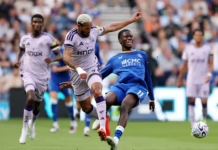

Mallorca vs Paris Saint-Germain: Contrasting Preparations Meet at Son Moix. Read on for all our free predictions and betting tips.



Mallorca's strong pre-season scoring form and match rhythm contrast with PSG's defensive reshuffle due to 13 key absences. Mallorca's assertive attack and PSG's unsettled backline suggest a high-scoring game exceeding two goals.
A 3-1 scoreline balances Mallorca's physical sharpness and PSG's superior individual quality. PSG's technical edge and tactical tools, despite absences, could secure a late victory as Mallorca's intensity wanes.
Mallorca welcome Paris Saint-Germain to the Estadi Mallorca Son Moix on Wednesday evening in a pre-season friendly shaped by two very different levels of preparation.
Mallorca vs Paris Saint-Germain — bet365 Market Snapshot
Swipe through key markets with illustrative probabilities and sample bet365 odds based on our match analysis.
Mallorca's recent wins contrast with PSG's squad rotation challenges, influencing match outcome probabilities.

Mallorca's consistent high scoring and PSG's defensive adjustments suggest a match with multiple goals.
Mallorca's scoring ability and PSG's attacking quality support a 1-3 scoreline prediction.
Mallorca's recent wins and scoring form indicate superior match fitness compared to PSG's altered lineup.
Three Punchy Stats
- Mallorca have scored seven goals across their first two pre-season matches, following a 3-0 win with a 4-2 victory.
- Four of Mallorca’s last five matches have produced more than two goals, with Luis Garcia’s side scoring 11 and conceding seven during that sequence.
- PSG have conceded only four goals across their last five matches, while four of those fixtures finished with fewer than three goals.
Attacking Form Contrast
Mallorca carry the attacking momentum, while Paris Saint-Germain need a far sharper final ball.
Mallorca’s attacking intent should create openings, but Paris Saint-Germain carry enough threat to answer.
Paris Saint-Germain’s blunt recent output leaves Mallorca with the stronger attacking edge.
Defensive Stability Comparison
Mallorca look steadier without the ball, while Paris Saint-Germain remain exposed under pressure.
Mallorca’s steadier back line gives them a defensive edge over Paris Saint-Germain.
Paris Saint-Germain’s recurring defensive lapses invite Mallorca to attack with confidence.
Luis Garcia’s side have already played twice this summer, scoring seven goals across victories over Al Fateh and Al-Ittihad. PSG, by contrast, are preparing to take the field for the first time since beating Arsenal on penalties in the Champions League final at the end of May.
That gap in match rhythm gives the contest its central tactical question. Mallorca should arrive sharper and more settled, while PSG will rely on technical quality, positional discipline and a squad containing several players eager to earn greater responsibility.
For Mallorca, this is another step towards their Segunda Division opener against Real Valladolid on August 15. For PSG, it begins a compressed build-up that also includes Manchester United, Aston Villa in the UEFA Super Cup, Lens in the French Super Cup and Rennes in their Ligue 1 opener.
Mallorca Have Built Genuine Pre-Season Momentum
Mallorca’s opening two friendly results have been emphatic.
A 3-0 victory over Al Fateh was followed by a 4-2 success against Al-Ittihad, giving Luis Garcia’s team seven goals scored and two conceded before PSG arrive in Palma.
Those performances matter because Mallorca are attempting to reset after relegation from La Liga. They finished 18th last season with 42 points from 38 matches, so this summer is not merely about improving fitness. It is about rebuilding belief, reshaping the squad and developing a style capable of supporting an immediate promotion challenge.
Six players have arrived and seven have departed, including Vedat Muriqi. Losing an established striker changes more than the identity of the centre-forward. It can alter how a team progresses the ball, attacks crosses and occupies opposition centre-backs.
Mallorca’s early pre-season scoring suggests they are already finding alternative routes to goal. Adrian Fuentes and Arnau Puigmal could feature in advanced positions, while Jan Virgili is expected to play an important role after being included among the likely starters.
Virgili’s presence may be particularly valuable against PSG. At 20, he offers the type of energy and directness that can trouble a defence still building its physical sharpness. Friendly matches often appear comfortable until a quick winger decides that “pre-season intensity” is somebody else’s problem.
Pablo Torre and Manu Morlanes are also expected to contribute, giving Mallorca technical quality in midfield. Their ability to receive under pressure and move possession quickly will be crucial if the hosts want to avoid spending long periods defending close to their own penalty area.
Match Rhythm Could Be Mallorca’s Biggest Weapon
Football fitness is not the same as general fitness.
Players can train intensely, but match rhythm includes timing, spatial awareness, decision-making under pressure and the ability to repeat high-speed actions while reading a constantly changing game. Mallorca have already had two opportunities to sharpen those qualities. PSG have not played competitively or in a friendly since the end of May.
That does not automatically make Mallorca the stronger side, but it may give them an advantage in the opening phases. Their pressing could be more coordinated, their runs more instinctive and their passing combinations more familiar.
Luis Garcia may therefore encourage an assertive start. If Mallorca can press PSG’s early build-up, they could force mistakes from a defence and midfield lacking recent match minutes.
Pressing is most effective when it is collective rather than emotional. One player sprinting towards the ball may look committed, but without support it merely creates space elsewhere. Mallorca must move as a unit, close central passing lanes and guide PSG towards areas where they can trap possession.
The possible midfield combination of Samu Costa, Morlanes and Torre gives them a platform to do that. Costa can provide balance, while Morlanes and Torre may be asked to progress possession and support attacks.
Mallorca will also need to manage their own ambition. PSG possess enough individual talent to punish an overcommitted press, even with several senior players unavailable. A bold approach can energise Son Moix, but a reckless one could turn the match into a sprinting contest against technically gifted opponents. That is rarely a relaxing evening.
PSG Begin a Short and Unusual Preparation
PSG’s summer schedule leaves little room for gradual development.
They are due to play only two friendlies before facing Aston Villa in the UEFA Super Cup on August 12. Their second warm-up fixture comes against Manchester United on Saturday, meaning Luis Enrique has limited time to establish fitness levels and assess squad depth.
The situation is complicated by the expected absence of numerous players involved in the 2026 World Cup. Marquinhos, Achraf Hakimi, Ousmane Dembele, Fabian Ruiz, Nuno Mendes, Vitinha, Lucas Hernandez, Willian Pacho, Bradley Barcola, Joao Neves, Desire Doue, Ibrahim Mbaye and Warren Zaire-Emery are all expected to miss out.
That is not a minor rotation. It removes experience, speed, creativity and established relationships from almost every area of the pitch.
However, the absences also create opportunities. Young and fringe players can earn meaningful minutes in a demanding environment rather than being restricted to brief late appearances.
The possible PSG lineup includes Chevalier in goal, with Zague, Zabarnyi, Beraldo and Zulovic forming the defence. Renato Sanches could start in midfield following his loan spell at Panathinaikos, while Dro may partner him centrally.
Ndjantou, Ayari and Ghalleb could operate behind Meite, giving Luis Enrique a youthful attacking unit to assess.
This makes the friendly tactically intriguing. PSG may still attempt to dominate possession, but the players responsible for carrying out that plan will not have the same level of established chemistry as the regular starting group.
Kvaratskhelia Could Change the Attacking Picture
Khvicha Kvaratskhelia is available because Georgia did not participate in the summer tournament, and his involvement would immediately raise PSG’s attacking threat.
His ability to receive wide, carry the ball inside and engage defenders can create instability in an organised block. Mallorca may attempt to defend compactly, but a player capable of beating an opponent can break the structure without requiring an elaborate passing sequence.
That individual quality matters in pre-season, when collective timing is often imperfect. A well-drilled attack may need weeks to reach full fluency. A skilful forward can create danger immediately.
Mallorca’s defensive unit could include Mateu Morey, David Lopez, Antonio Raillo and Toni Lato. Their distances will need to remain tight whenever Kvaratskhelia receives possession.
If the full-back moves forward too quickly, PSG may exploit the space behind. If the defender retreats, Kvaratskhelia can advance and combine around the penalty area. The supporting midfielder must therefore help create a two-against-one situation without leaving central areas exposed.
Mallorca will also be without Jan Salas through injury, while Johan Mojica remains doubtful after his involvement with Colombia at the World Cup. That reduces Luis Garcia’s options and may influence how aggressively the hosts defend the flanks.
PSG’s Departures Increase the Pressure on Emerging Attackers
PSG have made only one signing so far, adding teenage goalkeeper Alessandro Longoni from AC Milan, while six players have departed.
Goncalo Ramos, Randal Kolo Muani and Lee Kang-in are among those who have left, creating openings within the attacking structure.
Those departures place more emphasis on the players selected against Mallorca. Meite could lead the line, while Ndjantou, Ayari and Ghalleb may be asked to provide movement behind him.
For a young forward, pre-season can be both liberating and unforgiving. There is less pressure surrounding the result, but every touch becomes part of a selection argument. One sharp run can catch the manager’s eye; one unnecessary flick can produce the sort of silence normally reserved for a waiter dropping a tray.
PSG’s challenge will be to create clear chances rather than relying on possession alone. Their recent five-match sequence produced six goals, while four of those games contained fewer than three goals. They conceded only four times during that run, highlighting defensive control but also a relatively modest attacking return.
Mallorca’s recent matches have been much more open. Their last five produced 18 goals in total, with 11 scored and seven conceded. Four of those five fixtures contained at least three goals.
The contrast suggests Mallorca may be more comfortable in a high-tempo exchange, while PSG could prefer to slow the game, establish territorial control and build attacks patiently.
Mallorca Must Balance Aggression with Protection
The hosts’ possible shape places Puigmal, Fuentes and Virgili ahead of Costa, Morlanes and Torre.
That attacking configuration should give Mallorca several options between the lines. Puigmal can move inside from a wider position, Fuentes can occupy central defenders and Virgili can stretch the pitch.
Their success will depend on how effectively the midfield supports them. If the front three become isolated, PSG can circulate possession around them and gradually push Mallorca deeper. If Costa, Morlanes and Torre step forward together, the hosts may create pressure but risk leaving space behind.
This is where rest defence becomes important.
Rest defence describes the positioning of players who remain prepared for a counter-attack while their team is attacking. Mallorca may commit their full-backs and midfielders forward, but they must leave enough protection against PSG’s speed.
A poor attacking structure can become a defensive problem within seconds. The ball is lost, one pass breaks the midfield line and suddenly everyone is running towards their own goal with the expression of someone who has just remembered the oven is still on.
PSG will look to exploit those moments. Even without many senior players, Luis Enrique’s side should have enough technical quality to play through pressure if the first pass is clean.
Renato Sanches Has a Chance to Reassert His Influence
Renato Sanches could become one of the most important players in PSG’s possible starting XI.
Returning after a loan spell at Panathinaikos, he has an opportunity to demonstrate that he can give the midfield drive and progression. Against a Mallorca side likely to press with intensity, his ability to protect the ball and carry it forward could help PSG escape difficult situations.
He may also be required to guide younger teammates. With so many established midfielders unavailable, PSG’s central structure could depend heavily on his decisions.
The role is not simply about playing ambitious passes. He must judge when to accelerate the match and when to slow it down. If PSG attempt to attack too quickly, they could lose control and allow Mallorca to build momentum. If they become overly cautious, the hosts may push higher and compress the pitch.
Luis Enrique will want balance: secure possession without sterile possession, vertical passing without needless risk.
That balance could define PSG’s performance.
A Friendly with Very Different Stakes
Mallorca and PSG are preparing for contrasting campaigns.
The hosts are attempting to recover from relegation and build a squad capable of challenging for promotion. PSG are moving towards domestic and European trophy matches after ending last season as Champions League winners.
Mallorca have more immediate rhythm, greater continuity from their opening friendlies and the emotional energy of playing at Son Moix. PSG bring superior individual quality but arrive with limited preparation and a heavily altered squad.
That makes this a valuable examination for both managers.
Luis Garcia can assess whether Mallorca’s attacking confidence survives against stronger opposition. He can also test whether the defensive structure is secure enough when possession is lost.
Luis Enrique can measure the readiness of returning players, young prospects and fringe options before the competitive schedule begins. With only one more friendly before the UEFA Super Cup, there is little time for leisurely experimentation.
The controversial view is that Mallorca may learn more from this game than PSG. The hosts are testing a promotion project against elite opposition, while PSG are mainly trying to discover which members of a reshuffled squad can survive the pace of their own calendar.
Still, the match should carry genuine intensity. Mallorca have scored freely, PSG have barely had time to unpack their boots, and several players on both sides are fighting for prominence.
The result will not define either season, but the patterns may matter. Mallorca want proof that their bright start is built on structure rather than summer optimism. PSG need signs that their depth can support a schedule that becomes serious almost immediately.
At Son Moix, sharpness meets status, ambition meets expectation and a supposedly friendly evening could become uncomfortable very quickly.
📊 Market Explainer
Total Goals Market
Selection: Over 2.5 Goals. This market is settled by the combined number of goals in normal time. The selected line determines how many goals are needed for the bet to win.
Correct Score Market
Selection: Mallorca vs Paris Saint-Germain 1-3. Predict the exact score at the end of 90 minutes plus stoppage time. Extra time and penalties do not count unless the bookmaker states otherwise.
Pick 1: Over 2.5 Goals @ 2/5
Mallorca enter this pre-season contest with genuine match rhythm, having already completed two warm-up fixtures this summer. Luis Garcia’s team generated seven goals across victories over Al Fateh (3-0) and Al-Ittihad (4-2), establishing clear attacking output despite extensive squad changes following their relegation from La Liga. Four of Mallorca’s last five fixtures produced at least three goals, reflecting an assertive approach supported by creative midfielders Pablo Torre and Manu Morlanes. Young winger Jan Virgili provides direct energy along the flanks, while Arnau Puigmal and Adrian Fuentes occupy key central spaces to test opposition defensive lines during fast transitions.
Paris Saint-Germain take the field for their first fixture since winning the Champions League final in late May. With 13 key first-team players absent following World Cup duty—including Marquinhos, Achraf Hakimi, and Ousmane Dembele—manager Luis Enrique must field a heavily altered lineup. Defenders Zague, Zabarnyi, Beraldo, and Zulovic lack competitive minutes together, creating spatial gaps during build-up phases under Mallorca’s collective press. Nevertheless, PSG retain high-level individual quality through Khvicha Kvaratskhelia, alongside motivated emerging talents like Meite and Renato Sanches. The contrast between Mallorca’s physical sharpness and PSG’s defensive disruption aligns with a high-scoring encounter exceeding two total goals.
🎯 Tactical Indicators
- Mallorca scored seven goals in their opening two pre-season games.
- Four of Mallorca's last five matches produced over two goals.
- PSG's missing defensive core forces a new backline into action.
Risk Factor: PSG may focus on low-risk ball retention to control tempo, while second-half squad rotations could reduce match intensity.
Key Tactical Mismatch
Two pre-season games already under their belt with 7 goals scored, testing pressing patterns against active opposition.
First match since late May with 13 first-team players missing due to World Cup duty, forcing an unfamiliar backline.
Pick 2: Mallorca vs Paris Saint-Germain 1-3 @ 10/1
A 3-1 scoreline in favour of Paris Saint-Germain balances Mallorca’s physical sharpness with the visitors’ superior individual quality. Mallorca have scored 11 goals across their past five matches, establishing consistent chance creation through Arnau Puigmal and Adrian Fuentes. Facing an unfamiliar PSG backline missing Marquinhos and Lucas Hernandez, the hosts have the match fitness to score at Son Moix, particularly through direct wing play involving Jan Virgili.
However, PSG maintain elite technical quality in key areas despite widespread senior absences. Khvicha Kvaratskhelia offers direct 1v1 threat against a Mallorca defence comprising Mateu Morey, David Lopez, Antonio Raillo, and Toni Lato, who operate without injured Jan Salas and doubtful Johan Mojica. Additionally, emerging attackers Ndjantou, Ayari, and Meite possess the speed to exploit central gaps whenever Mallorca’s full-backs push high up the pitch. With Renato Sanches anchoring midfield progression, PSG possess the tactical tools to capitalize on transition moments. As Mallorca’s physical intensity drops during the second half, PSG’s superior conversion rate positions them to secure a 3-1 victory.
Risk Factor: Lack of match fitness among PSG's starters could hinder late-game conversion, leaving the scoreline closer than anticipated.
Frequently Asked Questions
What does the Over / Under 2.5 Goals market mean?
It is a bet on whether the total goals scored by both teams will be three or more (Over) or two or fewer (Under) in regular time.
How does the Correct Score market function in football betting?
You must predict the exact final scoreline at the end of regulation time; any other result loses the bet.
Why is match rhythm considered an advantage for Mallorca in this fixture?
Mallorca have played two pre-season games already, scoring seven goals, while PSG have not played since late May, giving Mallorca sharper match fitness.
Which key players are missing from the Paris Saint-Germain squad?
PSG are missing 13 senior players due to World Cup duty, including Marquinhos, Achraf Hakimi, and Ousmane Dembele.
How does Khvicha Kvaratskhelia impact Paris Saint-Germain's attack?
Kvaratskhelia offers elite 1v1 dribbling ability, capable of breaking down organized defenses and creating immediate danger.
What defensive vulnerabilities exist for Mallorca in this match?
Mallorca are without injured Jan Salas and doubtful Johan Mojica, and committing full-backs forward may leave space behind for PSG to exploit.
What is the difference between Over 1.5 Goals and Over 2.5 Goals?
Over 1.5 Goals requires at least two goals to win, offering higher probability; Over 2.5 Goals requires three or more goals, with higher odds but more risk.
Why do pre-season friendlies often feature volatile scoring patterns?
Frequent substitutions, uneven fitness, and tactical experiments often open space for late goals in pre-season matches.