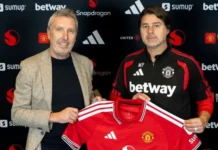

Enzo Maresca might actually be the perfect manager for Manchester City’s next era. Not because he looks capable of extending their dominance, but because he is rapidly teaching a generation of City supporters what football feels like when their club is no longer the protagonist.
That sounds brutal after only a few months, but the decline in City’s authority is impossible to ignore. A side that once made winning feel routine now looks vulnerable, disjointed and surprisingly easy to unsettle. Four consecutive Premier League games without a victory have followed three straight defeats and a 1-1 home draw with Fulham, a club City had beaten in each of their previous 20 meetings.

City began Maresca’s reign by winning their opening seven league matches, so nobody can claim the entire experiment has been a disaster. That start was impressive. But it also makes what has followed more revealing: opponents have adjusted, problems have multiplied and Maresca has not yet shown he possesses convincing answers.
Fulham supplied the latest warning. City fell behind after 16 minutes, required a spectacular Elliot Anderson volley to rescue a point and left the Etihad to jeers. Erling Haaland also had a goal disallowed in a debatable incident involving Bernd Leno, and Maresca understandably believed it should have stood. Yet blaming one refereeing decision would obscure the far larger problem.
City have now developed an extraordinary habit of damaging themselves almost immediately. Maresca admitted that nearly 80 per cent of the goals they concede arrive in the opening 20 minutes. Aston Villa scored early. Brighton scored early. Nottingham Forest scored early. Fulham did exactly the same. Once is an accident. Four consecutive league matches is a pattern.
Then there is the midfield, rebuilt for a staggering £327million. Enzo Fernandez cost a club-record £125m, Anderson £116m and Ayyoub Bouaddi £86m. That kind of expenditure should purchase answers. Instead, several months into Maresca’s tenure, City are still trying to establish which combinations actually work.
Fernandez was dropped against Fulham. Maresca preferred Bouaddi alongside Anderson and was rewarded with one of Anderson’s best City performances. The England midfielder scored, created a match-high three chances, completed all 16 of his passes in the final third and repeatedly arrived dangerously in the opposition box.
Then Rayan Cherki was introduced, Anderson was pushed deeper and much of that influence disappeared. It captured City’s current tactical uncertainty beautifully: Maresca found something that worked and then, while chasing victory, partly neutralised it himself.
Maresca insists this is a process that began four months ago rather than four years ago. That is fair. Replacing Pep Guardiola, restructuring a midfield and creating new relationships across the team was never going to happen instantly. But Manchester City did not spend £327m in midfield to receive lectures about patience while drifting through matches looking as though the players have only recently met.
And hovering over all of this is an unresolved financial case capable of changing City’s future far more dramatically than any bad month of football. City are appealing the independent commission’s findings and the eventual outcome remains unknown, so it would be wrong to claim that uncertainty is directly causing dropped points. But it undeniably forms part of a wider moment in which the old sense of Manchester City certainty — on and off the pitch — has disappeared.
Free Bet Offers
Swipe to see more →
T&Cs Apply. Click to view.

T&Cs Apply. Click to view.

T&Cs Apply. Click to view.

T&Cs Apply. Click to view.

T&Cs Apply. Click to view.

T&Cs Apply. Click to view.
Maresca has turned control into uncertainty
This is the biggest difference from Guardiola’s Manchester City.
Guardiola’s finest teams could lose matches, of course. They suffered bad spells. They made individual mistakes. But even when results went against them, the underlying structure was usually recognisable.
You knew what City wanted.
You knew where the midfielders would appear.
You knew how possession would manipulate an opponent.
You knew the pressure would eventually become suffocating.
Maresca’s City currently feel less certain about themselves than their opponents do.
Against Fulham, Anderson appeared liberated without Fernandez. Against previous opponents, City’s expensive midfield has repeatedly struggled to produce the right balance. Maresca openly admits he is still searching for solutions.
At some clubs, that is acceptable experimentation.
At Manchester City, after spending £327m on one department, it looks alarmingly like improvisation.
Fernandez has become the £125m question
This is where City’s recruitment and Maresca’s coaching collide.
Fernandez is unquestionably an elite footballer. The issue is not whether he possesses quality.
The issue is whether City know exactly what they bought him to do.
If Anderson plays deep to accommodate Fernandez, City lose some of the carrying, intensity and penalty-area threat that made Anderson so dangerous against Fulham.
If Anderson moves higher, where does Fernandez fit?
The number 10 spaces are already contested by Cherki and Phil Foden.
Bouaddi, meanwhile, appears to give City greater protection and allows Anderson more freedom.
That is an extraordinary dilemma to possess after making Fernandez the club’s record signing.
When a £125m midfielder creates more questions about your best midfield than answers, somebody has got the planning wrong.
Eighty per cent of goals conceded early is coaching territory
Maresca cannot simply dismiss City’s early concessions as unfortunate individual moments.
When approximately four-fifths of your goals conceded arrive inside the opening 20 minutes, something systemic needs examining.
Preparation.
Concentration.
Defensive positioning.
Intensity.
Risk management.
Whatever the explanation, elite managers are paid to identify it before the same issue destroys another match.
City keep entering games and immediately giving themselves a problem to solve.
That is particularly damaging because opponents no longer arrive expecting inevitable defeat. Fulham had lost 20 consecutive matches against Manchester City stretching back to 2011.
This time they left believing they might have won.
That psychological change matters.
The most damaging thing Maresca has done is not lose matches. It is make Manchester City look beatable before opponents have even settled into them.
Guardiola left a machine; Maresca has a laboratory
Nobody expected Maresca simply to copy Guardiola.
That would have been absurd.
Managers need their own ideas and City deliberately chose somebody whose positional principles had similarities without being identical.
But there is a vast difference between evolution and dismantling certainty.
Guardiola left behind a club accustomed to competing for every major honour. Maresca inherited enormous resources and then received one of the most expensive midfield rebuilds football has ever seen.
Yet City now resemble a laboratory.
Anderson here.
Fernandez there.
Bouaddi for balance.
Cherki between the lines.
Foden somewhere else.
Try this.
Change that.
See what happens.
Top-level coaching obviously involves experimentation. But the Premier League table is not a pre-season tactical workshop.
Chelsea already provided a warning
Maresca’s defenders will point to the obvious fact that he has managed only a few months at City.
They are right.
But this is not his first exposure to an elite Premier League environment.
His Chelsea tenure showed many of the same qualities we see now: strong positional ideas, intelligent possession structures and moments when the football looked excellent.
It also never truly convinced that Maresca possessed the flexibility and authority required to build a championship-winning machine.
That distinction matters because Manchester City did not hire him to qualify for Europe.
They hired him to succeed Guardiola.
Those are completely different standards.
A good Premier League coach can produce impressive football.
A Manchester City coach is expected to win the Premier League.
Based on the evidence so far, Maresca looks far more convincing as the former than the latter.
The best defence of Maresca is legitimate
There is a strong counterargument.
City are rebuilding.
Rodri and Bernardo Silva left.
Three major midfield signings arrived.
Players need time to understand each other.
Fernandez had just returned from a 14,000-mile international round trip before Fulham.
Maresca’s opening seven league victories demonstrated what the team can look like when functioning properly.
And Haaland’s disallowed goal might easily have turned the Fulham draw into victory.
All fair.
It would be ridiculous to declare City’s season dead in November.
They remain capable of producing a long winning sequence and have enough individual quality to challenge almost anybody.
But none of that removes the warning.
Great managers solve the problems created by transition faster than ordinary ones.
Maresca currently appears to be learning about his team at roughly the same speed everybody else is learning how to hurt it.
Maresca wants to win 1-0 — Arsenal have already mastered it
Perhaps the most revealing comment after Fulham was Maresca admitting City need to learn how to keep clean sheets and occasionally win by a single goal.
There is nothing wrong with that.
In fact, it is exactly what champions must do.
The uncomfortable part is that Arsenal have already built precisely that capability.
Mikel Arteta’s side can be criticised for becoming overly controlled and considerably less entertaining, but their defensive security means one goal frequently wins a match.
City are attempting to rediscover that control while conceding almost automatically during the opening phases of games.
Maresca wants the weapon Arsenal already possess.
That tells you plenty about how the balance of power has changed.
Then comes Arsenal
City’s immediate schedule offers very little sympathy.
Napoli arrive in the Champions League before City travel to Arsenal.
They could reach the Emirates eight points behind the champions.
That match will tell us much more than a controversial disallowed goal against Fulham.
Arteta has created a team whose identity is obvious.
Maresca is still looking for his.
Arsenal know how to protect narrow advantages.
City have gone nine matches in all competitions without a clean sheet.
Arsenal have become experts in reducing uncertainty.
City currently manufacture it.
The financial uncertainty makes the sporting decline feel bigger
The unresolved regulatory battle should not be used as an excuse for Maresca.
It does, however, change the atmosphere around City’s current stumble.
For most of the Guardiola era, Manchester City represented permanence.
Elite manager.
Elite recruitment.
Elite players.
Elite results.
The assumption was always that next season would look roughly as powerful as the previous one.
That assumption can no longer be made quite so confidently.
Guardiola has gone.
The midfield has been reconstructed.
Maresca is struggling to reproduce control.
And the ultimate consequences of City’s regulatory case remain unresolved during the appeal process.
For the first time in a very long time, City’s future contains more questions than guarantees.
Perhaps this is exactly what post-Guardiola City looks like
Manchester City supporters have lived through an extraordinary period.
Winning became routine.
Ninety-point seasons stopped looking ridiculous.
Domestic trophies accumulated.
European football eventually surrendered too.
That was never normal.
And it was never guaranteed to continue once the architect left.
Maresca may improve enormously. City may solve the midfield, eliminate the early goals and rediscover the relentless winning rhythm that defined Guardiola.
But the evidence available today points somewhere else.
City have gone from seven straight league wins to four matches without one.
They cannot keep clean sheets.
They repeatedly concede early.
Their £327m midfield remains unresolved.
Their £125m record signing was benched during a must-win home match.
And clubs that spent years arriving at the Etihad expecting punishment are beginning to believe again.
Maybe Maresca is not the manager who continues Manchester City’s age of dominance.
Maybe he is the manager perfectly suited to what comes after it.
Pep Guardiola taught Manchester City supporters how domination feels. Enzo Maresca, remarkably quickly, is teaching them the other side of football: uncertainty, frustration and the growing realisation that being Manchester City no longer guarantees being the main character.
This article is an opinion and analysis piece. The views expressed are those of the writer and do not necessarily represent the views or official position of BettingTips4You.com or BSpin Limited.