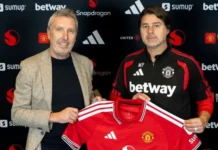

After roughly 18 months of hearing remarkably little from Manchester United chief executive Omar Berrada, supporters finally received the big interview. They deserved accountability, detail and an explanation for how a club that finished third last season is now sitting 18th. What they got instead was one of the most extraordinary exercises in executive optimism Old Trafford has heard in years.
Berrada says Manchester United are “100 per cent” moving in the right direction. He says the foundations for sustained success are already there. He says the ownership structure is working very well. He says the squad has been fundamentally improved. He says United had sufficient defensive depth. He says the summer transfer policy was disciplined. He says Mauricio Pochettino has already created a buzz after two days. Supporters are apparently also living amid social-media negativity that sometimes crosses a line.

The problem is not that every sentence is demonstrably false. Calling Berrada a liar would require evidence that he knowingly stated things he believed to be untrue, and that evidence is not available. The more defensible criticism is almost as damaging: his description of Manchester United is so detached from the measurable outcomes that it asks supporters to trust executive assurances over their own eyes.
United are 18th in the Premier League with eight points from ten matches. They have already dismissed Michael Carrick after their worst start to a top-flight season in 40 years. Berrada himself acknowledges United have gone through three permanent managers in fewer than three seasons. This is apparently the backdrop against which the club is “heading in the right direction”.
That does not mean every strategic decision has been wrong. Football rebuilding is rarely linear, injuries have hurt the squad and executives should not abandon a long-term plan because of ten bad matches. Berrada is entitled to believe work behind the scenes will eventually produce better outcomes.
But supporters are equally entitled to demand some visible evidence. “Foundations” are one of football executives’ favourite concepts because they cannot be seen on the league table. If the results collapse, the foundations are supposedly still underneath. If another manager gets sacked, the foundations remain. If recruitment looks unbalanced, apparently the foundations continue to strengthen anyway.
Berrada’s comments about supporter criticism are particularly ill-judged. Abuse, threats or personal harassment obviously cross a line and should be condemned without qualification. But legitimate fury about the people running Manchester United is not merely social-media content engineered for engagement. The club is in the relegation zone. Supporters have watched repeated managerial resets, questionable recruitment and another season unravel before winter.
Berrada then claimed the Glazer-INEOS arrangement is working “very well”, with constant dialogue and everyone aligned behind decisions. Fine. But that defence creates an obvious consequence: if everybody at the top has been on the same page, everybody at the top owns the results produced by those decisions. Alignment is not automatically competence.
His explanation of Carrick raises another uncomfortable question. Berrada says Carrick earned the right to continue after finishing third and qualifying for the Champions League. That sounds reasonable until you remember what the permanent job actually required. Carrick had successfully rescued a season; United assumed that meant he could construct the next one. Ten league games later, the experiment was abandoned.
Then there is recruitment. United spent £163million in the summer, overwhelmingly strengthening midfield, while entering the season with a defence Berrada says had enough depth because nine players could cover four positions. United subsequently produced one of the poorest defensive records in Europe’s major leagues. Counting available names on a spreadsheet is not the same as possessing enough quality, reliability or balance.
Finally, Berrada praises the “buzz” Pochettino has brought to Carrington after two days. Hopefully that enthusiasm becomes something meaningful. But Manchester United have produced enough new-manager buzz to power half of Greater Manchester since Sir Alex Ferguson retired. Buzz is not progress. Results are progress.
Free Bet Offers
Swipe to see more →
T&Cs Apply. Click to view.

T&Cs Apply. Click to view.

T&Cs Apply. Click to view.

T&Cs Apply. Click to view.

T&Cs Apply. Click to view.

T&Cs Apply. Click to view.
Claim: “We are heading in the right direction”
This is the statement that should frustrate supporters most.
What evidence available to the public currently supports it?
United are 18th.
They have eight points from ten Premier League games.
They have already changed manager.
They have endured their worst start to a top-flight campaign in four decades.
They have one of the weakest defensive records across Europe’s major leagues.
Nobody expects Berrada to appear on television and announce that every decision he has made has been disastrous. Leadership requires confidence.
But confidence without evidence becomes corporate messaging.
If the club were seventh, playing well and showing obvious signs of development, supporters could accept that results had yet to catch up with process.
When the team is in the relegation zone, the burden of proof changes.
Do not tell supporters the direction is correct.
Show them.
Claim: “Some criticism crosses the line”
Of course it does.
Every large football club has abusive idiots on social media. Threatening executives or targeting their families is unacceptable. Nobody serious should defend it.
But Berrada bundled that legitimate point together with a broader complaint about negative Manchester United stories driving engagement.
That is where the argument becomes convenient.
The negativity surrounding United has not been invented by algorithms.
Manchester United generated it.
Three permanent managers in fewer than three seasons is not clickbait.
Eighteenth in the Premier League is not an engagement tactic.
A £163m transfer window followed by another managerial dismissal is not a social-media narrative.
Supporters criticising Jason Wilcox after Lisandro Martinez himself publicly questioned the technical director’s transfer work is not manufactured outrage.
Social media may amplify Manchester United’s problems. It did not create them.
The hierarchy cannot complain about noise while repeatedly providing the material producing it.
Claim: the ownership arrangement is “working very well”
This may be the most revealing statement in the entire interview.
Berrada says the Glazers and INEOS are engaged, communicate constantly and have been aligned on decisions.
If true, that removes one of the easiest excuses available.
There can be no argument that different ownership groups are pulling Manchester United in conflicting directions.
No rogue executive.
No decision imposed by one faction against another.
They are aligned.
Good.
Then they can share accountability too.
Erik ten Hag.
Ruben Amorim.
Michael Carrick.
Now Mauricio Pochettino.
Repeated changes in football leadership.
A squad still carrying obvious weaknesses.
United in 18th.
You cannot present collective alignment as evidence of good governance while treating collective failure as somebody else’s responsibility.
If all the major football decisions were taken together, judge the structure by those decisions.
Claim: Carrick “earned the right” to stay
This exposes the original strategic error.
Carrick unquestionably performed extremely well last season. He simplified the system, improved results, restored confidence and somehow took United to third place and Champions League qualification.
He deserved enormous praise.
But management positions are not loyalty rewards.
United should have asked whether Carrick was the best available coach to build the club’s next three years, not whether five excellent months had emotionally earned him another season.
Those are different questions.
Berrada’s explanation sounds less like strategic succession planning and more like precisely the sentiment that led United to make Ole Gunnar Solskjaer’s interim appointment permanent years earlier.
The rescue went well.
Therefore, give the rescuer the rebuild.
Then everything changed.
And United changed manager again.
Claim: they deliberately waited until November to assess Carrick
This one is difficult to reconcile with the sense of crisis that had already engulfed the club.
United were hammered by Como.
They lost 3-0 at Old Trafford to Bournemouth.
Carrick’s authority came under intense scrutiny.
Bruno Fernandes had publicly criticised the coaching staff’s methods.
Yet Carrick continued until the international break.
If November was genuinely the predetermined review point, it was an extraordinary risk for a club whose season was deteriorating rapidly.
If it was not, then portraying the timing now as part of a structured review process looks suspiciously like hindsight making chaos appear deliberate.
Either way, United lost valuable weeks.
Claim: Pochettino is already creating a “buzz”
This is harmless enough.
New managers almost always create one.
Training changes.
Players get a clean slate.
Staff become energised.
Everybody smiles for photographs.
The problem is that Manchester United have mistaken emotional resets for structural progress too many times.
Solskjaer produced one.
Ten Hag produced one.
Amorim produced one.
Carrick produced one.
Now Pochettino has produced one.
United should stop measuring managerial change in vibes.
Pochettino should be judged on whether the press works, whether players improve, whether the defensive structure becomes coherent and whether United start winning football matches.
Anything else is public relations.
Claim: the squad has been “fundamentally better”
This deserves serious scrutiny.
Carlos Baleba, Andrey Santos and Youri Tielemans may ultimately prove excellent acquisitions. It would be unfair to permanently judge players after a difficult opening few months in a dysfunctional side.
But Berrada is not merely saying they possess potential.
He says the squad has been fundamentally improved.
The observable evidence currently struggles to support such certainty.
United spent £163m this summer and more than £1bn in total transfers since 2022. Sky’s analysis calculated that their £769.5m net spend since 2022 is the highest in the Premier League over that period.
Yet the squad still entered this campaign with obvious imbalance.
Only 19 per cent of that £1bn spending since 2022 had gone on defenders before the season, according to the same analysis.
That is not Berrada’s personal spending record alone, but it illustrates the inheritance and planning problem his football structure was supposed to fix.
United then spent heavily on midfield again.
Now they are 18th.
If this is fundamental improvement, supporters can reasonably ask when they are supposed to see it.
Claim: United had enough defensive depth
Nine players.
That was Berrada’s explanation.
United believed they had nine players capable of filling four defensive positions, therefore midfield received priority.
This is football management by headcount.
The question was never whether United could physically name enough defenders.
The question was whether the defence possessed enough quality, availability, durability and balance to compete across the Premier League and Champions League.
Berrada admits United considered adding another defender.
He acknowledges injuries subsequently hurt them.
And the team has produced one of the worst defensive records in Europe’s major leagues.
That does not automatically prove the summer decision was irrational. Every club must prioritise limited resources.
But it makes presenting the original depth assessment as vindication rather difficult.
Claim: United showed “discipline” in the market
The principle is absolutely correct.
Manchester United should stop paying inflated prices simply because selling clubs know they are desperate.
They should walk away when valuation exceeds value.
They should avoid another decade of expensive players who become impossible to move.
Berrada is right about that.
The contradiction is that supporters have heard versions of this promise for years while watching colossal sums disappear.
United have spent more than £1bn since 2022.
They possess the Premier League’s highest net spend over that period.
They still required another £163m summer.
And they are 18th.
Financial discipline is not simply refusing to pay £116m for Elliot Anderson.
It is constructing a balanced squad from the enormous resources already available.
A club cannot endlessly celebrate the transfers it refused to overpay for while avoiding scrutiny of the hundreds of millions it did spend.
Bruno Fernandes: finally, a sensible answer
Not every part of Berrada’s interview deserves demolition.
His response regarding Bruno Fernandes was appropriate.
Contract discussions with the club captain should largely remain private. Fernandes has reportedly rejected offers, his contract situation is delicate and Pochettino needs to assess his squad.
There is no benefit in negotiating publicly.
Berrada was right to keep that conversation behind closed doors.
The contrast actually makes some of his other answers more frustrating.
He clearly knows when restraint is appropriate.
JJ Gabriel: “We did absolutely everything”
That assertion is impossible for outsiders to verify.
Perhaps United did.
The academy’s history is outstanding and the club continues giving young players opportunities.
But when a highly regarded 16-year-old chooses to leave amid interest from Real Madrid, simply declaring that the club did “everything” does not answer every question.
Why did the player believe another pathway was better?
What could United have done differently?
What lessons will be taken?
Those are more useful questions than presenting the outcome as unavoidable because the player and his family ultimately chose to leave.
Berrada’s Manchester City answer should be treated differently
The chief executive was also asked about the financial-rule case involving his former employer.
Here, criticism should remain evidence-based.
Berrada says he was not involved in wrongdoing, was not involved in the proceedings and faces no allegations personally.
Unless evidence emerges contradicting that position, those statements should not be turned into accusations merely because he previously worked at City.
That is precisely the standard Manchester United supporters should demand everywhere else too.
Evidence first.
Which brings us back to his United interview.
Fans are not stupid
This is the biggest mistake Berrada made.
Manchester United supporters can tolerate failure.
They have had plenty of practice.
What becomes harder to tolerate is being presented with a description of their football club that appears completely disconnected from the one they watch every weekend.
They can see the league table.
They remember the managers.
They know how much money has been spent.
They know where the squad remains weak.
They watched Carrick qualify for the Champions League and then get sacked ten league games later.
They do not require social media to tell them something has gone badly wrong.
Berrada says Manchester United are building the foundations for sustained success.
Fine.
But foundations eventually have to support something.
At the moment they support an 18th-placed team, another new manager and another promise that this time the process really is working.
Manchester United supporters have heard enough explanations.
Pochettino now deserves the opportunity to change the football.
And the executives who hired him deserve to be judged by what happens next.
The most insulting part of Berrada’s interview was not one specific claim. It was the assumption running through almost all of them: that Manchester United’s direction should be judged by what the executives say they are building rather than by what supporters can plainly see they have built.
This article is an opinion and analysis piece. The views expressed are those of the writer and do not necessarily represent the views or official position of BettingTips4You.com or BSpin Limited.