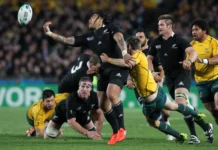


England arrive at Perth Rectangular Stadium on Saturday morning needing a significant points haul against France to keep any semi-final hope alive. France arrive having leaked 78 points to Samoa in their opening fixture — a result that didn’t just damage their points difference but exposed specific structural problems in their defensive alignment. The combination of a team under genuine external pressure to score heavily and an opponent with demonstrably fragile defence is the foundation of the over 62.5 total points case at 21/20. The market is essentially calling this a coin flip. The argument below is for why the contextual factors in 2026 tip that balance.
France conceded 78 points to Samoa and have no answer to England’s NRL-strength backline. England need to maximise their score to keep semi-final hopes alive, creating real motivation to press hard for 80 minutes. At 21/20, the contextual case — a historically weak French defence facing a side with scoring targets — tilts toward the over.
Why Over 62.5 Total Points Stands Out
The Betting Case
The first thing to establish is what 62.5 total points actually requires of England. The current handicap sits at 46 points — meaning the market expects England to win by roughly that margin. If England cover that comfortably, say a 52-4 result, the total lands at 56. The over-62.5 bet loses. For this bet to win, England need either a bigger victory than the handicap market expects, a meaningful French contribution to the score, or both. That distinction between “England win easily” and “England score heavily” is the central tension in the analysis.
Now layer in what France’s Samoa result actually tells us about their defensive structure. Ten different Samoan players crossed the try line in that 78-4 defeat. Their right defensive edge was targeted repeatedly — a left-sided winger opened the scoring, his early replacement then crossed four times in the same match exploiting the same channel. England’s right-side attacking threat, anchored by Dom Young — 23 NRL tries in the 2026 season and 10 tries across nine England appearances — maps almost directly onto the weakness Samoa exposed. That isn’t the Samoa result making England look impressive by proxy; it is a specific defensive flaw that England’s most dangerous attacking individual is positioned to exploit.
England’s tournament situation adds a dimension that doesn’t exist in a standard international fixture. Brian McDermott’s side have already lost to Tonga and need to win both remaining games by large margins to have any semi-final prospect. Head-to-head points difference is the first tiebreaker in the combined pool standings. That means every point scored against France carries genuine competitive value — not just for the result but for the tiebreaker arithmetic. Teams in that position don’t ease off once the result is settled. They maintain attacking intent across 80 minutes in a way that teams playing low-stakes fixtures often don’t. That sustained pressure is an argument for higher totals that the H2H averages — compiled largely from non-competitive friendlies and qualification matches — don’t fully capture.
The historical record is the honest counter-argument and it belongs in the opening analysis rather than buried in the risk section. The last six England-France meetings have averaged 50.67 total points. Five of the last seven produced fewer than 59.5 combined. The five most recent H2H results — 40-8, 64-0, 42-18, 30-10, 44-6 — produce totals of 48, 64, 60, 40 and 50. That’s one over-62.5 result from five matches. The 2023 encounter (64-0, 64 total) is the precedent that most closely mirrors the case being made here: England at attacking capacity against a France side that couldn’t compete. The argument for Saturday is that conditions are closer to 2023 than to 2021 or 2024 — France are as exposed as they’ve been in that sequence, and England have more reason to keep pressing than in any of those non-World Cup fixtures. The 21/20 price is the market’s honest expression that it isn’t quite convinced.
Key Betting Snapshot
Market Value Assessment
What 21/20 Is Asking You to Accept
At 21/20, the decimal price is 2.05 and the implied probability of the over landing sits at approximately 49%. The bookmakers are describing this as the closest thing betting markets produce to a genuine coin flip — neither outcome meaningfully favoured. For a total points line, that framing usually signals the line has been set accurately using the available evidence rather than shaded heavily in either direction.
The question that implied probability raises is whether the specific circumstances of this fixture justify a meaningfully higher personal assessment. If you price the over at 55-58% likely — based on France’s 78-point defensive concession within this same tournament, England’s external competitive motivation to score heavily, and the personnel advantages in the English backline — then 2.05 returns at a rate that slightly exceeds the assessed risk and the trade-off is reasonable on those terms. The case is not that the line is mispriced in any systematic way; it is that the specific 2026 context creates a conditional probability that differs from what the historical averages suggest.
The England match result price (1/1000) tells you the result itself is essentially resolved. The total points market is where the genuine uncertainty sits in this fixture. At 21/20, the price rewards those who believe the current tournament context — France’s exposed defence and England’s scoring imperative — shifts the distribution of likely outcomes meaningfully toward higher totals. The reward for being right is roughly equal to the stake. That is an accurate reflection of the genuine balance in this bet.
The handicap line at -46 for England is itself a useful reference point. England simply covering that spread — a 52-6 result, for instance — produces 58 combined points and loses the over bet. For the over to land at 63+, England need to exceed the handicap expectation by approximately 17 points, or France need to contribute more than their typical single-digit output in these fixtures. That is achievable but requires a specific kind of performance rather than just a competent one.
Free Bet Offers
Swipe to see more →
T&Cs Apply. Click to view.

T&Cs Apply. Click to view.

T&Cs Apply. Click to view.

T&Cs Apply. Click to view.

T&Cs Apply. Click to view.

T&Cs Apply. Click to view.
How Total Points Betting Works in Rugby League
Beginner-Friendly Explanation
A total points bet — also called an over/under market — has nothing to do with who wins the match. You are betting on whether the combined score of both teams reaches a set number. In this case, the line is 62.5. Add England’s score to France’s score: if the combined total is 63 or more, the over wins; if it is 62 or fewer, the under wins. The 0.5 in the line eliminates the possibility of an exact tie — rugby league scores come in multiples of two (converted try) or four (unconverted try), so a combined score of exactly 62.5 is mathematically impossible. There is always a clear winner or loser.
You don’t need to call the margin or the scorers — only the combined score. A dominant England performance where France contribute even a try or two brings the total closer to the line without requiring England alone to reach 63 points. The bet stays alive through the full 80 minutes: late French tries (which do occasionally materialise in these fixtures) can push the total over the line even when England are already comfortable.
England could win very convincingly — covering the -46 handicap easily — while the total still lands under 62.5. A 48-4 result is a dominant England display but produces only 52 total points. The bet requires volume rather than just quality: you need tries to keep coming through 80 minutes, not just until the result is settled and England begin managing the game.
Performance and Match-Fit Analysis
England’s opening game against Tonga revealed two things simultaneously: a backline with genuine attacking quality and a set of execution problems that limited how often that quality was expressed. They completed just 29 of 41 sets in that match. Against a Tonga side with NRL physicality and pace, those errors translated directly into conceded field position and a difficult second half. Against France, the consequences of poor ball control are significantly less damaging — French counter-attacks from turnovers are not the same threat as Tongan ones — but the incomplete sets still reduce the volume of England’s attacking sequences. A side that completes 75% of its sets generates fewer opportunities than one completing 85%, regardless of the defensive quality in front of them.
The individual attacking personnel are the clearest argument for a high-scoring England performance. Dom Young brings an NRL try-scoring profile — a rate of more than a try per game across the 2026 NRL season — to an international fixture where France’s right defensive edge has already been identified as the weakest channel on the pitch. Herbie Farnworth in the centres, described as one of the best in the world at his position, offers the power and footwork to create and finish against defensive lines not calibrated to NRL-level footspeed. AJ Brimson at fullback already crossed against Tonga in this tournament and carries the attacking threat from deep that full modern rugby league demands. Zach Eckersley, who scored 36 tries across all competitions for Wigan Warriors in the 2026 season, provides the left-side attacking outlet.
Junior Nsemba and Kai Pearce-Paul were kept relatively frustrated in the Tonga match by an opposition physically equipped to contain them. France don’t offer the same containment. If England’s set completion improves even modestly from the Tonga game, those forward runners create second-phase opportunities that eventually reach the backline. The question is how consistently England string that process together for 80 minutes rather than producing it in bursts.
France’s attacking contribution to the total is worth a brief note. They’ve scored no more than one try in eight of their last eleven meetings with England. Their single try against Samoa came despite conceding 78 — so they are capable of scoring sporadically without that implying any defensive solidity. If France add 4-10 points, England need roughly 53-59 to bring the total past the line. That range is more accessible than the round-number 63 England would need if France were scoreless.
France’s 78-point concession to Samoa identified a specific right-edge defensive weakness that Dom Young — 10 tries in nine England appearances — is optimally placed to target. Combine that with England’s competitive motivation to sustain maximum scoring pressure for 80 minutes and the case for an above-average combined total is concrete rather than speculative.
Five of the last seven England-France matches produced fewer than 59.5 total points, and the last six averaged 50.67. England also completed only 29 of 41 sets against Tonga, showing that a poor ball-retention day limits scoring output regardless of the defensive quality faced. The historical pattern is the market’s primary justification for offering near-evens rather than shorter odds on the over.
What Could Go Against This Bet?
Risk Factors
- The H2H average sits well below 62.5 and this isn’t a new pattern. The last six England-France meetings averaged 50.67 total points. Five of the last seven produced fewer than 59.5. The 2024 match ended 40-8 (48 total), the 2021 fixture was 30-10 (40 total), the 2022 game was 42-18 (60 total). Only the 2023 result (64-0) has cleared this specific line in recent meetings. These aren’t distant historical oddities — they represent the typical output of this fixture in genuinely competitive international rugby league.
- England’s set completion was 29/41 against Tonga and the same problems could recur. Poor ball control doesn’t just waste individual possessions — it compresses the number of meaningful attacking sequences England generate per game. Against France this matters less for the defensive risk, but it limits how many opportunities are created. A side completing 70% of sets scores fewer tries than one completing 85%, even against limited opponents.
- France may defend better than their Samoa result implies. The 78-4 scoreline against Samoa was exceptional even by the standards of lopsided World Cup pool games. France had injury disruption, faced an NRL-depth Samoa squad at full intensity, and conceded some tries from momentum rather than structural collapse. England are a different opponent with a different style, and France coach Laurent Frayssinous will have identified specific areas to tighten up after that experience. France have scored tries against England before — including 18 in 2022 — and their contribution to the total should not be entirely discounted.
Related Betting Angles
The over 62.5 total points is one specific market in a fixture where the result is largely settled at the outset. The markets below sit alongside it in the available betting landscape — they’re listed here as context to help you understand how the total points line relates to broader pricing, rather than as additional selections.
England vs France Rugby League World Cup Q&A
What does “over 62.5 total points” actually mean as a bet?
It means you’re betting on the combined score of both teams — England’s points plus France’s points — finishing at 63 or more. The result of the match is irrelevant to this bet. If England win 50-14, the total is 64 and the over wins. If they win 44-8, the total is 52 and the over loses. The .5 ensures there can be no tie on the line — rugby league scores come in whole numbers, so 62.5 is never exactly reachable.
Why is the price 21/20 rather than much shorter given France’s 78-4 loss to Samoa?
Because the 62.5 total points line asks for something more specific than England winning easily — it requires the combined score to reach a level that England-France fixtures have historically not produced very often. The last six meetings averaged 50.67 combined points, and five of the last seven came in under 59.5. The Samoa result tells us France can concede heavily, but England still need to score at a rate above their typical H2H output for the bet to land.
Does England’s need to score big for tournament reasons genuinely affect betting?
Yes, in a meaningful way. Head-to-head points difference is the first tiebreaker in England’s combined World Cup pool. Every point England score against France carries tiebreaker value, which means Brian McDermott’s side have a competitive incentive to press for tries right through 80 minutes rather than managing the game once the result is settled. In a standard non-competitive fixture, England might win by 30 points and be satisfied. Here, a larger margin is actively sought.
What does the England vs France H2H history show for total points?
The five most recent results were: 40-8 in 2024, 64-0 in 2023, 42-18 in 2022, 30-10 in 2021 and 44-6 in 2018. In total points terms: 48, 64, 60, 40 and 50. Only the 2023 result (64 total) cleared the 62.5 line. That’s a clear record — four of the last five meetings produced totals well short of this bet’s requirement. The 2023 game is the model the over is implicitly targeting, and that requires a specific attacking performance England haven’t yet reproduced in this tournament.
Which England players are best placed to contribute to a high-scoring total?
Dom Young is the standout — 23 NRL tries in the 2026 season and 10 in nine England caps. He’s positioned on the right wing where France’s defensive edge was repeatedly breached by Samoa. Herbie Farnworth in the centres carries the physical and technical quality to trouble France’s line. AJ Brimson already crossed against Tonga and provides an attacking fullback option. Zach Eckersley scored 36 tries across all competitions for Wigan during the 2026 season. In the pack, Junior Nsemba and Kai Pearce-Paul were kept quiet against Tonga by superior opposition — France don’t present the same physical containment.
What was England’s problem against Tonga and does it affect this total points bet?
England completed only 29 of 41 sets against Tonga — a completion rate of around 71% that limited their attacking opportunities and contributed to a second-half fade. Against France, poor set completion is less likely to produce damaging counter-attacks, but it still compresses the number of times England can set up try-scoring opportunities. If their ball retention doesn’t improve from the Tonga game, they may produce a competent rather than prolific performance — enough to win comfortably but not necessarily enough to clear the 62.5 line.
When and where does this match take place, and how can I watch it?
England vs France kicks off at 7:35am BST on Saturday, October 24 — the early morning time reflecting the Perth, Australia venue (Perth Rectangular Stadium). Coverage is live on Premier Sports 1 in the United Kingdom. The match is England’s second fixture of the 2026 Rugby League World Cup pool stage, following their 30-12 opening defeat to Tonga. France are also playing their second match after their 78-4 loss to Samoa.
What happens to the total points bet if the game is abandoned before full time?
If a match is abandoned before completion, most bookmakers void all bets and return stakes — but the precise rules vary by operator and their individual terms and conditions. Total points bets typically require the match to reach full time for settlement. As a pool stage group fixture in a tournament setting, there are no extra time provisions — the result stands at 80 minutes. Always check the specific terms with your chosen bookmaker before placing, as settlement rules are not standardised across the industry.
Safer Gambling Note
18+ | GambleAware | T&Cs apply. This article contains analysis and opinion only — it is not financial advice. Only bet what you can afford to lose, set clear personal limits and stop when betting stops being enjoyable. If gambling is causing concern, visit BeGambleAware.org. Offer terms not provided — check bookmaker terms before placing.