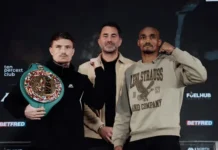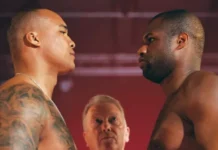


Saul ‘Canelo’ Alvarez makes his ring return on Saturday night at the Kingdom Arena in Riyadh, challenging WBC super middleweight champion Christian Mbilli thirteen months after a unanimous decision loss to Terence Crawford. The Mexican legend is not just bidding to reclaim a title he once held across four belts simultaneously — he is fighting to prove that enough of the old Canelo remains to matter. The question worth examining closely is whether Mbilli’s particular style creates the conditions for a specific kind of Canelo win that the scorecards market does not give you nearly enough credit for.
Mbilli’s limited head movement and straight-forward pressure is precisely the profile Canelo has historically punished with accurate body work and counters. His 44.9% career power punch accuracy — well above the division average of 36.1% — gives a stoppage finish genuine credibility at a price shaped by the market’s reasonable caution about Canelo’s recent decline.
Why the KO/TKO Angle Has a Genuine Case
The Betting Case
The five-year stoppage drought is the first thing any honest assessment must address. Canelo has not stopped an opponent since TKO’ing Caleb Plant in November 2021, going the full distance in his last eight fights, including bouts where a stoppage would have been expected. That is not a run of difficult opponents — it is a pattern, and the 16/5 price exists because the market takes that pattern seriously.
What makes the KO/TKO worth examining despite that context is Mbilli’s defensive profile. The WBC champion is a forward-pressing, high-volume fighter who throws 78 punches per round but offers minimal head movement. He marches forward in a near-straight line, looking to land looping right hands and hooks to the body. His last fight before this one — a drawn bout with Lester Martinez — saw Martinez land 49% of his power punches against him. Mbilli absorbed that and kept coming. His durability is real. But so is the difference in technical class between Martinez and the man he faces on Saturday.
Canelo lands 44.9% of his power punches, against a division average of 36.1%. His opponents manage only 5.3 power shots per round against him — sixth-best defensive percentage among super middleweight champions and contenders. Against a fighter who does not move his head and delivers his punches in a predictable, straight-ahead pattern, Canelo’s accuracy is not diminished by age in the same way his output has been. He throws far less. What he throws, he lands. And 33.6% of his power punches go to the body — a figure that, accumulated over the middle rounds against a stationary target, has historically been the foundation of his most damaging performances.
The 16/5 (4.20 decimal, implying roughly 24% probability) is not asking you to bet against a five-year trend blindly. It is asking whether Mbilli’s style represents a specific enough exception to that trend to be worth the risk-reward trade-off. That is a reasonable question, and the answer is not obvious in either direction.
Key Betting Snapshot
Market Value Assessment
What the Price Is Asking You to Accept
The decision market — Canelo winning on the scorecards — sits at 8/11. That is the market’s preferred framing of a Canelo victory, and eight consecutive points wins give it substantial justification. The KO/TKO at 16/5 represents a distinctly different calculation, not a variation of the same bet.
At 4.20 decimal, the implied probability is approximately 23.8%. That sits in a realistic range for a KO/TKO outcome from the technically superior fighter against an opponent with specific defensive limitations — but only if Canelo shows up closer to his 2021 form than the version seen against Crawford, where he defaulted to single punching, flatfooted, and rarely generated the three- and four-punch combinations that make his body attack effective. His trainer has acknowledged that pattern was the key failure in Las Vegas.
The price therefore reflects two compounded uncertainties: how much Canelo has physically declined after 13 months away from the ring, and whether Mbilli’s untested durability at this level is as real as his 30-fight unbeaten record suggests. Bettors comfortable with both of those unknowns get considerably more upside at 16/5 than the decision market provides. Those who want a Canelo win with less conditional exposure should look elsewhere.
The decision market at 8/11 will suit most bettors who simply want Canelo to win. The KO/TKO at 16/5 rewards a specific reading of this matchup — that Mbilli’s style, unlike most of Canelo’s recent opponents, genuinely invites the kind of counter-based, body-first, combination punishment that produces stoppages. The trade-off between those two positions is clear, and neither is obviously wrong.
Free Bet Offers
Swipe to see more →
T&Cs Apply. Click to view.

T&Cs Apply. Click to view.

T&Cs Apply. Click to view.

T&Cs Apply. Click to view.

T&Cs Apply. Click to view.

T&Cs Apply. Click to view.
How the KO/TKO Market Works
Beginner-Friendly Explanation
A KO/TKO bet on Canelo settles as a winner only if the fight ends before the final bell with Mbilli unable to continue. A knockout means Mbilli is knocked down and cannot beat the referee’s count; a technical knockout means the referee stops the bout because Mbilli is standing but no longer adequately defending himself. If Canelo wins on points — regardless of how dominant the performance — a KO/TKO bet loses. A disqualification win for Canelo typically settles as a winner too, though that outcome is extremely uncommon at this level. Some bookmakers also count a technical decision (where the fight is halted early due to an accidental cut or clash of heads, with Canelo ahead on the cards) as a KO/TKO win — check your bookmaker’s specific settlement terms before placing.
At 16/5 (4.20 decimal), a £10 stake returns £42 in total — £32 profit — if Canelo stops Mbilli. The price reflects genuine uncertainty rather than a novelty premium, meaning the return is proportionate to a real and specific risk. A KO/TKO can also settle early, before a 12-round decision has to go to three scorecards.
Eight consecutive Canelo decisions is a formidable recent sample working against this bet. If he wins 120-108 on all three scorecards, the KO/TKO ticket is worthless. The bet requires a specific ending — not just the right winner. Bettors wanting less conditional exposure should consider the decision market, even at the shorter price.
Performance and Match-Fit Analysis
The CompuBox comparison between Canelo’s last 13 fights and Mbilli’s most recent five makes the volume gulf look alarming at first glance: 35.1 punches per round from Canelo versus 78 from Mbilli. That gap of 42.9 punches per round has led some analysts to frame this as a fading volume fighter against an unstoppable engine. The reality requires a more careful look at where those punches land.
Canelo’s 35.1 thrown per round produces 12.3 landed at a 35% rate. Mbilli’s 78 thrown produces 30.4 landed at 39%. Both fighters sit above the division average of 28.6% for total punch landing. The power punch picture is where the distinction sharpens. Canelo lands 44.9% of his power shots from a base of 19.6 thrown per round — a tight, selective output. Mbilli lands 46.1% from 57.7 per round, generating 26.6 power punches landed — extraordinary accumulated pressure but achieved through saturation rather than precision. Against an elite counter-puncher with superior defensive discipline, that approach typically produces lower landing rates than the five-fight sample shows.
The defensive comparison is the part of the data most relevant to the KO/TKO case. Canelo’s opponents land only 5.3 power punches per round against him at a 31.2% success rate — sixth best among super middleweight champions and contenders. Mbilli’s last opponent, Martinez, landed 49% of his power shots against the champion. Canelo is markedly harder to find cleanly than any challenger Mbilli has faced. If Mbilli cannot land at anywhere near Martinez’s rate, his volume creates less threat and Canelo can remain disciplined in selecting his own shots.
The body punch ratio is the clearest structural argument for a stoppage. Canelo sends 33.6% of his power output to the body — not randomly, but with placement designed to accumulate damage across multiple rounds. Mbilli matches that at 38.9%, but the comparison is in accuracy rather than rate. When Canelo’s body work lands cleanly over rounds five through eight, it historically changes the way opponents respond to head-level attacks in the final third of a fight. Plant was the last clear example. Whether that mechanism still operates at full effectiveness after 13 months without a competitive bout is the central question Saturday will answer.
Mbilli’s straight-ahead pressure and absence of head movement make him a natural target for Canelo’s counter-based attack. The more Mbilli commits to his forward pattern, the more he telegraphs his shots. Canelo’s superior ring IQ — still his greatest advantage at 36, regardless of physical decline — allows him to create angles, draw Mbilli’s weight forward and land clean behind his own punches. That interaction, sustained over 12 rounds, builds the case for a late stoppage that the body-then-head combination delivers.
Eight consecutive decision wins is not coincidence — it includes fights against opponents of Canelo’s own weight class where a stoppage would have been expected from the version of him who dominated 168lbs between 2020 and 2021. His output has measurably dropped, his combination work has become sparse and his footwork is slower. The Crawford fight showed what happens when the 2024-26 Canelo faces someone who makes him work: flatfooted, single-shot, no engine. Mbilli will demand similar output.
What Could Go Against This Bet?
Risk Factors
- Five years without a stoppage win. Canelo has gone to a decision in every fight since TKO’ing Caleb Plant in November 2021. That run includes bouts against Golovkin, Charlo, Munguia and Berlanga — none of which ended early despite Canelo’s technical superiority. Eight data points is enough to suggest a real shift in finishing capacity, not a scheduling quirk.
- Mbilli has never been stopped or knocked down. Across 30 professional fights and 24 of his own KO/TKO wins, Mbilli has demonstrated significant durability. His last outing saw Martinez land 49% of power punches against him — he absorbed that volume and kept moving forward. Canelo will need to land with greater precision and accumulative effect than anyone has managed to date.
- Canelo’s physical condition after 13 months out is an unknown. The version that struggled against Crawford — flatfooted, throwing single punches, unable to generate combinations — is a realistic base case for a 36-year-old returning from his longest spell of inactivity in years. If his body does not respond to ring action the way it once did, the body work that underpins the KO/TKO argument never materialises and Mbilli’s volume controls the pace.
Related Betting Angles
The method-of-victory market offers several ways to frame Saturday’s fight depending on your view of both fighters’ physical condition. The two markets below are educational reference points — neither represents a tip, but understanding how they are priced helps illustrate what the KO/TKO at 16/5 is competing against.
Canelo vs Mbilli Betting Q&A
What exactly does the KO/TKO bet mean, and how does it settle?
A KO/TKO bet on Canelo settles as a winner only if the fight ends before the final bell with Mbilli unable to continue — either because he is knocked down and counted out (KO), or because the referee stops the contest while he is standing but no longer defending himself effectively (TKO). A Canelo points win, however dominant, returns nothing on this bet. A disqualification of Mbilli typically counts as a winner too, though that outcome is extremely rare. Settlement rules for a technical decision vary by bookmaker — check the specific terms before placing.
What do odds of 16/5 translate to in simple numbers?
At 16/5, you win £16 for every £5 staked. In decimal form that is 4.20, meaning a £10 bet returns £42 in total — your £10 stake back plus £32. The implied probability at 4.20 is approximately 23.8%, meaning the bookmaker’s pricing suggests this outcome occurs roughly once in every four times this specific scenario plays out, based on their modelling.
Why is Canelo the betting favourite despite being the challenger?
Canelo enters with 28 world title fights of experience against Mbilli’s two interim title bouts. His technical superiority, ring IQ and career body of work make him the clear market favourite regardless of who holds the belt. Mbilli became full WBC champion by elevation — not by beating a top-level contender for the full title — when Crawford retired. The market prices that distinction heavily. Canelo is expected to represent a different level of challenge than anything Mbilli has faced.
How did Mbilli become WBC champion without beating a former world champion?
Mbilli won the WBC interim super middleweight title with a first-round knockout of Maciej Sulecki in June 2025 and defended it with a split draw against Lester Martinez on the undercard of Canelo vs Crawford in September 2025. When Crawford won all four belts and subsequently retired, the WBC elevated Mbilli from interim champion to full champion in January 2026. Saturday is his first defence of the full title, and his most significant professional examination by some distance.
When did Canelo last stop an opponent?
Canelo’s most recent stoppage win came in November 2021 — a TKO in round 11 against Caleb Plant at the MGM Grand Garden Arena in Las Vegas, which completed his undisputed super middleweight reign. Since that performance, he has gone to a points decision in all eight of his subsequent bouts, including fights against Golovkin, Charlo, Munguia, Berlanga, Scull and Crawford. That run is the primary reason the KO/TKO market is priced where it is rather than significantly shorter.
Has Mbilli ever been knocked down or stopped?
No — Mbilli has never been put on the canvas or stopped in 30 professional fights. His durability was most recently tested in the split draw with Lester Martinez in September 2025, where Martinez landed 49% of his power punches against the champion. Mbilli absorbed that volume and maintained forward pressure throughout. His chin and engine are genuine assets for the challenger side of this argument, and the KO/TKO bet on Canelo requires a level of sustained damage that nobody has yet inflicted on him.
What do the CompuBox numbers tell us about how this fight might unfold?
The headline contrast is 78 punches per round from Mbilli versus 35.1 from Canelo — a gap of 42.9 per round. That volume difference sounds decisive until you look at accuracy: Canelo lands 44.9% of his power shots against a division average of 36.1%, while opponents land only 5.3 power punches per round against him. Mbilli’s most recent opponent landed 49% of power shots against him — significantly above what Canelo typically concedes. If Mbilli cannot improve on that landing rate meaningfully, his volume advantage becomes less decisive, and Canelo’s superior punch selection creates the sustained damage that makes a stoppage possible.
What went wrong for Canelo when he fought Terence Crawford?
Crawford defeated Canelo via unanimous decision in Las Vegas in September 2025, claiming all four super middleweight belts. The key tactical failure, widely acknowledged after the fight, was Canelo’s inability to generate combinations — he defaulted to single punching and became flatfooted, allowing Crawford’s speed and timing to dictate the fight’s tempo throughout. Crawford subsequently retired as undisputed champion, vacating the titles Saturday’s bout partially seeks to reclaim. How much of that performance reflected permanent decline versus a specific opponent mismatch is the central unknown for anyone betting on Canelo this weekend.
Where is the fight and how can I watch?
The fight takes place at the Kingdom Arena in Riyadh, Saudi Arabia, on Saturday 1 November 2026. The card starts at 4pm GMT with the main event ring walk expected around 8:30pm GMT. The card is live on DAZN PPV.
Why not just back Canelo to win rather than specifically KO/TKO?
The outright Canelo win market is priced at approximately 1/3 to 2/5 depending on the bookmaker — considerably shorter than the 16/5 available for a stoppage win. The method-of-victory market rewards a specific reading of the matchup: if you believe Mbilli’s defensive profile gives Canelo a genuine route to a finish that his recent opponents have not provided, the 4.20 decimal offers a meaningful return for that specific assessment. The outright market is appropriate if you want Canelo to win without caring how. The KO/TKO is appropriate if your betting case depends on the stylistic matchup producing a particular kind of performance.
Safer Gambling Note
18+ | GambleAware | T&Cs apply. Only bet what you can afford to lose, set clear limits, and stop when betting stops being enjoyable. Offer terms not provided — check bookmaker terms. If gambling is affecting you, visit BeGambleAware.org or call 0808 8020 133.