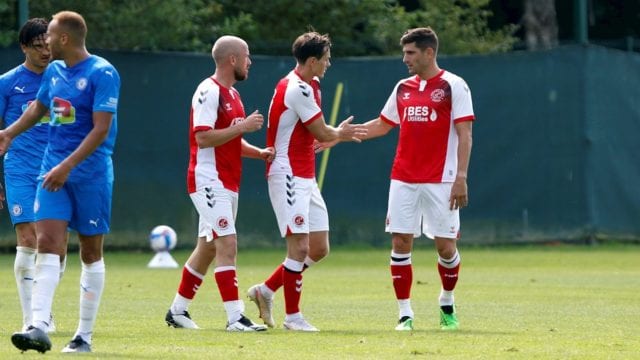

Cheltenham Town vs Charlton Athletic: Carabao Cup Preview and Tactical Analysis. Read on for all our free predictions and betting tips.



Charlton's superior squad depth and recent wins against Cheltenham, combined with Cheltenham's home attacking options and defensive vulnerabilities, suggest a Charlton victory with goals at both ends. Despite Charlton's recent away cup struggles, their midfield quality and attacking firepower give them the edge to secure the win while conceding.
A 3-1 scoreline fits recent history and defensive records, with Charlton having won 3-1 at Whaddon Road previously and Cheltenham conceding multiple goals in recent matches. Charlton's attack is capable of scoring three, while Cheltenham's home attack should secure a consolation goal, reflecting the expected flow of the match.
The Carabao Cup returns with an intriguing first-round contest at Whaddon Road as League Two Cheltenham Town welcome Championship side Charlton Athletic.
Cheltenham vs Charlton Athletic — bet365 Market Snapshot
Swipe through key markets with illustrative probabilities and sample bet365 odds based on our match analysis.
Charlton's recent head-to-head wins and Cheltenham's defensive struggles suggest a Charlton victory.

Cheltenham's recent conceding record contrasts with Charlton's attacking potential.
The 3-1 scoreline reflects recent encounters and defensive patterns of both teams.
Charlton's midfield quality could dictate possession and attacking chances.
Three Punchy Stats
- Cheltenham have lost five of their last six EFL Cup ties, and they have conceded an average of more than three goals per match across that sequence. That combination puts considerable emphasis on defensive discipline against a Charlton side capable of placing several attacking players between the lines.
- Cheltenham have also suffered four defeats in their last five matches and conceded at least two goals in four of those five outings. With recent results including 3-1, 4-0, 4-1 and 2-0 defeats, Cotterill's side have an immediate need to make themselves more difficult to break down.
- Charlton have won the last two meetings between these clubs, following a 2-1 home victory with a 3-1 success at Whaddon Road. That recent head-to-head edge gives the visitors encouragement, although Cheltenham had previously gone four listed meetings without defeat against them.
Attacking and Scoring Contrast
Cheltenham and Charlton Athletic bring comparable attacking form into this contest.
Cheltenham’s attacking output gives Charlton Athletic a clear tactical problem to solve.
Charlton Athletic can trouble Cheltenham by turning promising attacks into cleaner final actions.
Defensive Stability Comparison
Cheltenham's defensive frailty contrasts with Charlton's steadier back line.
Cheltenham’s defensive shape will be tested whenever Charlton Athletic increase the tempo.
Charlton Athletic must match Cheltenham’s discipline and avoid conceding cheap openings.
This is more than an early cup assignment for two teams still trying to sharpen themselves for the domestic campaign ahead. Cheltenham are looking for a response after a difficult end to last season and an uneven pre-season, while Charlton arrive with ambitions of producing a more convincing campaign after finishing 19th in the Championship.
There is an obvious divisional gap, but this fixture is unlikely to be defined by league status alone. Both managers have reasons to experiment, new faces could be involved and neither club can claim an especially reassuring recent record in this competition.
For Cheltenham, that combination creates opportunity. For Charlton, it creates pressure.
Cheltenham need to turn preparation into resistance
Steve Cotterill begins the new competitive campaign attempting to change the direction of a Cheltenham side that finished 18th in League Two last season.
The Robins were not dragged into serious relegation danger, but their closing sequence was uncomfortable. They lost 3-1 at home to Tranmere Rovers, were beaten 4-0 at Bristol Rovers and then suffered a 4-1 home defeat against Colchester United.
Those results matter because of the manner in which the goals accumulated. Cheltenham have conceded at least twice in four of their last five matches, while four defeats have arrived across those five outings.
Their summer work has therefore involved more than simply restoring fitness.
An intensive training camp in Valencia gave Cotterill an opportunity to improve physical conditioning and tactical organisation, although the friendly programme produced mixed evidence. A 3-0 victory away to Evesham United was followed by a 2-0 defeat against MK Dons in Cheltenham's final warm-up match.
That result means the Carabao Cup arrives at a useful time. Cheltenham can test themselves against Championship opposition before turning their attention to next weekend's League Two home match against Rotherham United.
It is a difficult examination, certainly. It is also the sort of fixture in which nobody needs to manufacture motivation.
New arrivals could reshape Cheltenham
There should be considerable interest in how Cheltenham incorporate their summer additions.
Pierce Sweeney is included in defence alongside George Nurse, Robbie Cundy and Jonathan Tomkinson, with Wyll Stanway in goal. Shaun McWilliams adds another fresh element in midfield, where Joe Tomlinson, Charlie McCann, Luke Young and Josh Martin are also involved.
George Miller leads the attack.
Young forward Kirsten Otchere, who has arrived on loan from Leicester City, could provide an additional option from the bench.
From a tactical perspective, Cheltenham's midfield workload may be particularly significant. Facing higher-division opposition does not automatically mean surrendering possession, but it does increase the importance of protecting central spaces and making transitions count.
McWilliams, McCann and Young give Cheltenham bodies through the middle, while Tomlinson and Martin can contribute to the connection between defensive work and attacks.
The challenge is straightforward to describe and much harder to execute: Cheltenham cannot afford for their midfield and defence to become separated.
Charlton have enough attacking names in their expected side to punish that sort of structural problem.
Charlton arrive with greater depth but their own questions
Nathan Jones takes Charlton into their first competitive fixture of the campaign after a busy July programme.
Their recent results contain several encouraging performances. Charlton beat Colchester United 2-0 and Gillingham 1-0, while they also drew 1-1 against Maribor. AFC Wimbledon defeated them 2-0.
That preparation comes after a Championship season in which Charlton finished 19th, six points above the relegation zone. The ambition now is to move away from another battle near the bottom and become significantly more competitive.
Their summer recruitment reflects that desire.
Ivan Mesik, Billy Koumetio, Danny McNamara and Millenic Alli are among the additions made by Jones, with Koumetio and McNamara included in the expected defensive unit for this fixture.
Thomas Kaminski is positioned behind a back line containing Amari'i Bell, Koumetio, Lloyd Jones and Dan McNamara.
The midfield and attacking areas contain Karlan Grant, Harvey Knibbs, Tyreece Campbell, Greg Docherty and Conor Coventry, with Matthew Godden operating as the forward.
That gives Charlton plenty of potential combinations between midfield and attack. The important word, though, is combinations. A collection of technically capable players is not automatically a functioning unit in an early-season cup tie. Timing, distances between players and decision-making under pressure still need to be established.
August football can be wonderfully unforgiving like that. Everyone has spent weeks discussing preparation, conditioning and tactical detail, and then somebody miscontrols the ball after three minutes and all the theory briefly goes out of the window.
The midfield battle could dictate the contest
The most interesting tactical confrontation may develop centrally.
Charlton have the divisional advantage and enough midfield variety to attempt to control the tempo. Coventry and Docherty can form part of the platform behind more attack-minded players such as Grant, Knibbs and Campbell.
If Charlton establish sustained possession in advanced areas, Cheltenham's defensive shape will be tested repeatedly.
That is where Cotterill's organisation becomes critical.
Cheltenham cannot simply retreat for long periods and hope their penalty area survives. Their recent defensive record makes that an especially uncomfortable strategy. Conceding an average of more than three goals per game across their last six EFL Cup ties underlines how damaging this competition has recently been for them, with five of those six matches ending in defeat.
Instead, Cheltenham need moments when they push the contest away from their own goal.
Miller's ability to provide a reference point in attack could help. Support must then arrive quickly enough for Cheltenham to retain possession rather than immediately invite another Charlton attack.
That may sound basic, but territorial relief is tactical currency in a match like this.
Charlton cannot treat possession as domination
Charlton are capable of having more control without necessarily controlling everything that matters.
Early cup rounds routinely become uncomfortable when a higher-level side circulates the ball neatly but lacks penetration. Cheltenham's task will be to make possession feel safe for Charlton without allowing it to become productive.
There is also a recent warning for the visitors in this competition: Charlton have lost their last three EFL Cup matches away from home.
Their previous campaign in the competition featured a 3-1 opening-round victory over Stevenage before a 3-1 second-round defeat against Cambridge United.
Cheltenham's own EFL Cup record is worse, but those numbers should discourage any idea that this is simply a formality for the Championship side.
The two clubs have also demonstrated an ability to hurt each other in recent meetings.
Charlton won the latest two listed league encounters, beating Cheltenham 2-1 in November 2023 and 3-1 at Whaddon Road in March 2024. Before those matches, the sequence included a 2-2 draw, a 1-0 Cheltenham victory, a 1-1 draw and a 2-1 Cheltenham success.
There is little in that run to suggest Cheltenham should approach this fixture with an inferiority complex.
Cup history gives both teams something to think about
Cheltenham have already shown they can eliminate Charlton in this competition, winning 1-0 at home when the teams met in the EFL Cup a decade ago.
That result cannot decide anything about the present contest, but it gives this fixture another layer.
More relevant is the recent head-to-head direction. Charlton have won the last two meetings, scoring five goals and conceding two across those games.
For Cheltenham, reversing that trend requires a much more secure defensive performance than they produced during the closing weeks of last season.
For Charlton, the responsibility is different. They need to turn their greater Championship experience into tangible control rather than simply assuming it will appear.
That distinction is important. Higher-level teams are supposed to manage these matches. Cup football has spent decades enjoying itself whenever somebody forgets that.
Why this could be decided by control rather than spectacle
There are reasons to expect chances.
Cheltenham's recent defensive numbers are difficult to ignore, while their EFL Cup record has involved plenty of goals conceded. Charlton's previous two matches in this competition both finished 3-1.
Yet the opening stages may be more measured than those figures suggest.
This is the first competitive fixture of the campaign for Charlton and an important final examination for Cheltenham before their league programme begins against Rotherham United. Neither manager has much incentive to encourage an unnecessarily chaotic contest immediately.
Jones will want his side concentrated from the first whistle, particularly with several players carrying minor fitness issues from pre-season and changes to the starting XI expected. That rotation could provide opportunities for younger Charlton players to make an impression, but it can also affect fluency.
Cheltenham, meanwhile, need a performance that restores confidence rather than another evening in which the match escapes them.
The emotional balance is therefore fascinating.
Charlton have more quality on paper within the information surrounding the fixture, but they also carry more expectation. Cheltenham can attack the evening knowing that progression against Championship opposition would immediately change the mood after a difficult run.
A significant early examination for both managers
The result will decide who advances, but the performance could reveal almost as much.
Cotterill needs evidence that Cheltenham's work in Valencia and their summer recruitment are beginning to produce a more resilient side. Sweeney and McWilliams could play important roles in that process, while Otchere offers another attacking option as the match develops.
Jones needs to see a Charlton team capable of controlling an opponent from a lower division without losing concentration. His summer additions will be judged not simply on individual ability but on how quickly they integrate into the collective structure.
Charlton's greater experience and midfield quality give them the tools to impose themselves, particularly if they establish possession in Cheltenham's half and force the home side into prolonged defensive phases.
But Cheltenham's route into the contest is equally clear: remain compact, avoid the defensive collapses that damaged them during their recent run and turn any Charlton looseness into quick attacking opportunities.
It is exactly the kind of early-season cup tie that can look simple on a fixture list and become considerably less simple once the whistle goes.
Charlton arrive with the stronger recent head-to-head record and a higher divisional platform. Cheltenham arrive with home advantage, several new players eager to establish themselves and an opportunity to make an immediate statement about the season they intend to have.
For both clubs, the Carabao Cup is providing an unusually useful first examination. The football may still carry the rough edges of August, but the competitive stakes are already very real.
Other opportunities in this market: Bettors seeking lower volatility often look toward standard Match Result or Double Chance markets, trading lower potential returns for broader outcome coverage. Combining outcomes—such as result with both teams scoring—increases odds by adding additional required conditions. Correct score selections represent the highest-risk tier, where late match state changes or single defensive errors can alter the outcome, balanced against higher potential return margins.
📊 Market Explainer
Win & Both Teams to Score
Selection: Charlton to win and both teams to score. The selected team must win in normal time and both teams must score. If the selected team draws or loses, or either side fails to score, the bet loses.
Correct Score Market
Selection: Cheltenham Town vs Charlton Athletic 1-3. Predict the exact score at the end of 90 minutes plus stoppage time. Extra time and penalties do not count unless the bookmaker states otherwise.
🎯 Pick 1: Charlton to win and both teams to score @ 23/10
Charlton Athletic enter this Carabao Cup tie at Whaddon Road as the higher-division side, possessing superior depth across their squad. Nathan Jones has assembled an attack featuring Karlan Grant, Harvey Knibbs, Tyreece Campbell, and Matthew Godden, giving the visitors substantial firepower to breach the home defence. Charlton won the last two meetings between these clubs, including a 3-1 triumph at Whaddon Road in March 2024, demonstrating their capacity to generate chances in this specific fixture.
However, Cheltenham Town possess genuine scope to score. Steve Cotterill’s team benefit from home advantage and have added fresh attacking elements, including George Miller leading the line and Kirsten Otchere available off the bench. Furthermore, Charlton have shown vulnerabilities on the road in this competition, losing their last three EFL Cup away matches and failing to keep a clean sheet during their previous League Cup campaign.
Cheltenham’s primary concern remains their defensive stability. The Robins have lost four of their last five matches, conceding two or more goals in four of those outings, and have lost five of their last six EFL Cup ties while conceding an average of over three goals per match. With Charlton holding the central quality through Conor Coventry and Greg Docherty, the Championship outfit hold the upper hand to secure victory, though Cheltenham’s motivation at Whaddon Road makes a home goal probable.
🎯 Tactical Indicators
- Charlton won the last two head-to-head meetings, including a 3-1 victory at Whaddon Road in March 2024.
- Cheltenham have lost four of their last five matches, conceding two or more goals in four of those fixtures.
- Charlton lost their last three EFL Cup away matches, conceding goals in each during their previous cup run.
Risk Factor: Charlton's recent away defeats and early-season squad rotations could affect their consistency and attacking sharpness.
Key Tactical Mismatch
Featuring Karlan Grant, Tyreece Campbell, and Matthew Godden, supported by central additions Greg Docherty and Conor Coventry.
Conceded two or more goals in four of their last five matches, averaging over three goals conceded across their last six EFL Cup ties.
⚔️ Pick 2: Cheltenham Town vs Charlton Athletic 1-3 @ 10/1
A 3-1 scoreline in favour of Charlton Athletic aligns directly with recent historical patterns and defensive figures surrounding both clubs. In their most recent encounter at Whaddon Road in March 2024, Charlton secured a 3-1 victory over Cheltenham Town. Furthermore, both of Charlton’s fixtures in the EFL Cup during their previous campaign concluded with identical 3-1 outcomes, first winning 3-1 against Stevenage before suffering a 3-1 loss to Cambridge United.
Cheltenham’s defensive record provides further logic for this exact scoreline. Steve Cotterill’s side have conceded at least two goals in four of their last five outings, a stretch that includes 3-1 and 4-1 home defeats to Tranmere Rovers and Colchester United respectively. Across their last six EFL Cup ties, Cheltenham have surrendered an average of more than three goals per match, highlighting a clear vulnerability when defending against cup opposition.
While Charlton’s attacking selection—comprising Karlan Grant, Tyreece Campbell, and Matthew Godden—holds sufficient penetration to score three goals, the visitors remain susceptible to conceding once. Charlton have lost three consecutive EFL Cup away ties and failed to keep clean sheets in those cup outings. With George Miller and Joe Tomlinson driving Cheltenham forward at home, a single consolation goal for the League Two hosts fits the structural flow of the contest before Charlton’s Championship depth ultimately prevails.
Risk Factor: Early-season cup squad rotations and potential lack of competitive match sharpness could slow Charlton's attacking output or lead to a lower-scoring scoreline.
Frequently Asked Questions
What does the Charlton to win and both teams to score market mean?
This market requires Charlton Athletic to win the match and both teams to score at least one goal during normal time.
How does the Correct Score market work in cup matches?
The Correct Score market involves predicting the exact scoreline at the end of 90 minutes of normal time, excluding extra time or penalties.
What is the difference between Match Result and To Qualify markets?
Match Result covers the outcome at the end of 90 minutes, while To Qualify determines which team advances regardless of how the win is achieved.
Why are Correct Score bets considered higher risk than Match Odds?
Correct Score bets require exact score prediction, making them more sensitive to late goals compared to broader Match Odds selections.
How do recent head-to-head results influence match outcome analysis?
Recent head-to-head results reveal performance patterns and can indicate which team has a psychological or tactical edge.
What role do recent defensive records play when considering goal markets?
Defensive records highlight a team's vulnerability or strength, helping to assess potential goal-scoring opportunities.
Does the Carabao Cup first round follow standard 90-minute betting rules?
Yes, betting markets settle based on the score at the end of 90 minutes plus injury time, excluding extra time or penalties.
What is the trade-off between choosing Over 2.5 Goals versus Both Teams to Score?
Over 2.5 Goals requires three total goals regardless of scorer, while Both Teams to Score requires both teams to score at least once.