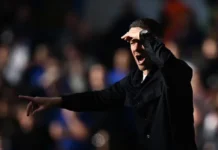

There comes a point when patience stops being sensible and starts becoming an excuse for refusing to admit that something has gone badly wrong. Tottenham have reached that point with Roberto De Zerbi, and the club should act before an already extraordinarily expensive experiment becomes even more costly.
Sacking a manager after five Premier League matches would normally look absurdly premature. But judging De Zerbi solely on those five matches ignores everything that came before them. He arrived at Tottenham last season, experienced the club’s relegation battle first-hand, had months to assess the squad and its weaknesses, and then presided over a summer in which Spurs spent more than £300million rebuilding the team.
The result of that investment is currently a side sitting bottom of the Premier League with two points, no victories and only two goals from five matches. Nobody expected Tottenham to become title contenders overnight, and nobody should demand that a dramatically rebuilt squad immediately plays perfect football. But after committing that level of money to a managerial project, supporters are entitled to expect something much more convincing than this.
What Tottenham have produced so far is not simply underwhelming. It is deeply worrying.
£300m should increase accountability, not reduce it
One of the most convenient arguments now being made in De Zerbi’s defence is that Tottenham changed too much during the summer. There are new players, new relationships to build and tactical connections that cannot realistically become automatic within a few weeks.
That is all true, but it is being stretched into an excuse for almost any level of failure. Spending more than £300m on footballers cannot suddenly be portrayed as some terrible burden imposed on the manager. The purpose of investing that money was to give De Zerbi a better team and remove many of the weaknesses that had contributed to Tottenham’s previous struggles.
There is an enormous difference between accepting that a new team needs time and accepting a team being bottom of the table. Tottenham do not need to look like a finished product in September, but they should already look as though somebody knows what the finished product is supposed to become.
Right now, that is far from obvious.
The midfield has been extensively and expensively reconstructed, yet its balance remains uncertain. Large sums have been spent on attacking players, yet Tottenham have struggled desperately for goals. Players have been used in different roles while the overall structure has often looked unsettled, and discussion has already returned to whether Spurs may need to spend heavily on another centre-forward.
That should be an enormous concern. If a £300m rebuild immediately creates the need for another rebuild, then something in the original plan has gone badly wrong.
The problem is not that every signing must immediately succeed. Recruitment always carries risk. The problem is that Tottenham appear to have spent an extraordinary amount of money without resolving some of the most basic questions that existed before the spending began.
De Zerbi cannot keep describing problems he was hired to solve
The manager’s public rhetoric makes the situation even more uncomfortable.
De Zerbi has spoken about mentality, fragility, physical condition, leadership and players failing to carry out instructions. Individually, none of those observations is outrageous. Managers are entitled to criticise poor performances and, sometimes, players need to hear uncomfortable truths.
But De Zerbi is not an outside analyst diagnosing Tottenham’s problems. He is the man being paid to solve them.
If the team is psychologically fragile, developing greater resilience is part of his responsibility. If players are struggling to understand what he wants, the coaching staff must communicate it more effectively. If the midfield lacks balance, the manager has to find a structure that works. If Tottenham lack leadership, that characteristic should have featured prominently in a summer recruitment programme worth hundreds of millions.
This is where the contradiction surrounding the current Tottenham project becomes increasingly difficult to ignore. De Zerbi has been afforded significant influence over a major rebuild, yet some of the shortcomings he now identifies are precisely the shortcomings that rebuild was supposed to eliminate.
A manager cannot demand authority over a project while separating himself from responsibility when the project struggles. If the squad is badly constructed, questions must be asked about the football decisions behind that construction. If the squad is good enough but is performing badly, questions must be asked about the coaching. Neither explanation offers De Zerbi much protection.
When a manager inherits a dysfunctional squad, criticism of its deficiencies can be understandable. When he helps oversee a £300m reconstruction and then quickly begins discussing the deficiencies of the reconstructed team, the focus inevitably returns to him.
Tottenham need football, not theory
De Zerbi has built a substantial reputation as one of European football’s more sophisticated tactical coaches. His teams are discussed in terms of build-up structures, attracting pressure, creating overloads, manipulating opponents and finding space through possession.
There is nothing wrong with tactical sophistication. At the highest level, it is essential. But Tottenham did not hire De Zerbi to produce interesting tactical diagrams; they hired him to improve Tottenham Hotspur.
Modern football can sometimes become so fascinated with managerial philosophy that results begin to sound almost secondary. Poor performances are explained through automatisms that have not yet developed, relationships that need time and tactical concepts that players have not completely absorbed. Eventually, however, all that theory has to produce something tangible.
Tottenham need goals, points and victories.
Before finally breaking through against Aston Villa, Spurs had endured a league scoring drought lasting 445 minutes. That is not some microscopic tactical imperfection visible only to analysts studying passing networks. It is a fundamental football problem, and one that becomes much harder to excuse when De Zerbi has already been inside Tottenham for months.
He did not arrive on deadline day with no knowledge of the squad or the club’s weaknesses. He was there last season, experienced the relegation battle first-hand, saw where Tottenham needed to improve and then had an entire summer in which the squad was extensively rebuilt.
That context matters. Five league matches may represent a small sample of the new season, but De Zerbi’s Tottenham project did not begin five matches ago. He has already had time to assess the players, influence recruitment, shape the squad and prepare it for this campaign. The expectation is not that Tottenham should already be a finished team, but after that amount of time and investment they should at least show clear signs of becoming one. Instead, too many of the same fundamental questions remain unanswered.
Injuries undoubtedly provide some mitigation. Important players have been unavailable and Xavi Simons’ serious knee injury in particular deprived Tottenham of a major attacking option. Every fair assessment of De Zerbi has to recognise that.
But injuries cannot explain everything. Every Premier League manager loses important players, and a squad costing more than £300m should not become incapable of functioning because several individuals are missing. If it does, Tottenham have another reason to question how wisely their enormous summer budget was allocated.
Nobody is criticising De Zerbi because Tottenham are fifth rather than first. They are bottom. That distinction matters.
Waiting may become more expensive than acting
Tottenham now face a decision that is much more difficult psychologically than it is financially.
The easiest option is to wait.
Give De Zerbi another month. Wait for injured players to return. See what happens before Christmas. Allow another transfer window. Buy another striker. Give that striker time to settle. Continue extending the deadline by which the project must finally begin to justify itself.
That is how clubs become trapped by their own investment.
The more money committed to a project, the more reluctant decision-makers become to admit that the underlying idea may have been wrong. They start protecting previous decisions instead of judging what should happen next. Another £50m is spent because £300m has already been spent, and then another £50m follows because changing direction would make the previous £350m look misguided.
Tottenham should resist that temptation.
The £300m already invested is gone. It should have no bearing on whether the club commits another enormous sum to the same strategy. What matters now is whether those running Spurs still believe, based on what they have actually seen, that De Zerbi is the manager they want controlling the next stage of this rebuild.
They should ask themselves one brutal question: if De Zerbi were available today, with Tottenham bottom of the league and this squad already assembled, would they be sufficiently impressed by his work to appoint him and immediately hand him another £100m?
If that question produces hesitation, Tottenham already know what they need to do.
There is inevitably a risk in dismissing a talented coach early. De Zerbi could succeed spectacularly somewhere else. Tottenham could be accused of panicking and the next appointment could prove no better. Football offers no guarantees.
But keeping a manager also carries risk, and in Tottenham’s case that risk is becoming increasingly expensive.
The club has spent two successive seasons finishing dangerously close to the bottom of the Premier League. De Zerbi deserves credit for helping Tottenham survive after arriving last season, but survival was supposed to be the beginning of a recovery rather than the permanent standard by which progress is measured.
This summer was Tottenham’s attempt to move beyond that cycle. More than £300m was committed to giving the club a different future.
Five matches into the new campaign, Tottenham are back at the bottom.
That does not prove beyond doubt that De Zerbi will fail, but football clubs cannot wait for mathematical certainty before making important decisions. They have to assess the evidence in front of them, measure the direction of travel and decide whether continuing represents a greater risk than changing.
For Tottenham, it increasingly does.
The club has already given De Zerbi time, extraordinary financial backing and considerable opportunity to shape the team. What it has received so far is a side without a league victory, struggling to score and still searching for an obvious identity while its manager publicly identifies weaknesses in the squad constructed under his watch.
Tottenham’s greatest mistake now would not necessarily be sacking Roberto De Zerbi too early. It would be spending another fortune before finally admitting they should have done it earlier.
They should act now.
This article is an opinion and analysis piece. The views expressed are those of the writer and do not necessarily represent the views or official position of BettingTips4You.com or BSpin Limited.