
There is a particular cruelty in a result that solves nothing while appearing to solve everything. Manchester United’s 3-2 comeback win over Roma at Old Trafford on Tuesday night was dramatic, emotional and utterly irrelevant to the dysfunction eating this club from the inside out. If anything, it has made the situation measurably worse. Because Old Trafford just handed the people responsible for this shambles another month of breathing room they haven’t come close to earning.

Let’s be absolutely clear about what actually happened. For the opening 45 minutes, Roma — a side from a league United barely acknowledge as serious competition — took Manchester United apart. They didn’t just score early. They exploited structural holes in Carrick’s setup that have been visible since August. Diogo Dalot, playing on the wrong flank, was consistently marooned upfield as Matias Soule ran riot down the left channel. A twenty-year-old centre-back in Ayden Heaven was left to cope with a Serie A attack on his own, conceded a penalty, and collected a yellow card. Kobbie Mainoo lost possession in central areas that led directly to goals. And Carlos Baleba — the £70 million summer acquisition meant to anchor this midfield — played a pass straight out of play under routine pressure before limping off with a hamstring injury that the club deserves to feel acutely.
The score was 2-0 at half-time and it could have been four. This is a Manchester United side that has won three games in an entire season.
What changed in the second half was not Michael Carrick’s tactical genius. What changed was Roma’s willingness to self-destruct. The Italian side, unbeaten in Serie A before Tuesday night, have a documented problem this season with managing leads — a flaw so recognised and consistent that Serie A analysts have written about it extensively. And once again, entirely predictably, they obliged. Leonardo Balerdi’s catastrophic clearance handed Matheus Cunha the equaliser. Roma’s backline buckled under pressure that, in truth, they should have been equipped to absorb. This was not United brilliance. This was Roma’s generosity.
Cunha’s winner — a stunning near-post finish that deserves full credit — came because a Roma defender let the ball skip past him at the worst possible moment. The Brazilian then immediately got himself sent off. That is the reality. A moment of individual genius built on a defensive error, followed by a disciplinary lapse. That is the foundation on which United’s revival is now being constructed.
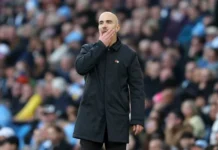
Carrick said he is “proud of a lot of people” and that Old Trafford “does magical things.” Bruno Fernandes said the win “should be a turning point.” Pundits are already reaching for Mikel Arteta’s slow-burn Arsenal rebuild as a comparable. These reactions are, with the greatest possible respect, the exact problem. The story the football world is telling itself after Tuesday night is precisely the narrative that keeps bad situations alive at clubs like Manchester United — the idea that one wild comeback in Europe washes away months of evidence pointing somewhere far more uncomfortable.
The uncomfortable truth is this: Carrick has yet to demonstrate — in any game, against any opponent, in any competition — that he understands how to set a team up coherently before it goes behind. United have produced spirited second-half performances when already losing. They have not produced a controlled, dominant first-half display that suggests a coherent tactical system is being implemented. The Como humiliation was a 4-1 thrashing. The Bournemouth home defeat was 3-0. The Chelsea loss was 2-0. The pattern is not one difficult game or a rotten run of fixtures. The pattern is a team that does not know what it is doing until someone forces it to improvise.
Free Bet Offers
Swipe to see more →
T&Cs Apply. Click to view.

T&Cs Apply. Click to view.

T&Cs Apply. Click to view.

T&Cs Apply. Click to view.

T&Cs Apply. Click to view.

T&Cs Apply. Click to view.
The captain’s public criticism of his manager’s tactics after Como was not rumour or media speculation. Fernandes said it, clearly, publicly. His subsequent omission from the Bournemouth squad was, as he acknowledged himself, almost certainly a consequence of that. These are not the dynamics of a stable, well-led football club. These are the dynamics of a dressing room navigating its way through a management crisis in real time.
And the board? The board that has watched this club win three times in its opening three months of a season, oversee a Europa League ejection, produce some of the most incoherent football seen at Old Trafford in living memory — that board last night got exactly what football boards pray for when they want to avoid making a difficult decision. They got a result. A loud one, an emotional one, with fans in the stands bouncing at the final whistle and broadcasters reaching for superlatives. The green tennis balls have been swept up. The golden balloons deflated. The board can go back to doing what it does best: not very much.
The best counterargument here is entirely legitimate. Sacking a manager mid-season rarely solves structural issues. Arteta’s first year at Arsenal was genuinely dreadful and he went on to build one of Europe’s best sides. Carrick deserves time, deserves the squad bought for him, deserves the chance to work without the constant noise. These are reasonable positions. They deserve a fair hearing.
They would be more convincing if there were any tactical evidence — a single sustained first-half performance, one game where United didn’t need to come from behind, one coherent system visibly improving over time — that supports the case for patience. Right now, the case for patience rests almost entirely on the argument that the alternative is worse. That is not confidence in a manager. That is paralysis.
The reason this matters far beyond one wild European night is that the club now enters its Premier League programme under exactly the same conditions as last week, except with a reduced expectation that anything will change. The board will not act. The sporting structure will not be reviewed. The tactical incoherence will not be diagnosed or corrected. Because the narrative has shifted — however briefly, however artificially — from crisis to comeback.
Fans need to understand what Tuesday night actually was: a temporary anaesthetic administered by a Roma side that has now lost this season’s specific version of its recurring neurological problem. The pain it briefly masked is still there. The diagnosis has not changed.
This is what paper-over-the-cracks looks like in its most sophisticated form. Not a quiet unconvincing win on a Tuesday night at a half-empty ground, but a stunning, fist-pumping, shirt-off-in-the-corner comeback in the Champions League that will be replayed on highlight reels for weeks. Those results are almost more dangerous than defeats, because they don’t just delay a decision — they make the decision feel unnecessary. They make the people who should be asking hard questions look like overreacting pessimists.
Manchester United have won three games all season. The board remains inert. The manager’s tactical blueprint has not held together for a single complete ninety minutes. And Matheus Cunha just scored twice.
Watch how long it takes for the board to find that an acceptable summary.
This article is an opinion and analysis piece. The views expressed are those of the writer and do not necessarily represent the views or official position of BettingTips4You.com or BSpin Limited.