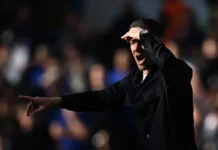

Manchester United lost 4-1 to Como in the Champions League on Wednesday night. They were outclassed, outrun and outwitted by a side managed by a 37-year-old in only his second season in professional management. That is embarrassing. It deserves to be called what it is.
But here is the more uncomfortable truth: Michael Carrick is not Manchester United’s biggest problem. He may not even be their second biggest. Because while the football world focused on the hapless defending, the passive shape and the mounting pressure on the head coach, the real story was happening on the touchline — when Bruno Fernandes was substituted off in the 67th minute, reacted with visible fury, and then used the post-match to publicly question United’s tactics.\

That moment encapsulates everything that is wrong at this football club. And it has nothing to do with Michael Carrick.
Let’s be honest about the manager first. The decision to give Carrick the permanent job last summer was always questionable. A short caretaker spell and a strong second half of a season — achieved with a relatively kind fixture schedule and a squad briefly energised by novelty — was treated as sufficient evidence to hand him one of the biggest jobs in club football. It wasn’t. His lack of top-level managerial experience was a legitimate concern then, and seven matches without a win, including a 4-1 collapse in Europe, has done nothing to answer it.
Carrick’s tactical decisions in Como were difficult to defend. Playing Bruno Fernandes as a centre-forward — a player with no pace and no instinct for the channels — was strange when Mbeumo was available in a wider role. The shape offered Nico Paz acres of space in the first minute. The defensive organisation buckled before United had even touched the ball in their own half. These are real problems, and they belong to the manager.
But here is where the narrative needs correcting: Carrick is a symptom, not the disease. He inherited a squad riddled with structural dysfunction, a wage bill that constrains every decision, and — this is the part nobody wants to say out loud — a captain who is actively making his job harder.
Because what Bruno Fernandes did after the Como defeat was not leadership. It was self-preservation.
Emerging from a 4-1 hammering in which he was hooked with 23 minutes remaining, Fernandes chose to publicly criticise the decision not to press man-to-man. The manager, to his credit, hit straight back. “If you don’t run back, you ain’t going to win.” A blunt response — and the correct one.
Jamie Carragher said what many were thinking: Fernandes’ comments were a disgrace. More pointedly, Carragher made an observation that deserves to be repeated far more widely — that Bruno Fernandes, for years, has been a major reason Manchester United cannot press. He runs without direction. He chases without purpose. He disrupts the defensive structure with erratic pressing that the rest of the team cannot coordinate around. And now he has the audacity to complain, publicly, that the team isn’t pressing correctly?
The hypocrisy is staggering. And it is not a one-off.
Free Bet Offers
Swipe to see more →
T&Cs Apply. Click to view.

T&Cs Apply. Click to view.

T&Cs Apply. Click to view.

T&Cs Apply. Click to view.

T&Cs Apply. Click to view.

T&Cs Apply. Click to view.
Last season, Fernandes won United’s Player of the Year award. He deserved recognition — but the uncomfortable fact is that Carrick was central to that revival. The manager restored Fernandes to a position that suited him, rebuilt the team’s system around his strengths and gave him the platform to produce. Without Carrick, there is every chance Fernandes’ 2025-26 season looks very different.
That context makes Wednesday’s post-match briefing even less defensible. This is a player who benefited directly from the manager’s trust and tactical consideration, delivering his verdict on the team’s pressing structure while still raw from being substituted off. It reads less like leadership and more like a man trying to protect his own reputation at the expense of the dressing room.
And this was not an isolated incident. Lisandro Martinez went public after the Atletico Madrid defeat, calling out the club hierarchy. Now the captain has followed. When players start using post-match press access to relitigate tactical arguments with the head coach, the dressing room is beyond fractured — it is actively working against itself.
The comparison Carragher drew to Bryan Robson was pointed and apt. Robson played in United teams that failed. He did not publicly throw team-mates or managers under the bus. He fought within whatever hand he was dealt. Fernandes, by contrast, has now had more managers than he can count at Old Trafford — and every single one has, at some point, been publicly undermined rather than publicly supported.
The most charitable reading of Fernandes’ behaviour is that he is a passionate player who wears his frustrations on his sleeve. That reading has run its course. Passion does not justify a club captain criticising team tactics to the press while the manager is still in the building. Passion does not explain years of arm-waving at team-mates, disrupted pressing structures and performances that vanish when the game demands something difficult.
The less charitable reading — and the increasingly credible one — is that Fernandes is a player who has decided this chapter of his United career is coming to an end, and is slowly but unmistakably detaching himself from the consequences. Saudi Arabia money does not tend to chase players who appear fully invested in their current club. The timing of these public statements, the body language, the willingness to distance himself from results by blaming structure — all of it points in one direction.
Manchester United cannot keep a manager who may not have the experience the job demands. That much may be true, and if Carrick goes in the coming days or weeks, the result will not come as a surprise to anyone who has watched this season honestly.
But sacking the manager without addressing what is happening in the dressing room is rearranging chairs. The next manager who arrives at Old Trafford will inherit the same fractured culture, the same public dissent from senior players, and the same squad that believes individual reputation is more important than collective accountability.
Carrick’s permanent appointment may have been the wrong call. But the question United need to answer first is simpler and harder: can a club move forward while its captain is already halfway out the door?
The answer is no. And the solution is not a new manager. It is a January window with the courage to admit that some problems cannot be coached away — they have to be sold.
This article is an opinion and analysis piece. The views expressed are those of the writer and do not necessarily represent the views or official position of BettingTips4You.com or BSpin Limited.